


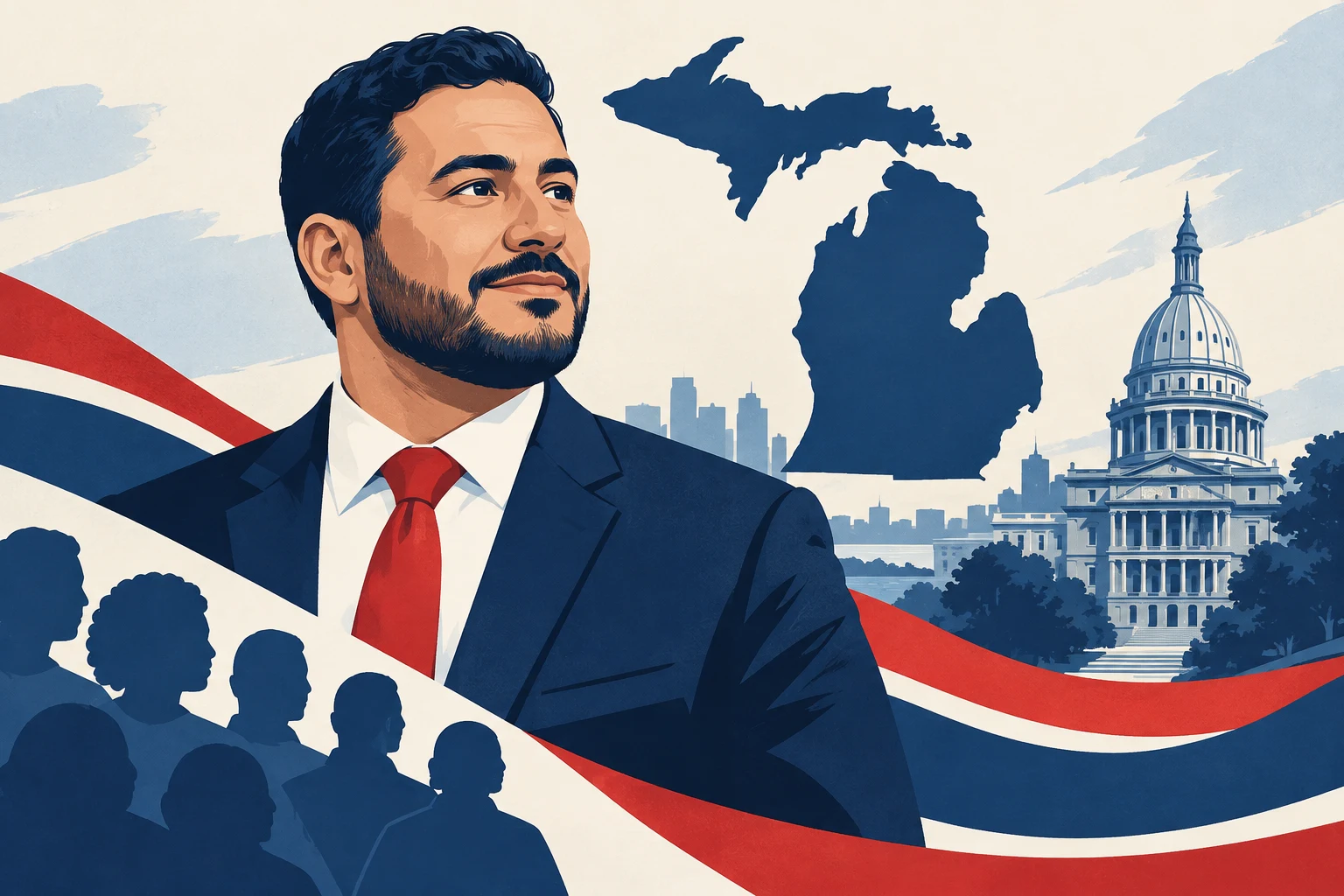
Abdul El-Sayed used a Fox News opinion essay published Nov. 2, 2026, to describe his Senate campaign’s outreach in Northern Michigan and the Upper Peninsula and to argue that residents in those areas have been neglected by both major parties. El-Sayed is seeking Michigan’s Senate seat against Republican Mike Rogers.
El-Sayed said his campaign recently began a week-long town hall tour, with stops in communities including Escanaba, Iron Mountain, Marquette, Sault Ste. Marie, Petoskey, Midland and Caro. He recalled meeting an Escanaba mother who told him it was her first political rally, saying political candidates rarely came to her town. He also described speaking with residents who felt overlooked by elected officials and campaigns.
The candidate said his campaign has held more than 700 events in over 120 cities. He characterized attendance in rural areas as evidence of growing support, including among people who previously voted for Trump. These descriptions and attendance claims are El-Sayed’s account in the opinion piece; the supplied material does not provide independent confirmation.
El-Sayed argued that voters are struggling with the cost of gas, groceries and health care, while wealthy individuals and corporations are benefiting. He attributed an estimated $5,600 in costs to tariffs for the average Michigan household and said drivers pay about $20 more per tank because of what he called Trump’s Iran war. The essay does not identify the experts behind the estimates or provide supporting methodology, so those figures cannot be assessed from the supplied material alone.
He criticized Rogers for describing the trade war as “an absolute win” and the Iran war as a “win-win-win,” and said Rogers had called the previous two years of Trump’s presidency “amazing.” The quotations are presented by El-Sayed, who argued that the policies have harmed Michigan households.
The essay also challenges Rogers’ financial and legislative record. El-Sayed said Trump reported at least $2.2 billion in income in 2025, and that Rogers’ net worth reached $14.6 million after he left Congress. He accused Rogers of benefiting from corporate interests while serving in Congress, citing contributions from pharmaceutical, oil and financial-sector interests and votes on children’s health coverage, prescription drug costs, gas prices and credit rates. He also criticized Rogers for accepting support from Trump-aligned super PACs and supporting the Iran war. The material does not include Rogers’ response or documents substantiating these allegations.
El-Sayed presented his own campaign around three proposals: reducing the influence of money in politics, putting more money in residents’ pockets and establishing Medicare for All. He closed by urging voters to reject Rogers and elect him, framing his candidacy as an effort to prioritize Michigan residents over wealthy donors and special interests.
The source is an advocacy piece by a candidate, not an independently reported account of the campaign or the claims made about his opponent. Its assertions should be read as El-Sayed’s positions unless separately verified.