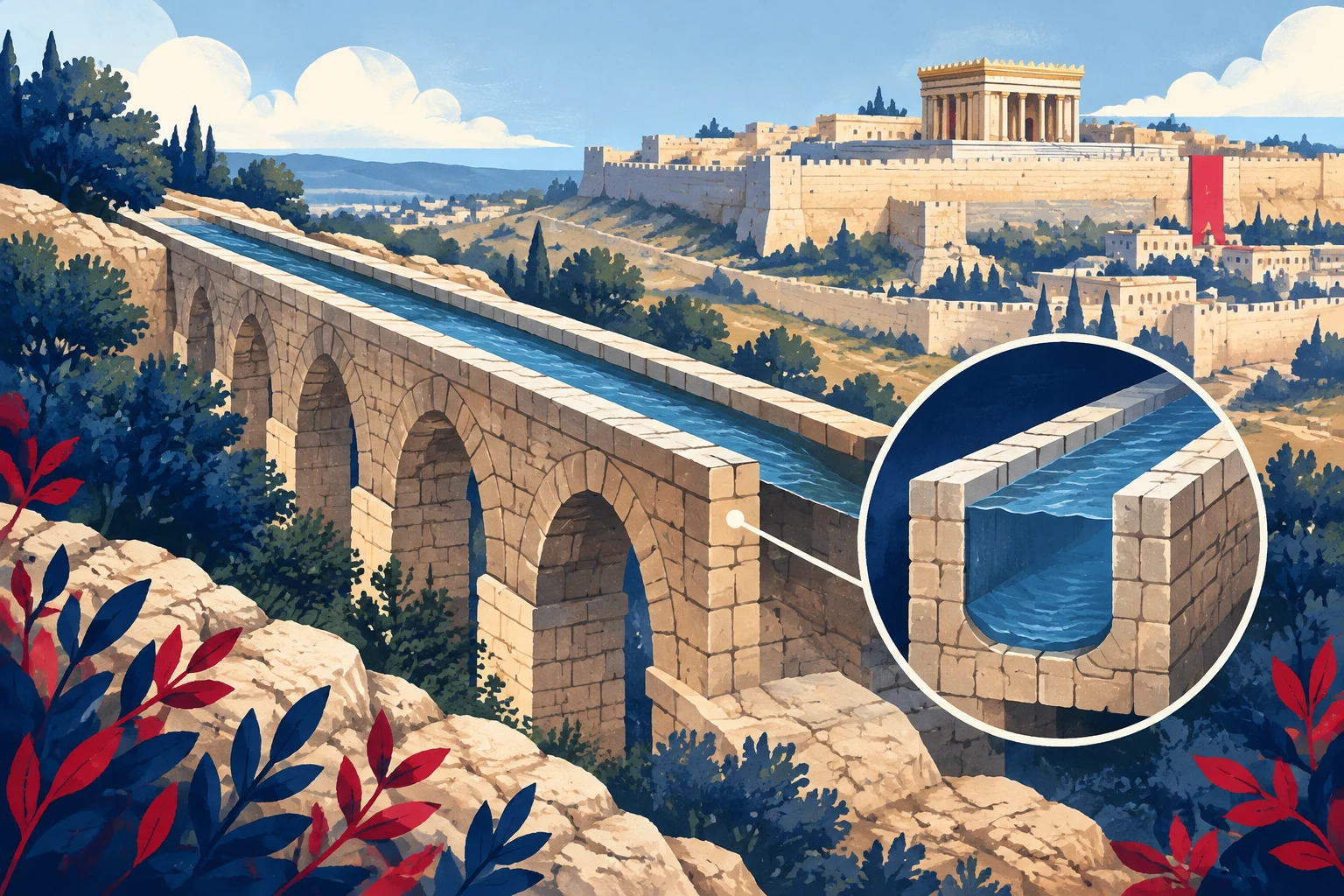
Archaeologists uncovered a roughly 984-foot section of an ancient aqueduct south of Kibbutz Ramat Rachel, near Jerusalem, the Israel Antiquities Authority announced Oct. 11. The find came during excavations conducted ahead of a planned residential development.
The waterway is part of the Lower Aqueduct, which the excavation directors said extended about 13 miles from Solomon’s Pools south of Bethlehem to Jerusalem. The IAA attributed its construction to the Hasmonean period and said it remained in intermittent use until about a century ago.
The aqueduct carried water by gravity toward Jerusalem’s Second Temple complex. According to excavation directors Benyamin Storchan, Gil Freid and Rotem Cohen, the route had a very gradual descent, losing about 3.3 feet in elevation per mile. The system’s water served practical needs at the Temple Mount, including cleaning after sacrifices, as well as ritual purification.
The Second Temple was central to Jewish religious life in that era. It is also the setting of the biblical account in which Jesus overturned money changers’ tables and drove merchants from the Temple.
Douglas Estes, an associate professor of religion at New College of Florida, told Fox News Digital that the aqueduct demonstrates the scale of engineering undertaken in ancient Jerusalem. He compared the Hasmonean project with Roman aqueduct construction, noting that both societies were building major water systems during the same broad period.
Estes said he was confident Jesus, his disciples and other early Christians would have used water supplied by the aqueduct. However, the source material does not establish direct archaeological evidence linking those individuals to this particular water system. Their possible use is an inference based on the aqueduct’s role in supplying the Temple complex and the period in which it operated.
Estes also discussed religious symbolism associated with the system’s water. He described the aqueduct as carrying fresh water from the Bethlehem area to the Temple Mount, where it supported purification after sacrifice, and connected the idea of “living water” to Christian belief about Jesus. That interpretation is Estes’ religious commentary, rather than a finding reported by archaeologists.
The IAA said the uncovered section will be preserved and incorporated into the main entrance of the planned residential development, where visitors will be able to view the ancient structure.