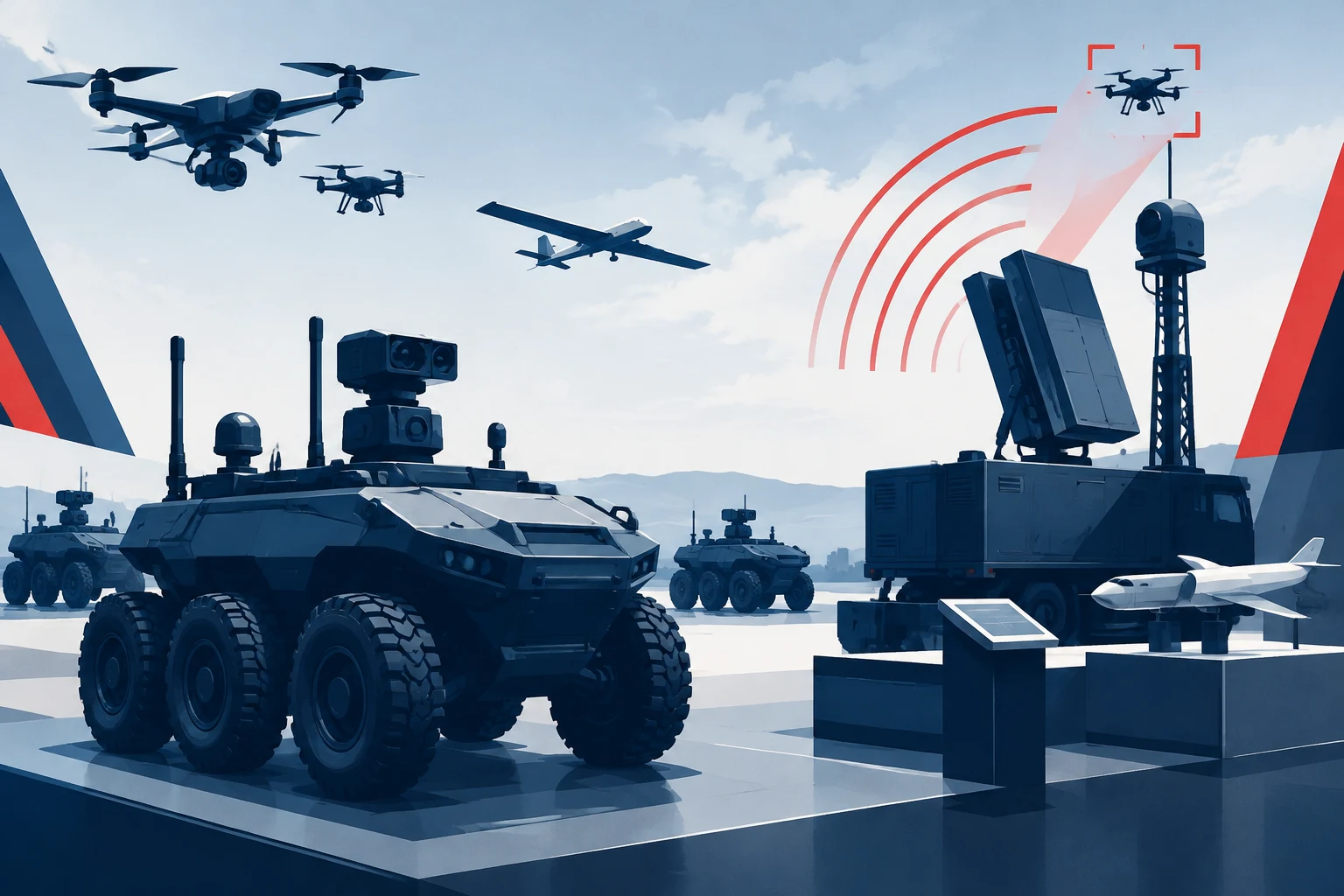
The Army’s annual Association of the United States Army (AUSA) meeting in Washington this week featured ground robots, drone-jamming equipment and interceptors designed to pursue incoming unmanned aircraft. The demonstrations reflected a military effort to adjust procurement and battlefield planning to the rapid spread of drones and autonomous systems, according to comments from Army officials and defense-industry executives reported at the event.
Ondas displayed Scout, a four-legged robotic system designed to enter buildings, tunnels and other hazardous areas ahead of soldiers and relay images to an operator. Company CEO Eric Brock said the system is intended to take risks that would otherwise fall to troops. His description of Scout’s purpose was a company representative’s account, not a report of the robot’s performance in combat.
The Army is also making organizational and purchasing changes. The service announced a Futures and Autonomous Systems Command this month, tasked with accelerating autonomous capabilities across areas including aviation, armor, fires, sustainment and reconnaissance. At AUSA, it expanded drone and counter-drone marketplaces intended to let the U.S. military and allies buy pre-approved systems more quickly. The article said the Army also offered as much as $20 million through a competition for more affordable technology to counter air and missile threats.
Army Under Secretary Mike Obadal said the prevalence of drone and counter-drone displays at the conference reflected Pentagon procurement and budget priorities. He also said the war in Ukraine had established counter-drone capabilities as a critical part of modern military operations. Defense Secretary Pete Hegseth, identified in the source as War Secretary, said at the meeting that the department was working toward an Autonomous Warfare Command led by a four-star officer.
Ondas demonstrated two different approaches to defeating drones. Its Dronebuster device uses electronic warfare to disrupt or spoof communications and navigation links. The company also showed IonStrike, a kinetic interceptor designed to physically pursue and strike incoming drones, including Shahed-class one-way attack aircraft. Brock said newer, faster threats require faster autonomous interceptors. The source describes the systems’ designs and demonstrations but does not report independent testing results or operational outcomes.
The distinction matters because electronic disruption may be ineffective against an aircraft that does not rely on a vulnerable radio connection, while a physical interceptor may be needed for other threats. The article described this as part of a layered counter-drone approach, in which changing weapons prompt new defensive measures and adversaries then adjust in response. It cited the development of countermeasures in Ukraine and efforts to make Shahed-type drones faster and harder to stop.
The changing threat environment is putting pressure on the Pentagon’s traditional acquisition timelines. Brock argued that defenses must be affordable and produced in large quantities to address attacks involving many drones. Ondas subsidiary Mistral, the article reported, has received more than $240 million in orders under the Army’s $982 million Lethal Unmanned Systems contract, including an order worth more than $50 million announced in August. Ondas also acquired DZYNE Technologies this summer in a transaction valued at roughly $875 million, adding drone and counter-drone products to its portfolio.
Beyond individual weapons, Ondas and Palantir are working on software intended to connect sensors, drones, robotic systems and command platforms. The system, called SkyWeaver, is described as using Palantir-powered artificial intelligence to link intelligence, mission planning and autonomous operations. Brock characterized the goal as moving from separate autonomous platforms toward coordinated mission autonomy, including in settings where conventional communications are degraded.
Brock said he believes the technology to build autonomous systems and fast interceptors is available, but questioned whether the United States can manufacture them at the scale a future conflict might require. The conference displays and procurement initiatives illustrate the military’s stated effort to accelerate development and purchasing; they do not establish how quickly the systems will be fielded or how effective they will be in combat.