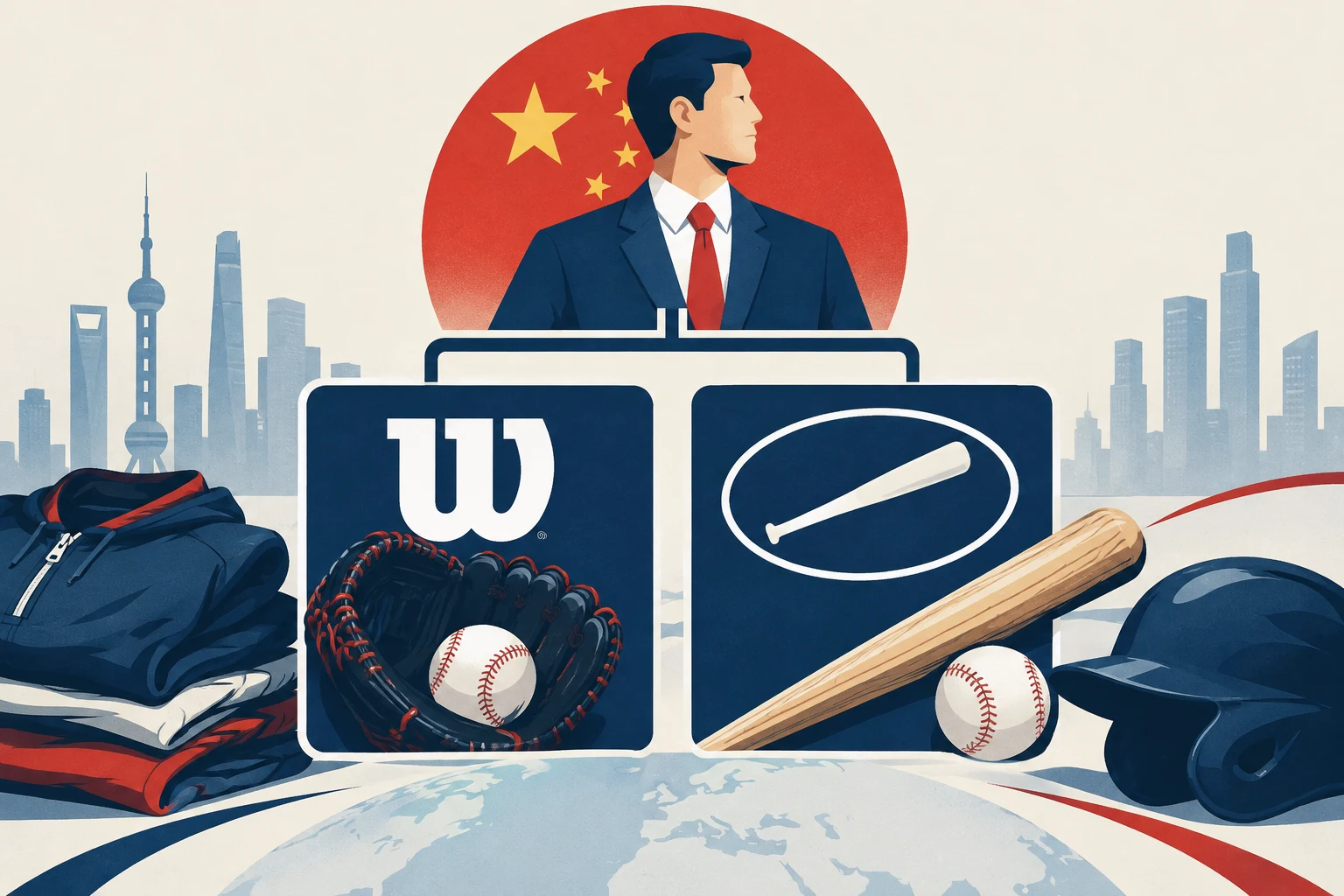
Wilson and Louisville Slugger, two long-established baseball equipment brands, are owned by Amer Sports, which was acquired by China-based Anta Sports in 2019. The article describes the chain of acquisitions and questions the implications of a Chinese company owning brands used in American baseball. It does not report a new ownership change or a recent decision affecting the brands’ products or operations.
Louisville Slugger began as part of Hillerich & Bradsby, a family-owned company founded in the 19th century. In 2015, Hillerich & Bradsby sold the brand to Wilson. The article quotes then-CEO John A. Hillerich IV as saying the family business could not compete with larger multinational companies and had little practical choice but to sell.
Wilson’s ownership had already moved beyond a family business. Amer Sports, a Finnish sporting-goods company, acquired Wilson in 1989. Anta Sports later acquired Amer, bringing Wilson and Louisville Slugger under the same parent company. The article gives 2018 as the year Anta purchased Amer, while the summary of its ownership history elsewhere dates the acquisition to 2019; the source does not resolve that discrepancy.
Anta was founded in 1991 and has grown into a major global athletic-apparel and equipment company. The article attributes that growth in part to manufacturing relationships and the expansion of Chinese consumer markets. It also alleges that Chinese companies have benefited from copying Western designs and business methods, citing a BBC account, but does not provide details from that reporting beyond a short description.
The piece points to Anta’s 2019 response to a social-media post by then-Houston Rockets general manager Daryl Morey supporting pro-democracy demonstrators in Hong Kong. According to the article, Anta suspended contract negotiations with the NBA after Morey’s post. It also says Anta’s billionaire owner announced in 2021 that he would donate company shares valued at $1.2 billion to a charity. The article characterizes the charity as closely connected to China’s Communist Party and cites a Forbes report describing the political pressures on Chinese companies. It does not identify the charity in the supplied text.
The article’s central concern is that ownership by a Chinese company could expose historically American brands to political or commercial pressure from China. It asks whether Anta might eventually change how Wilson and Louisville Slugger operate, but provides no evidence that such a change is planned or underway. It also does not document any withdrawal of the brands from U.S. markets or a decision to disrupt baseball equipment supplies.
The piece places the acquisition in a wider argument about outsourcing and competition: Western companies moved manufacturing to China to reduce costs, while Chinese firms expanded and later acquired international businesses. That is presented as the author’s interpretation of the trend, rather than as a new development involving Wilson or Louisville Slugger. The brands’ ownership history is the reported factual core; claims about political influence and the future of their operations remain concerns raised in the article, not established changes.