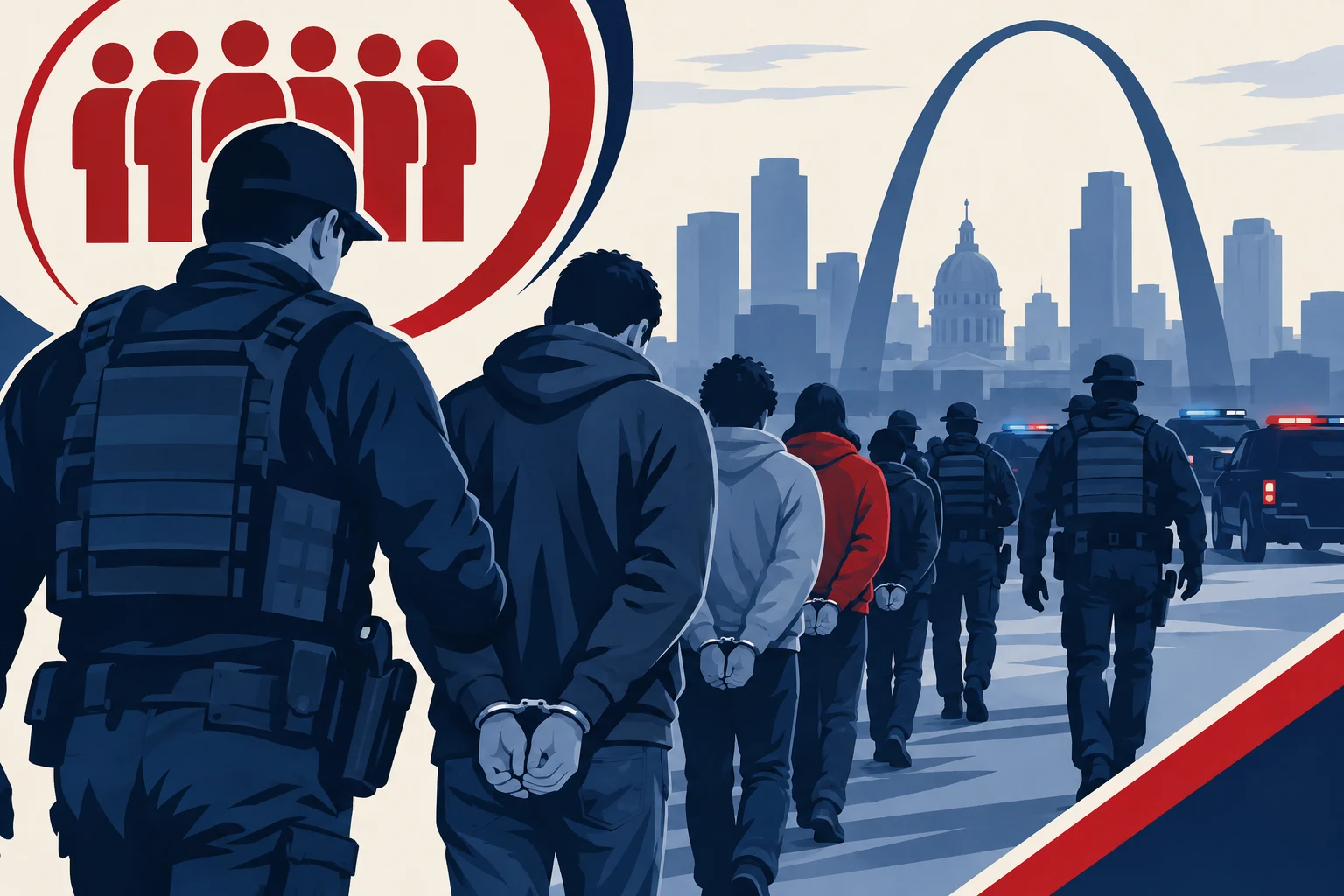
The Justice Department said Thursday that a months-long law enforcement operation in St. Louis resulted in 435 arrests and the seizure of drugs, firearms and cash. Acting Deputy Attorney General Trent McCotter announced the conclusion of Operation Show Me Justice at a news conference with Sen. Eric Schmitt, a Missouri Republican.
The operation began in August and brought together the U.S. Marshals Service, the Bureau of Alcohol, Tobacco, Firearms and Explosives, the Drug Enforcement Administration and the St. Louis Police Department. The agencies focused on gun offenses, drug crimes and other criminal activity in the city, according to the Justice Department’s announcement.
McCotter said 412 of the 435 arrests involved outstanding warrants. He told reporters that many of those arrested already faced warrants and that some had more than one. The announcement did not provide a breakdown of arrests by agency or specify how many were tied to each type of offense.
Authorities seized 80 kilograms of drugs, 166 firearms described as illegal, six devices used to convert firearms into machine guns and more than $1 million in currency, McCotter said. The source material did not identify the drugs or state how many people were charged following the arrests.
McCotter presented the operation as an example of federal, state and local cooperation, and called on mayors, city councils, governors and police chiefs to approach federal authorities about comparable efforts in their areas. He said the Justice Department was willing to work with local governments and argued that communities need not accept violent crime as inevitable.
Federal authorities have also partnered with state and local agencies on operations in Washington, D.C., and Memphis, the announcement said. It did not provide details about the results of those efforts.
The St. Louis announcement came about a week after a separate enforcement operation in Los Angeles’ Skid Row neighborhood. According to the supplied report, Operation Save Skid Row involved federal and city authorities and targeted drug distribution networks. Officials executed 28 arrest warrants and 44 search warrants, with more than 100 law enforcement vehicles involved.
The Los Angeles operation targeted people authorities associated with several gangs, including the Main Street Crips, Grape Street/Raymond Avenue Crips and Pueblo Bishop Bloods. First Assistant U.S. Attorney Bill Essayli said at a news conference that authorities intended to shut down open-air drug markets. He also alleged that drug dealers were keeping some homeless people addicted and taking their public assistance money to pay for drugs. Those remarks were made in the context of the Los Angeles operation and were not presented as findings about the St. Louis arrests.
The Justice Department’s announcement described the St. Louis operation as concluded. The supplied material did not include responses from people arrested, defense attorneys or local officials critical of the operation, and did not report case outcomes for those taken into custody.