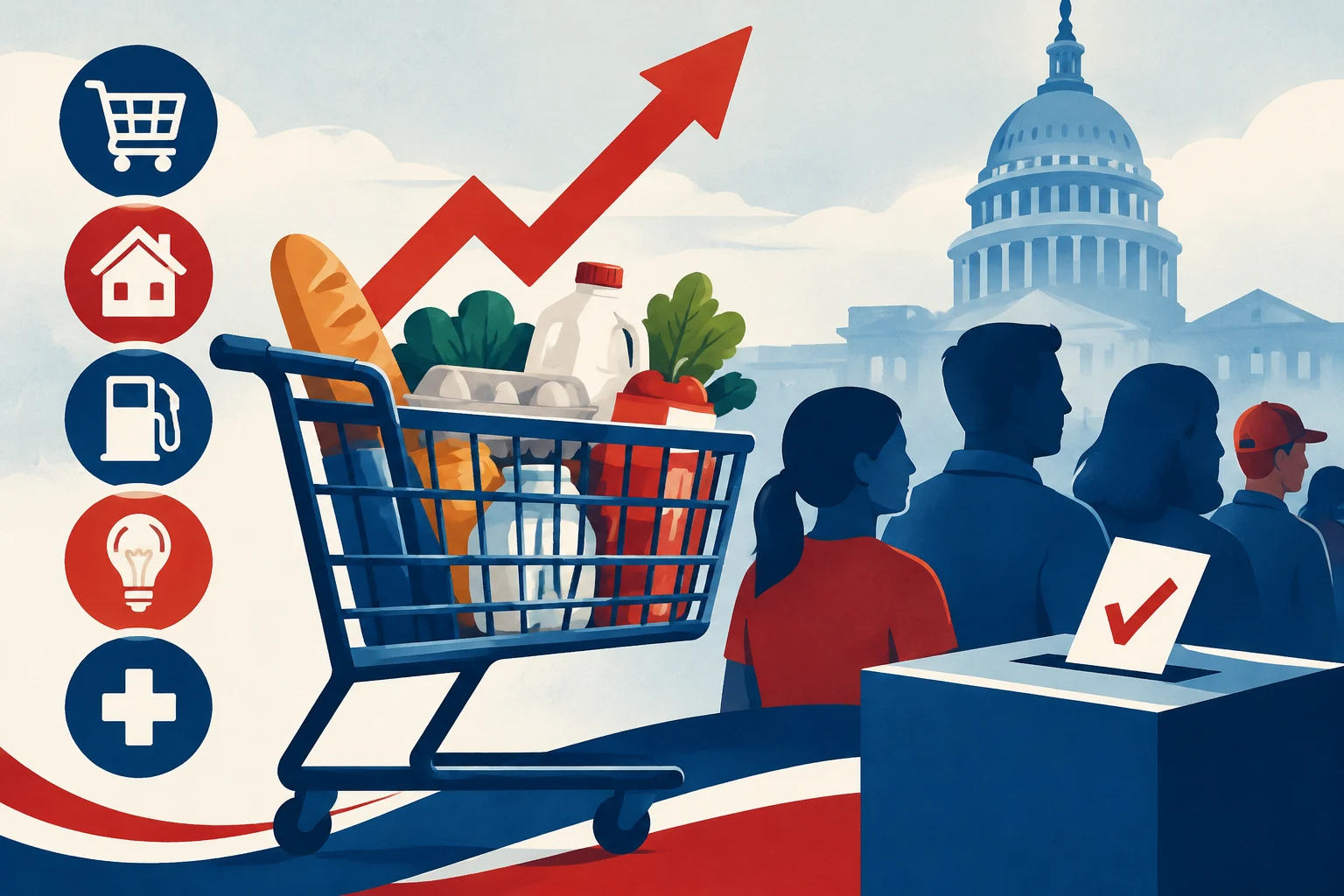
Cost-of-living concerns and dissatisfaction with the economy feature prominently in a Fox News poll released Oct. 14, 2026, weeks before Election Day. The survey found 60% of voters named the cost of living as their top economic worry, well ahead of government spending at 15%. Jobs and income inequality each registered 7%, tariffs 6% and taxes 5%.
The poll reported that 74% viewed the economy negatively, while 53% expected it to worsen over the next year. Two-thirds said they were dissatisfied with the direction of the country, and 18% said their family was better off than two years earlier. Among independents, 52% said their households were worse off and 70% expected the economy to deteriorate.
On inflation, 55% said it was “not at all” under control, up from 45% earlier in the year, according to the survey. President Donald Trump’s approval on inflation stood at 22%, which the poll described as a low for his rating on that issue. His overall job approval was 36%, also a low in Fox News polling for either of his terms. The poll said the decline was driven mainly by lower ratings among voters under 45, those with household incomes below $50,000, non-White voters and people without college degrees.
The survey found 77% disapproved of Trump’s handling of inflation, 70% of his handling of the economy and 69% of his handling of tariffs. On border security, views were evenly divided, with approval and disapproval each at 50%. Seven in 10 respondents said they planned to vote to send a message to Trump; 47% said that message would express opposition, compared with 25% who said it would show support.
In the generic House ballot, 54% said they would vote for the Democratic candidate in their district and 45% for the Republican. Among respondents certain to vote, Democrats led 52% to 46%. The poll found party identification nearly even: 43% identified as Democrats and 41% as Republicans. Independents favored Democratic candidates by 26 points, while 98% of Democrats and 94% of Republicans said they backed their party’s candidate.
Republican pollster Daron Shaw, who conducts the survey with Democratic pollster Chris Anderson, said small differences in turnout and defections could matter in a closely divided electorate. Shaw said Republicans had time to narrow the gaps, “but it’s getting late.”
On policy issues, Democrats were viewed as more capable of handling 10 of the 13 concerns listed in the poll. Their largest advantages included healthcare, by 22 points, and inflation, by 16 points. Republicans held leads on crime, by 10 points, and border security, by eight. Voters’ leading sources of extreme concern were government corruption at 60%, inflation at 58%, gas prices at 50%, government leadership at 49% and healthcare at 48%.
Despite the Democrats’ issue advantages, only 35% said the party had a clear plan for the country’s problems; 33% said the same of Republicans. Congressional approval was 15%, while 84% disapproved. Both parties also received negative overall favorability ratings: Democrats were at 42% favorable and 58% unfavorable, while Republicans were at 38% favorable and 61% unfavorable.
The poll was conducted Oct. 9-12 under the direction of Beacon Research and Shaw & Company Research. It included 1,202 registered voters selected randomly from a national voter file. Interviews were conducted by live interviewers over landlines and cellphones, or online after respondents received a text invitation. The stated margin of sampling error for the full sample was plus or minus 2.5 percentage points; the source noted that subgroup results have higher sampling error and that question wording and order can affect responses.