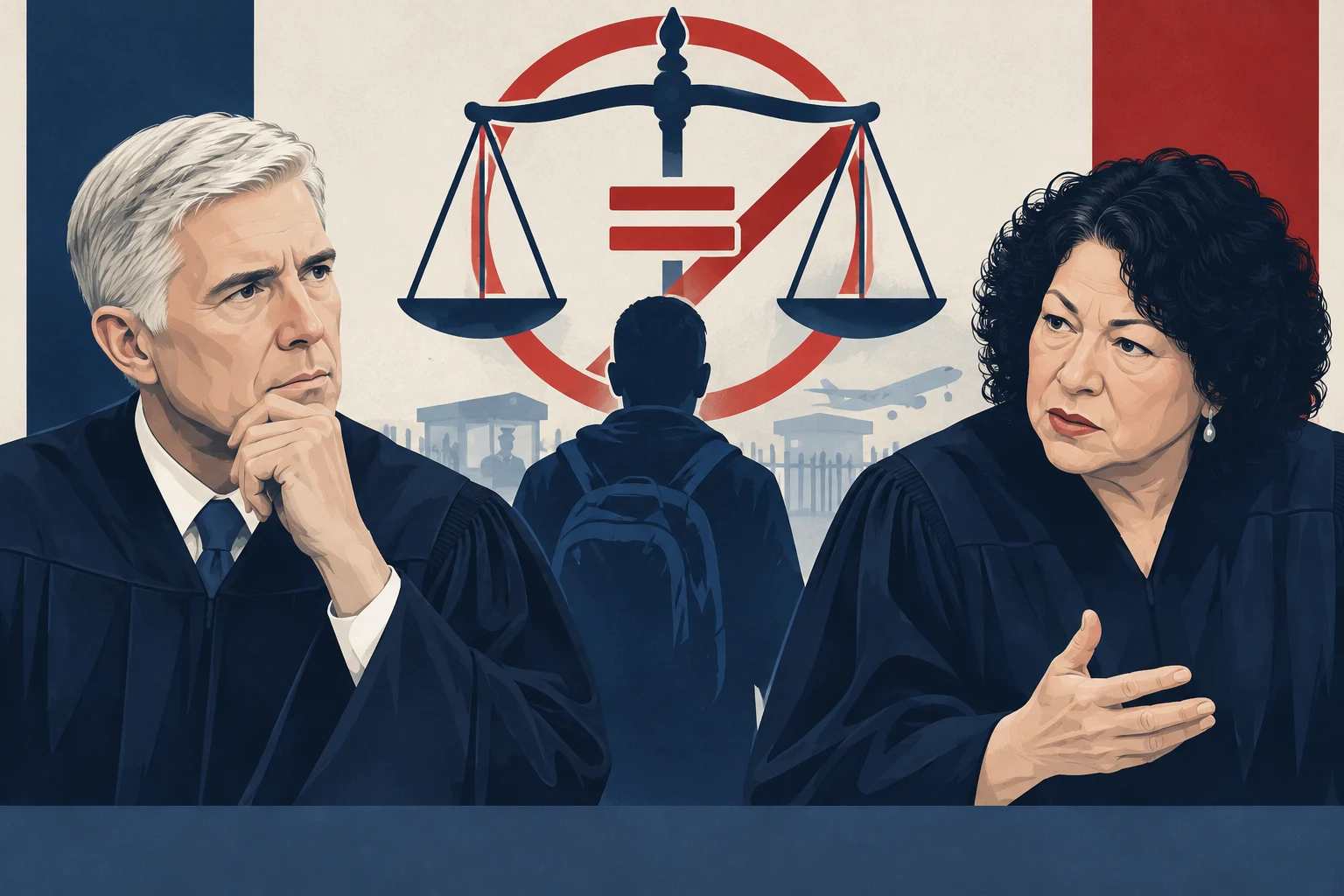
The Supreme Court declined to hear Mexican national Jesus Herrera-Salazar’s challenge to a second conviction under a federal law covering people found in the United States after deportation. Justices Sonia Sotomayor and Neil Gorsuch joined a statement warning that the prosecution raised serious questions under the Fifth Amendment’s protection against double jeopardy.
The justices did not dissent from the decision to deny review. Instead, Sotomayor wrote a statement respecting that denial, with Gorsuch joining her. Their concern centered on the circumstances between Herrera-Salazar’s two prosecutions: after serving his first prison sentence, he was placed on supervised release and barred from leaving the Eastern District of Oklahoma without permission.
While subject to that restriction, Herrera-Salazar was stopped by police in Heavener, Oklahoma. He was charged again under the same immigration statute and convicted by a jury, receiving another prison sentence and additional supervised release. He argued that the second prosecution punished him twice for one continuing period of unlawful presence, rather than for a distinct act.
The 10th U.S. Circuit Court of Appeals rejected his argument. It concluded that the offense is complete when authorities discover a person’s unlawful presence, and that a later discovery can support another prosecution without proof of a new illegal entry.
Sotomayor and Gorsuch questioned whether that approach could allow prosecutors to divide continuous conduct into multiple offenses. They also focused on the release condition that kept Herrera-Salazar from leaving the district, arguing that the government’s position created a conflict: he was restricted from leaving the country but could face another charge for remaining in it. The statement said the government’s theory could, in principle, permit separate charges for each day he remained imprisoned after the first conviction.
The justices’ objection was limited to the repeated prosecution question, not whether Herrera-Salazar had violated immigration law in the first instance. The statement noted that he had already been removed from the United States and expressed hope that the unusual circumstances would not recur. The Supreme Court’s refusal to take the case leaves the 10th Circuit’s ruling in place; the justices did not resolve the constitutional issue through a full review.
The joint statement continues a pattern of the two justices publicly raising constitutional concerns in cases the Court has declined to hear. In November 2024, they questioned whether a homeowner should bear the cost of property damage caused during a police operation to apprehend an armed fugitive. The case involved extensive damage to the home, and the justices acknowledged that officers had acted to protect public safety while raising questions about compensation.
In February 2025, they also raised concerns about warrantless misdemeanor arrests for conduct an officer had not personally witnessed. That matter involved a Florida man arrested for loitering and prowling after police responded to a report of suspicious activity. A later search uncovered stolen mail, leading to a federal charge.
The cases reflect agreement on particular constitutional questions despite the justices’ different judicial backgrounds. In each instance described, the Court declined review while individual justices used written statements to identify issues they believed merited attention. Fox News reported that it contacted Supreme Court chambers for comment but received no response before publication.