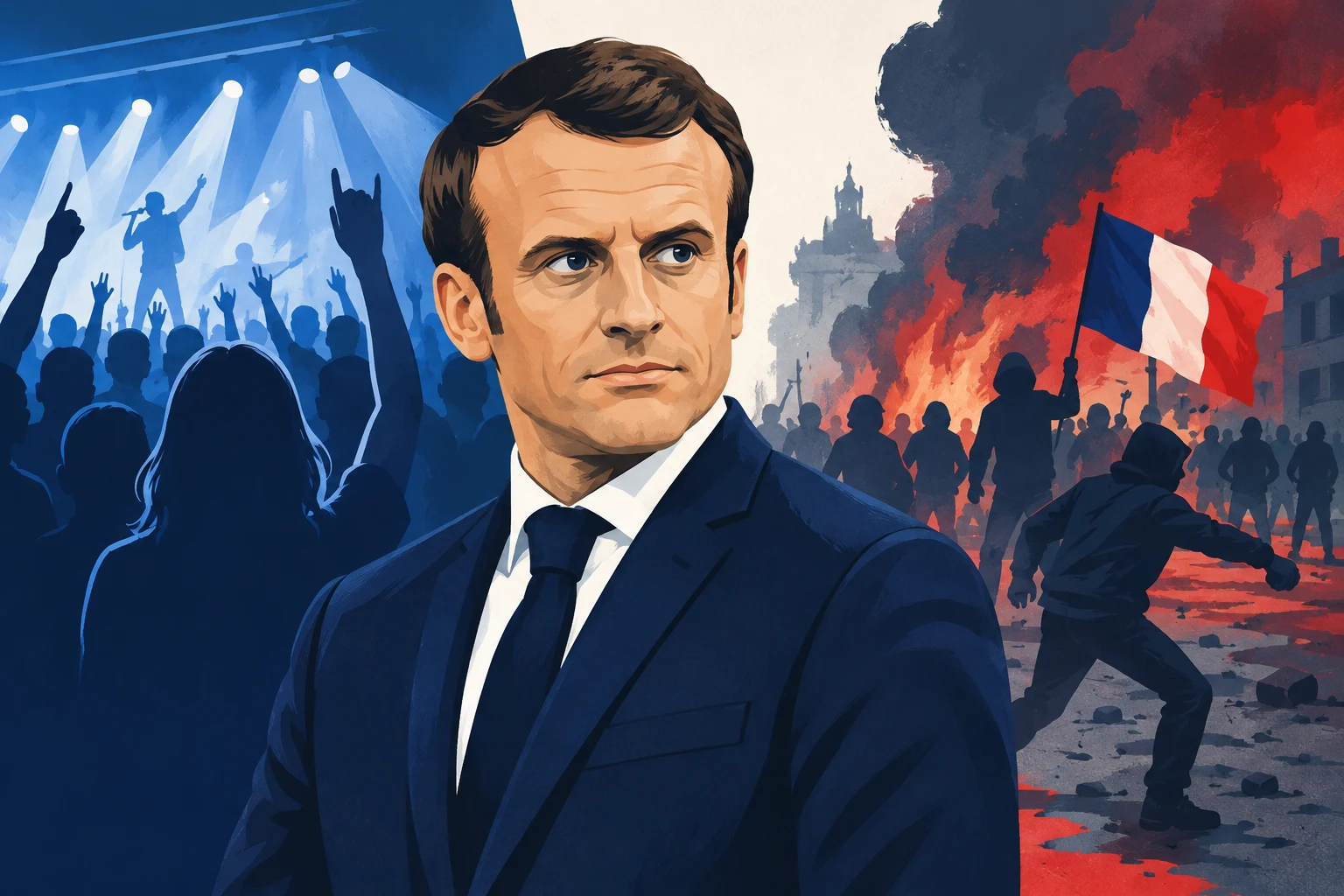
French President Emmanuel Macron faced criticism after attending a Céline Dion concert Friday night, hours before nationwide demonstrations that turned violent across France. Macron and his wife, Brigitte, were reported at the performance in Nanterre, west of Paris. French media said the couple arrived and departed discreetly and joined a crowd of about 35,000 spectators.
The concert followed two days of Macron’s meetings in Brussels at a European Council gathering. At a Friday news conference there, he urged people to remain calm and respect others, while saying the right to protest should be exercised without harm to people or property.
By Saturday, demonstrations focused on rising living costs, school conditions and declining public services had escalated into clashes with police, fires, looting and attacks on public buildings in several cities. French authorities said Sunday that nearly 1,800 people had been arrested nationwide, including 855 in the Paris region. Interior Minister Laurent Nuñez reported that more than 500 police officers, gendarmes and firefighters were injured. Authorities also said one protester died after suffering cardiac arrest during demonstrations in Paris.
The damage was reported in multiple locations. In Limoges, officials said a deliberately set fire caused significant damage to the historic city hall. Businesses were looted in Paris, Bordeaux, Marseille and Lyon, among other cities, and public buildings were vandalized or hit by fires.
Authorities estimated that more than 550,000 people took part in demonstrations across France. Organizers gave a higher estimate of roughly 800,000. The protest movement reportedly grew out of a month-long student campaign concerning school conditions and teacher shortages in working-class suburbs, then broadened to include grievances about inequality, public spending cuts and living costs.
Macron condemned the destruction in a post on X Saturday evening. He said people who damaged property, attacked public buildings or looted businesses would face prosecution and punishment, expressed support for law enforcement, and warned against attempts to weaken French institutions. The timing of his response, after violence had spread to several major cities, prompted questions about the government’s preparation and its ability to contain the unrest.
Government and opposition figures offered competing accounts of the disorder. Prime Minister Sébastien Lecornu blamed what he described as the ultra-left and criminals. Marine Le Pen, a right-wing political leader, condemned looting and destruction. Left-wing leader Jean-Luc Mélenchon defended the protesters’ wider concerns and criticized the government’s handling of events; reports attributed to him an accusation that Lecornu was “playing with fire.” Opposition leaders also criticized the government as it faces a presidential election next year.
The unrest has also imposed costs on businesses. Carrefour chief executive Alexandre Bompard told French television that 50 of the retailer’s stores had been damaged, 20 of them looted, and estimated losses in the tens of millions of euros, according to Reuters. The mayors of Paris, Marseille and Lyon sought a meeting with the prime minister to discuss the damage. Officials in Marseille and Bordeaux announced or proposed emergency support for affected businesses.
Macron was scheduled to address the nation at 8 p.m. local time Sunday, following a meeting with senior government officials. The planned speech came as cleanup efforts began and authorities prepared prosecutions for people arrested. The supplied account did not include the address or any subsequent response.