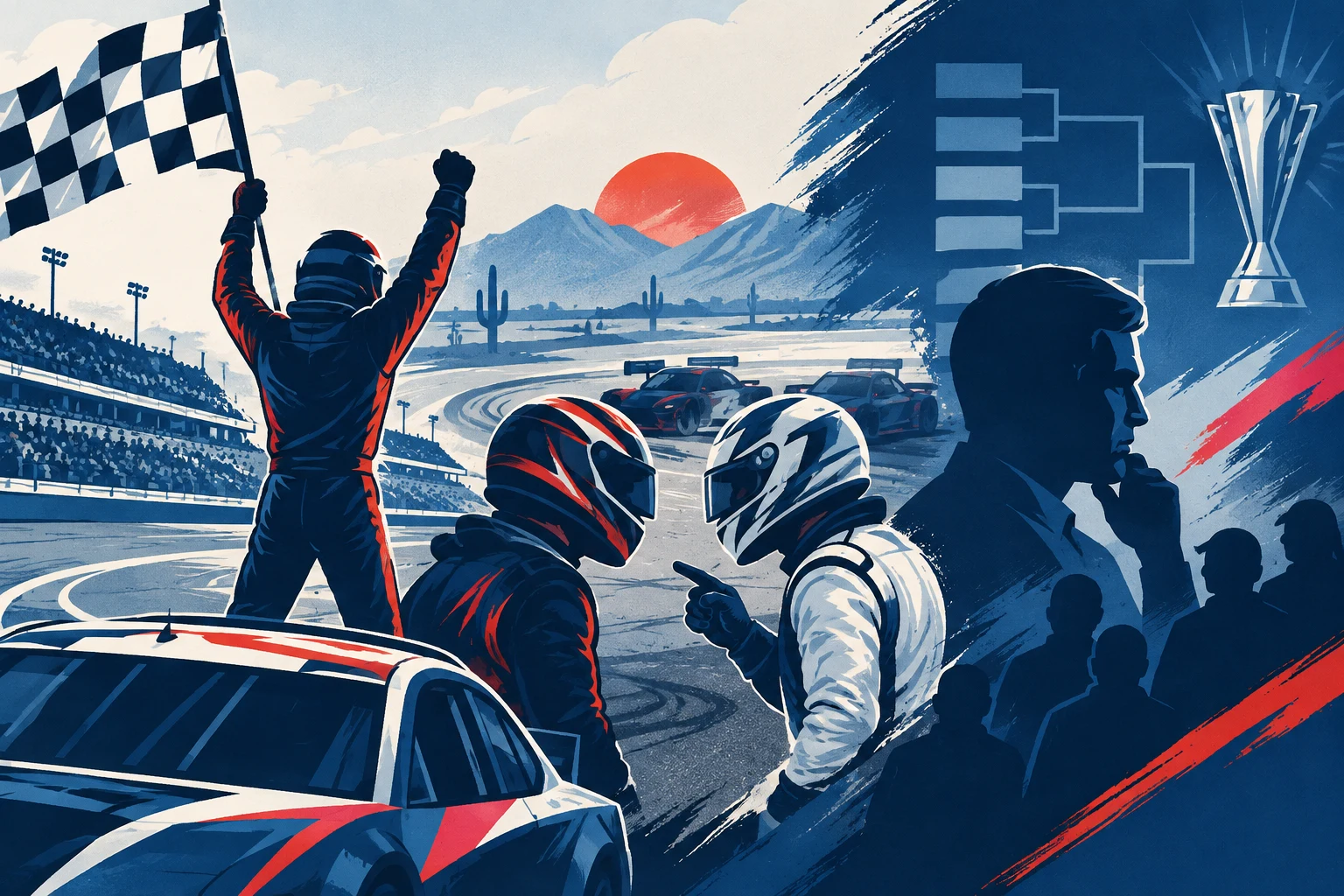
A Monday NASCAR column published by OutKick and Fox News Digital on Oct. 19, 2026, looked ahead to the final three races of the Cup Series season, recapped Tyler Reddick’s victory at Phoenix and discussed a confrontation between drivers Zane Smith and Carson Hocevar after the race.
The writer described the season as an unusually long February-to-November campaign and said five drivers had a legitimate opportunity to win the championship: Kyle Larson, Christopher Bell, Chase Briscoe, Denny Hamlin and Ryan Blaney. None of those five won at Phoenix, according to the column.
Reddick took the Phoenix race, his first victory since Kansas in April. The column noted that he had opened the season with three consecutive wins and said the Phoenix result kept him in the title conversation, though the writer considered a championship less likely. The column also pointed to the upcoming Talladega race as a possible source of movement in the standings, given the potential for a major crash to affect contenders. That was presented as a possibility, not a prediction that such a crash would happen.
The column’s account of the post-race incident said contact from Ross Chastain sent Hocevar up the track and into Smith. It said Smith then accelerated into Hocevar’s car after the race. The writer characterized the contact as deliberate and reported that Smith responded, “I don’t give a f–k,” after being told about the earlier chain of contact. The column attributed Smith’s hostility to an existing dislike of Hocevar, citing an earlier remark in which Smith said he did not like Hocevar “as a human.”
The article placed the episode within a series of conflicts involving Hocevar during the 2026 season. It referred to Ryan Blaney attacking Hocevar at Bristol the previous month and to Brad Keselowski threatening to wreck him after Darlington. It did not provide detailed accounts of those earlier incidents. The writer also praised Smith’s wife, McCall Gaulding, for social-media content that included a photograph of the couple making an obscene hand gesture. The column’s descriptions and judgments about the drivers were the writer’s commentary.
Beyond the race and confrontation, the column addressed a comparison circulating online between NASCAR’s playoff format and the expansion of college football’s playoff to 24 teams. A post cited by the writer argued that NASCAR lost viewers after adopting postseason changes and pursuing a broader audience. The writer disagreed that the playoff system introduced in 2004 was the primary cause of NASCAR’s ratings decline, saying ratings held up in the years immediately afterward. The column did not offer ratings figures or detailed evidence for that assessment; instead, the writer said multiple factors, including some decisions by NASCAR and other forces, had contributed.
The piece noted that NASCAR’s 2025 championship race had its lowest ratings ever, but provided no numerical audience data or source for the figure. It closed by inviting readers to offer their views on the sport’s audience decline and the college football comparison. The column was a commentary-style weekly roundup, combining race news with the author’s opinions about the drivers, playoff structures and NASCAR’s past decisions.