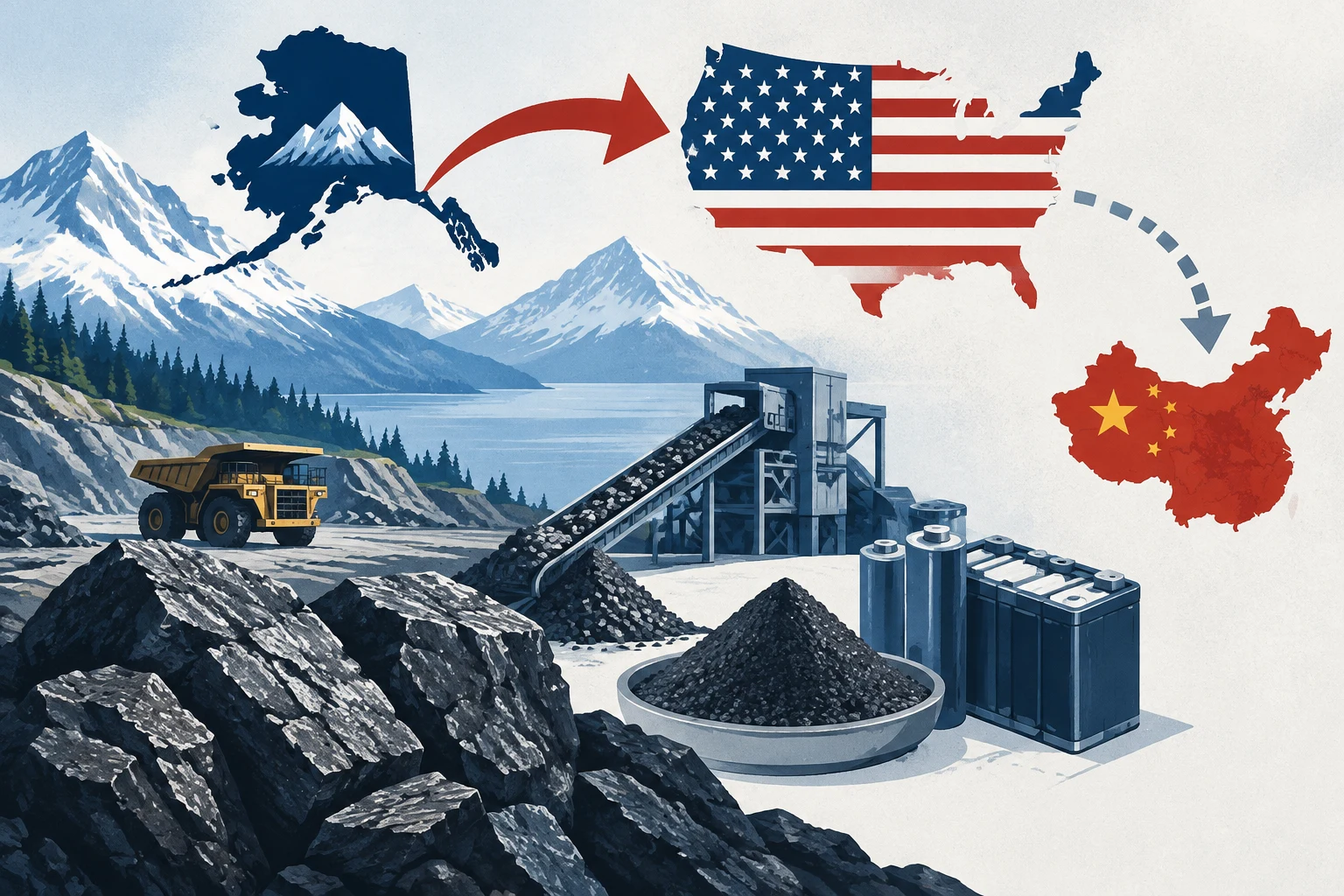
A Fox News opinion article published Oct. 16, 2026, argues that the United States should expand domestic production and processing of critical minerals, with Alaska’s Graphite Creek deposit as a proposed starting point. The article frames dependence on China for mineral supplies as a national-security and economic risk.
The author says critical materials are needed not only for military equipment but also for batteries, electronics, advanced manufacturing and infrastructure supporting artificial intelligence and data centers. Graphite is highlighted for its use in rechargeable batteries, including those used in electric vehicles and energy-storage systems, as well as in some defense technologies and drones.
The article draws a parallel with supply-chain disruptions during the COVID-19 pandemic. It says U.S. hospitals struggled to obtain masks, gloves and other medical equipment produced in China, and argues that reliance on overseas suppliers can leave the country vulnerable when supply is interrupted. The comparison is used to support the author’s broader case for producing more essential materials domestically.
According to the piece, China has built substantial influence across mineral supply chains, including mining, processing and advanced materials manufacturing. It also says Beijing has used restrictions on exports of strategic materials as leverage. The article does not identify specific export restrictions or provide figures for U.S. graphite imports.
The proposed domestic resource is Graphite Creek on Alaska’s Seward Peninsula. The author says Alaska contains 57 of the 60 minerals classified as critical to U.S. economic and national security. The piece describes Graphite Creek as the largest known graphite deposit in the United States and among the world’s largest, attributing that characterization to the U.S. Geological Survey. It presents the deposit as a potential foundation for an integrated American graphite supply chain.
The article cautions that mining alone would not eliminate dependence on foreign suppliers. It argues that the United States would also need to expand domestic processing and manufacturing of advanced materials, areas where the author says China is dominant. The stated goal is a supply chain that begins with U.S. resources and continues through processing and production for American industry.
The author attributes slow development of U.S. mining and manufacturing projects to lengthy permitting processes, regulatory uncertainty and inadequate investment in domestic processing. The piece calls for permitting that is more predictable and efficient, while saying rigorous environmental standards should remain in place. It also argues that importing minerals from countries with lower labor, safety or environmental standards is not a sound alternative.
The article says the United States has natural resources, engineering expertise, workers and private capital that could support greater domestic production. It urges Washington to move from recognizing mineral-supply risks to investing in domestic supply chains, and concludes by advocating investment in a major Alaska graphite mine.
These points are arguments made in an opinion article, not a project assessment. The supplied material does not give development costs, permitting status, production estimates, environmental studies or a timeline for Graphite Creek. It therefore does not establish how quickly the deposit could enter production or how much it would reduce U.S. reliance on foreign graphite.