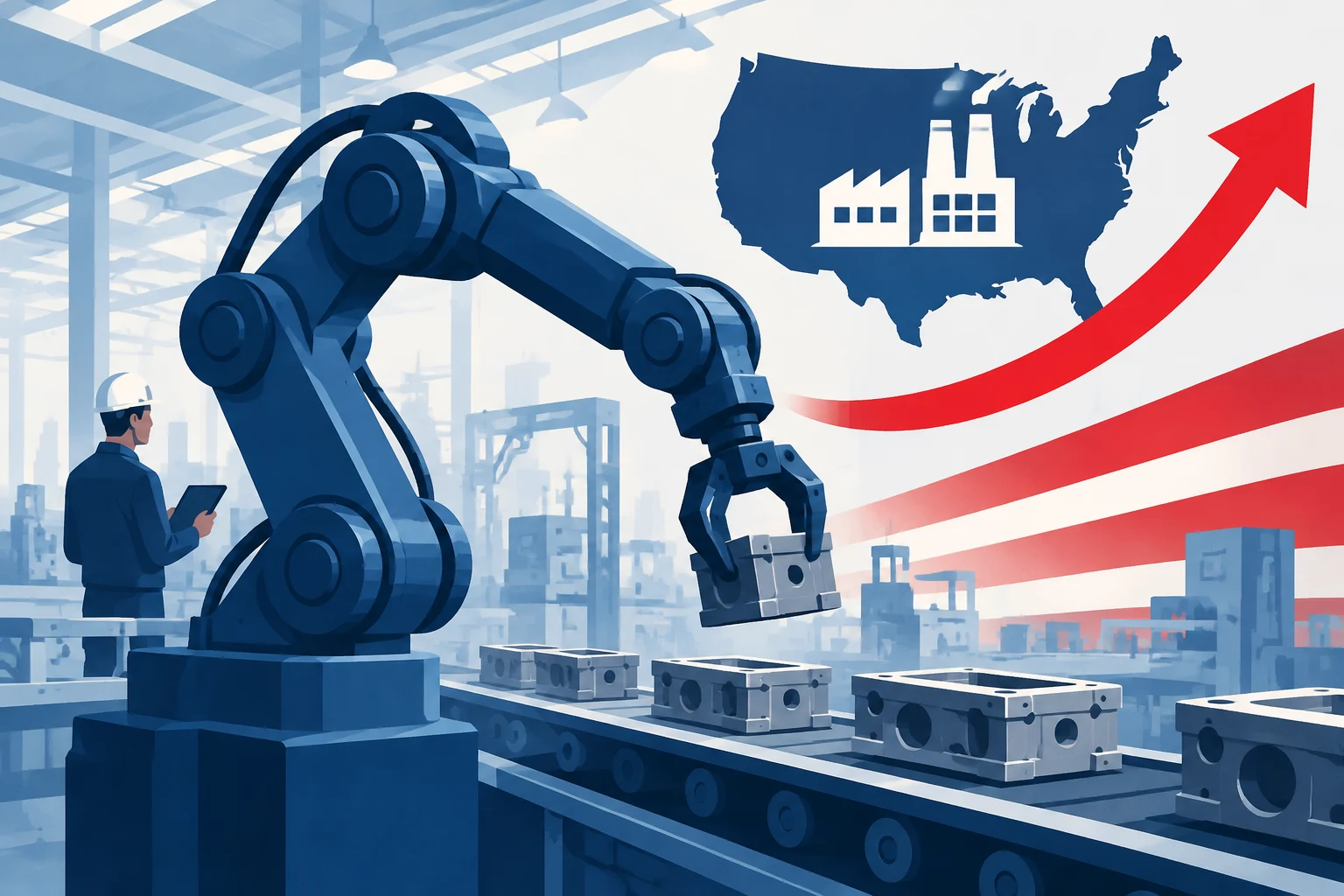
Robotics could help U.S. manufacturers increase production as they contend with shortages of skilled workers, according to Heather Carroll, chief revenue officer at Path Robotics. In comments to Fox Business, Carroll said the available workforce is not sufficient for manufacturers to expand at scale without automation.
She pointed to Saronic Technologies’ planned $3.2 billion Port Alpha shipyard in Brownsville, Texas, as an example of a project where automation could be combined with hiring American workers. Vice President JD Vance attended the shipyard’s groundbreaking the previous month, according to the source report. Carroll described the project as an opportunity to pair advanced technology with domestic jobs.
Carroll framed robotics adoption as part of the competition with China. She said China has moved more quickly to use robotics in factories and has developed a national approach linking government, industry and financing to encourage adoption. In her assessment, the United States lacks a comparable coordinated effort, and the difference in adoption is growing. She warned that slower uptake could put American manufacturers at a disadvantage.
U.S. companies considering automation face practical obstacles, Carroll said. These include difficulty obtaining capital, uncertainty about future demand and a lack of workers with the technical skills needed to install and operate robotic systems. She said advances in artificial intelligence could make robots easier to deploy and reduce the level of specialized expertise required.
Carroll identified welding as one area where automation could help meet demand. She said manufacturers face an aging welding workforce at a time when demand is increasing in shipbuilding, defense, energy and infrastructure related to artificial intelligence. Some manufacturers, she said, report having substantial orders but being unable to accept more work because they cannot staff an additional shift.
As an example of how tasks could be reorganized, Carroll said one welder could be trained to operate 10 welding robots while continuing to perform more specialized work. The example was presented as a potential way to extend workers’ capacity, rather than a claim that all welding operations could adopt the same arrangement.
Carroll acknowledged concerns that robotics and AI could displace jobs. She argued that manufacturers and policymakers should also focus on training and upskilling, so current workers can take part in jobs created around the new technology. Her comments emphasized using automation to supplement the available workforce while preparing employees for changing production roles.
The remarks reflect Carroll’s perspective as an executive at a robotics company. The supplied material does not include independent data comparing U.S. and Chinese adoption rates, details of the shipyard’s planned automation, or responses from manufacturers, workers or government officials about the broader claims.