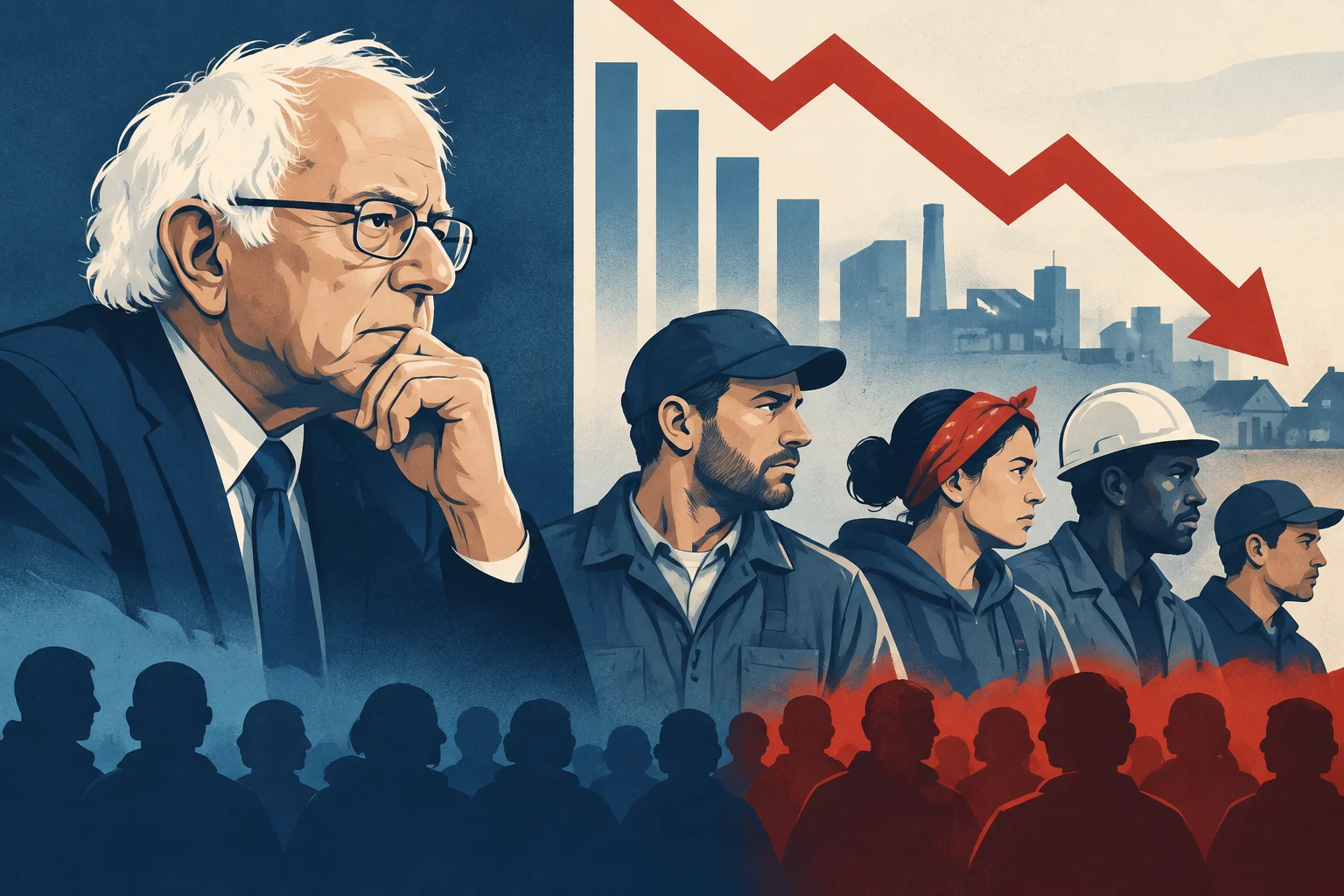
Sen. Bernie Sanders said Democrats’ failure to deliver on economic concerns contributed to working-class voters turning away from the party and supporting Donald Trump. Sanders, an independent from Vermont, made the remarks in a Saturday interview with MS NOW while discussing why Democrats lost support among those voters.
Sanders said Democrats had a record of advocating for civil rights, women’s rights, gay rights and environmental causes, but argued they had not done enough on working-class issues. He pointed to a gap between the party’s promises of help and what voters experienced, saying that disappointment had weakened their trust in Democrats.
He also criticized trade agreements backed by Democrats, arguing that they cost the country millions of well-paying manufacturing jobs. Sanders described that record as one reason working-class voters became disillusioned with the party. His comments were an assessment of the causes of voter movement, rather than a claim that economic concerns were the only factor.
A Republican National Committee spokesperson, Natalie Baldassarre, offered a sharply different partisan response when asked for comment by Fox News Digital. She said Democrats’ tax and economic policies had hurt working families, and accused the party of prioritizing its left-wing supporters over those families. Those statements reflect the RNC’s criticism of Democrats and were not presented in the source as independently established findings.
The report cited results from a 2024 Fox News Voter Analysis. According to those figures, Trump defeated then-Vice President Kamala Harris by 53% to 45% among voters whose household incomes were between $50,000 and $99,999. Harris won voters with household incomes of $100,000 or more, taking that group by 53% to 46%.
The analysis also found that Trump carried voters who said they were falling behind financially by 29 percentage points. About 40% of voters identified inflation as the most important factor in their vote, and that group supported Trump by nearly two to one, the source reported. The figures describe voting patterns; they do not, by themselves, establish why each person voted as they did.
Sanders has made similar criticisms since Trump’s 2024 election victory. In a statement after the election, he argued that Democrats’ loss of working-class support had broadened beyond white voters to include Black and Latino workers. He also said voters were angry and wanted change while economic inequality was growing and more people felt financially squeezed.
The source further included comments arguing that class issues were becoming more prominent in politics and that confronting corporate lobbying and advancing working-class priorities were gaining appeal across party lines. The excerpt does not identify the speaker of those remarks, so they cannot be attributed to a named person here.
Taken together, the comments present Sanders’ explanation for Democrats’ losses among some working-class voters alongside Republican criticism of Democratic economic policies and voter-analysis data from 2024. The cited results provide context about how different income and financial-stress groups voted, while Sanders’ explanation and the RNC spokesperson’s response remain competing political interpretations.