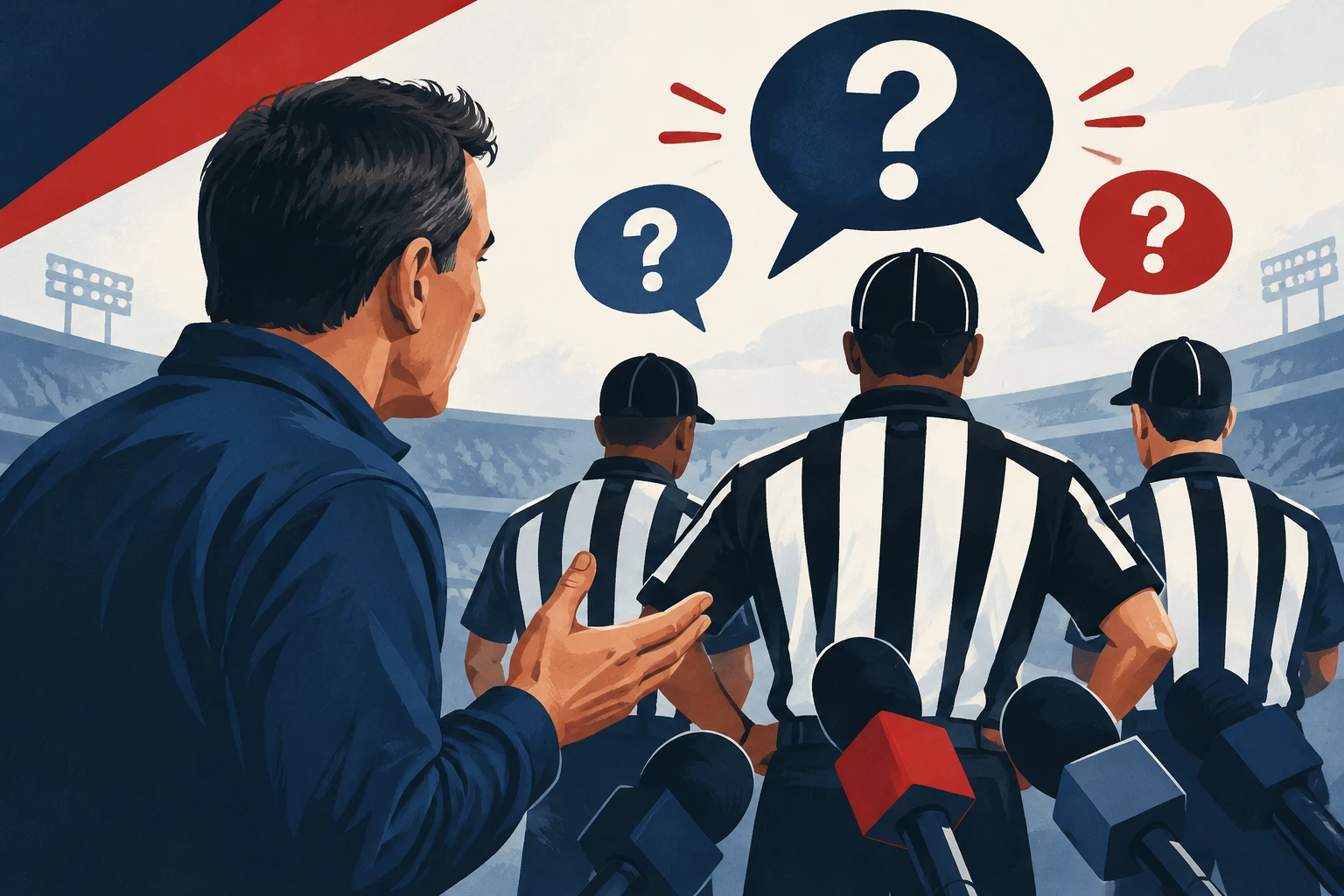
Former NFL quarterback Sean Salisbury has called for game officials to face on-camera questions after games, arguing that referees should explain their decisions in a setting comparable to the postgame interviews required of players and coaches. He made the comments in a conversation with OutKick.
Salisbury said he would like to hear officials describe what they saw shortly after a game, while the circumstances are still fresh. His proposal focuses on direct answers from the officials involved rather than waiting for explanations from league personnel later.
The NFL already has a process for media questions about individual calls. Reporters covering a game can request an explanation through a designated pool reporter, who asks questions and shares a transcript with other media. Salisbury’s suggestion would go further by putting officials before cameras routinely after games.
He said he respects the difficulty of officiating but believes some missed calls should be evident without relying on replay. Salisbury also raised the possibility that replay could make officials less decisive at first, describing it as a form of backup that might affect how they make an initial ruling. The source does not provide league data or other evidence establishing that replay has changed officials’ decisions.
Salisbury also criticized confrontations between officials and players. He said referees should not make tense exchanges worse, and that managing disputes is part of an official’s role. In his view, officials can be firm or try to calm a player, but should avoid turning a disagreement into a personal conflict.
The article cited two NFL suspensions announced on Oct. 5. Line judge Jeff Seeman received a two-game suspension after an incident involving Arizona Cardinals tight end Trey McBride during a game against the New York Giants. Video appeared to show Seeman directing profanity at McBride. Referee Adrian Hill received a one-game suspension following a separate incident with Minnesota Vikings linebacker Eric Wilson during a game against the Miami Dolphins. The article says Wilson was accidentally knocked into Hill and later said Hill accepted his apology and explanation.
Salisbury referred to the suspensions as examples of the league holding officials accountable, while maintaining that postgame questioning would offer another way to address controversial calls. He also warned that a heated exchange could affect how a team interprets a later disputed decision, potentially creating an impression that an official is acting against it. That is Salisbury’s concern, not evidence that any particular call was motivated by personal hostility.
The article connects disputed calls to fan suspicion, including speculation about gambling-related outcomes. Salisbury’s position is that hearing an official’s account could give the public more information than conjecture about a referee’s motives. He said officials should be accountable when they make mistakes, just as players and coaches are expected to answer questions about their performance.
The proposal is Salisbury’s view; the source does not report that the NFL has adopted or announced plans to adopt routine televised postgame interviews with officials.