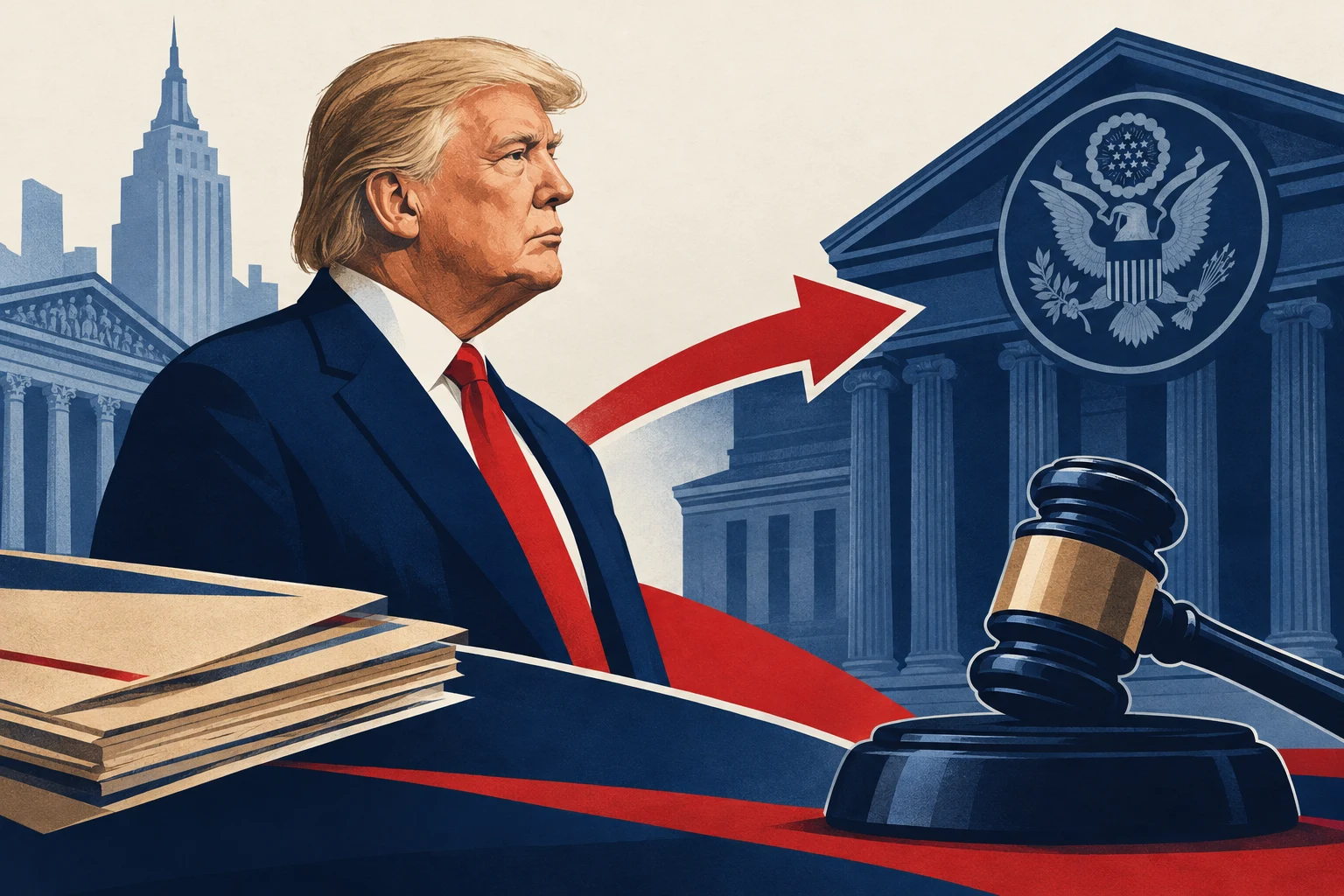
A three-judge panel of the U.S. Court of Appeals for the Second Circuit ruled Monday that a federal district judge improperly denied Donald Trump’s second request to move his New York hush-money case from state court to federal court. The ruling revives Trump’s effort to challenge his felony conviction using arguments based on presidential immunity, but it does not overturn the conviction or decide whether the immunity claim will succeed.
The panel said the late U.S. District Judge Alvin Hellerstein made two legal errors in rejecting the transfer request. The judges concluded that a federal official may seek to move a case after conviction and that Trump had shown “good cause” to submit a second notice seeking removal. The panel said a fuller written opinion would come later.
The case will now return to U.S. District Judge Lewis J. Liman, who took it over after Hellerstein died in October. The appeals court also asked New York courts to suspend additional proceedings until the federal jurisdiction issue is resolved. The supplied account does not report a decision from Liman on whether the case will be transferred.
Trump’s lawyers argued in a September filing that circumstances had changed since his first transfer effort in 2023. They cited the Supreme Court’s July 2024 presidential-immunity ruling and contended that state prosecutors had used evidence concerning Trump’s presidential activities that should not have been considered under that decision. Trump attorney Robert Giuffra Jr. argued that keeping the matter in the New York court system could delay Trump’s effort to obtain review by the Supreme Court.
Manhattan prosecutors urged the appeals court to leave Hellerstein’s ruling in place. They argued that Trump had pursued his immunity arguments in state court first and sought a transfer only when he thought he might lose there, describing the move as strategic delay. Prosecutors also maintained that the business-records charges concerned a personal payment and were unrelated to official presidential duties.
The criminal case arose from a payment made in 2016 by Trump’s then-attorney, Michael Cohen, to Stormy Daniels. The source describes Daniels as an adult-film actress who received $130,000 shortly before the presidential election to keep her from publicizing an alleged sexual encounter with Trump about a decade earlier. Trump denies that the encounter occurred.
In May 2024, a New York jury found Trump guilty of 34 felony counts of falsifying business records. At sentencing in January 2025, shortly before his second inauguration, he received an unconditional discharge, meaning the sentence imposed included neither prison time nor a fine. The conviction nonetheless remained on his record.
If Liman permits the case to move to federal court, the federal court would take up the existing conviction and the dispute over whether it must be set aside under the Supreme Court’s immunity standard. A transfer would not give Trump the power to pardon himself: the charges are New York state offenses, which the source says are beyond the reach of a presidential pardon.
The appeals panel included Circuit Judges Raymond J. Lohier Jr., José A. Cabranes and John M. Walker Jr. The source identifies them as appointees of Barack Obama, Bill Clinton and George H. W. Bush, respectively. The Manhattan District Attorney’s Office and Trump’s legal team did not respond to Fox News Digital’s requests for comment before publication, according to the source.