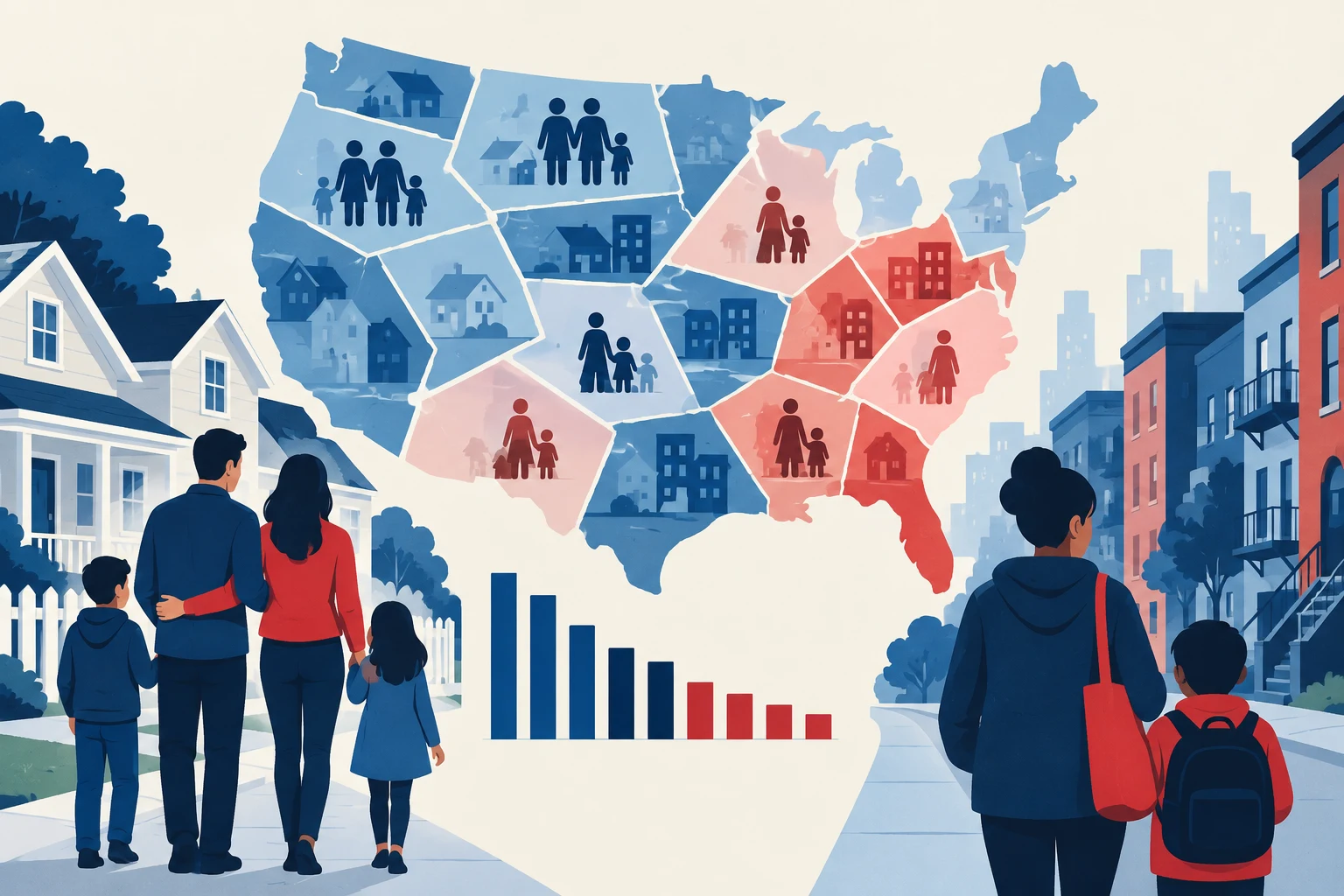
A study from the Institute for Family Studies, using 2020 Census data, found substantial variation in married-parent households across the communities it examined. In some neighborhoods in Cleveland, Washington, D.C., and Milwaukee, fewer than one in four households with children was headed by a married couple. The study reported rates as high as 89% in some suburban areas.
The report describes lower-marriage areas as “married-family deserts” and higher-marriage areas as “married-family gardens.” It identifies suburban Dallas-Fort Worth as the largest grouped area in the latter category, and Lower Manhattan and Brooklyn as the largest grouped area in the former. The report says the New York grouping includes nearly 686,000 householders, more than two-thirds of whom are unmarried.
The study’s examples of low married-parent shares include eastern Cleveland and nearby Bratenahl Village, Ohio, at 18%; eastern Washington, D.C., at 20%; and central Milwaukee, at 22%. Its suburban examples include Fremont, California, Lakewood, New Jersey, and parts of Utah County, Utah.
The report points to prior research associating family structure with economic mobility and social capital, including work by Harvard economist Raj Chetty. It argues that children in neighborhoods with different family patterns may encounter different levels of relationship stability and different social norms. These findings describe associations and neighborhood differences; they do not establish that family structure alone causes differences in children’s outcomes.
Ken Burchfiel, a research fellow at the institute, told Fox News Digital that marriage decisions may reflect cultural as well as financial considerations. He also noted that high incomes do not necessarily make it easy to buy a home or raise children in expensive urban neighborhoods. The report’s recommendations to consider local family patterns when choosing where to live are guidance from its researchers, not a conclusion demonstrated by the census analysis.