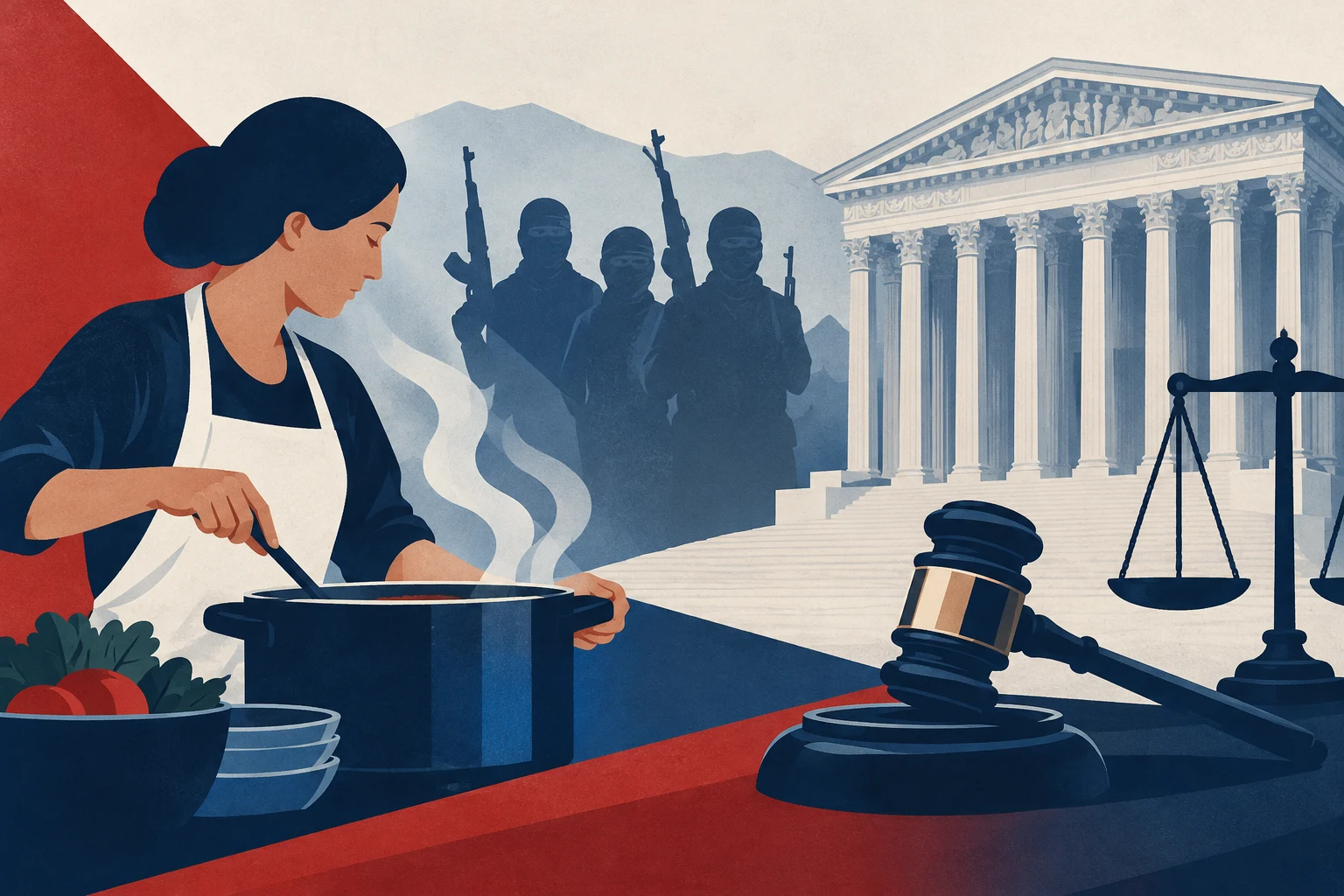
The Supreme Court agreed to review the Trump administration’s challenge to a federal appeals court ruling in the deportation case of Izuchukwu Ozurumba, a Nigerian citizen who said he was forced to cook for the Unknown Gunmen. The dispute centers on how broadly federal law bars asylum for people who provide “material support” to terrorist organizations.
Ozurumba said he accepted a chef job at what he understood was a rural camp, preparing three meals daily for 15 to 17 leaders. He later learned the camp was associated with the Unknown Gunmen. According to court records described in the source, armed guards kept him from leaving. He cooked for about six months, including three months without pay, before escaping while on a grocery trip.
An immigration judge found the group qualified as a Tier III terrorist organization under immigration law, although the State Department had not formally designated it as one. The judge denied Ozurumba’s asylum request and ordered his deportation. The Board of Immigration Appeals upheld that decision, concluding his cooking fell within the statute’s material-support restriction.
The Immigration and Nationality Act bars certain people who provide material support to terrorist organizations from receiving asylum. The law identifies examples such as transportation, communications, housing, money, weapons and training, but does not expressly define material support. The Trump administration argues that cooking can also assist an organization by freeing its members to perform other duties.
Ozurumba said Unknown Gunmen members threatened and attacked him after his escape. He fled Nigeria, traveled to Venezuela and eventually reached the United States. In July 2023, he crossed the southern border without valid entry documents and surrendered to Border Patrol agents.
In a 2-1 decision, the 4th U.S. Circuit Court of Appeals overturned the deportation order and returned the case to the immigration appeals board. The majority said that, although Ozurumba prepared thousands of meals, the cooking did not provide resources that could be directly used or readily redirected to terrorist operations.
The appeals court did not decide whether the law excuses assistance provided under duress. Ozurumba’s account that he was compelled to cook therefore was not resolved as a separate legal basis for the ruling. The majority instead concluded that the service, as it viewed the record, did not meet the statutory definition of material support.
Judge Julius Richardson dissented, arguing that providing meals to the group’s leaders enabled them to focus on the organization’s aims and therefore counted as support. The administration likewise says even routine services can help sustain a terrorist group. Legal commentators Bryce Poole and Hans von Spakovsky, both affiliated with Advancing American Freedom, criticized the appeals court’s interpretation in remarks to Fox News Digital. Their comments represent their views, not a ruling by the Supreme Court.
The case also raises questions about the role of judges in interpreting ambiguous laws. The source notes that the Supreme Court’s 2024 decision overturning Chevron deference increased judges’ authority to determine statutory meaning rather than defer to reasonable agency interpretations.
The Supreme Court’s review will address the scope of the material-support rule. A decision for Ozurumba would not itself grant asylum or guarantee his return to the United States. The appeals court had left the question of whether he should be brought back for further proceedings to government officials.