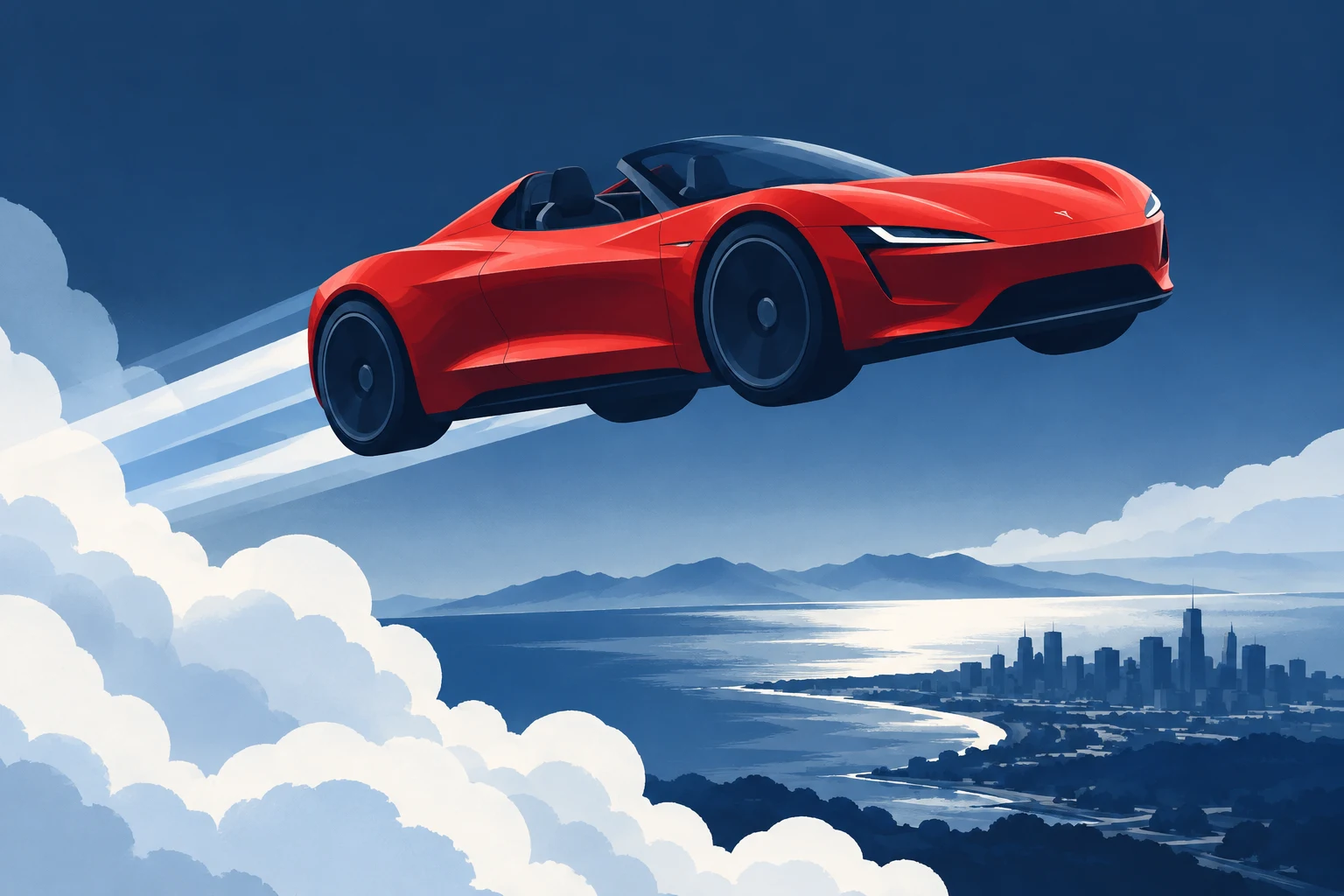
Tesla presented a redesigned Roadster prototype on Oct. 15, 2026, at SpaceX’s rocket testing facility in McGregor, Texas. In demonstrations shared by the company, the car climbed a curved ramp while inverted, launched into the air, rotated and landed on its wheels. It also flew over a lineup of Tesla vehicles. The source reports that nobody was inside the car during the stunts and that Tesla used automated controls.
The demonstration combined several systems developed with SpaceX. Electric fans near the rear of the car draw air from beneath it to create suction, increasing tire grip against a surface. A ground-sealing system is intended to help preserve that suction. Cold-gas thrusters release pressurized gas through nozzles to propel or maneuver the vehicle; they do not burn fuel like conventional rocket engines.
Tesla engineering executive Lars Moravy said the standard thruster setup uses a 200-liter high-pressure storage vessel behind the seats. The more advanced Rocket configuration adds 400 liters, for a total of about 600 liters, and uses additional thrusters. The source says refilling that larger storage system currently takes about six to seven hours. Tesla is seeking to reduce the time. These demonstrations show brief, controlled airborne maneuvers, not sustained flight comparable to an airplane.
Tesla also reported that the prototype accelerated from zero to 60 mph in approximately 0.81 seconds with thruster assistance. That result is the company’s claim; the source notes it has not been independently confirmed on a production vehicle. Tesla’s published performance projections vary by configuration. The company says the road-oriented Performance version can reach 60 mph in under 1.6 seconds without rocket-style thrusters. It claims the Thrust version can do so in under 0.9 seconds, and the Rocket version in under 0.59 seconds. Those figures remain projections, not independently verified production results.
The configurations differ in purpose and capacity. The source describes Performance and Thrust models as two-seat versions, while the Rocket configuration’s equipment takes up the passenger-seat area, leaving room for one occupant. Tesla says the Rocket model is invitation-only and warns it has not been approved for public-road use. Elon Musk reportedly acknowledged uncertainty about where the more extreme features would be legal and said safety was not necessarily the primary focus in developing them.
Other specifications remain company claims as well. Tesla says some versions can exceed 230 mph and projects more than 300 miles of range per charge. The source contrasts that range estimate with about 620 miles promised when Tesla introduced the second-generation Roadster in 2017. Musk also mentioned a longer-term goal of reaching half the speed of sound, roughly 380 mph depending on atmospheric conditions; the source describes this as an aspiration rather than an achieved result.
Tesla has not announced a final purchase price at the 2026 unveiling. The source says the company reopened reservations, requiring $5,000 initially for Performance and Thrust models. Performance reservations require another $45,000 within 10 days, bringing the total reservation payment to $50,000. Thrust buyers must pay another $245,000 within that period, for a $250,000 total. Pricing for the invitation-only Rocket configuration was not disclosed. Tesla had discussed a starting price of about $200,000 in 2017, but that is not a newly confirmed price.
According to Tesla’s reservation agreement, a reservation provides an approximate place in line, rather than constituting an order for a completed car. The agreement allows cancellation and a full refund until the customer is invited to configure a vehicle. It also says the reservation money is not held in escrow and earns no interest. Tesla states that the Roadster is still under development and does not guarantee when, or whether, it will be delivered.
Tesla initially expected deliveries to begin in 2020. Musk now identifies 2028 as the production target, according to the source, but that date is not guaranteed. The demonstration therefore marks a public display of the prototype and its claimed technology, not confirmation that the vehicle is ready for production.