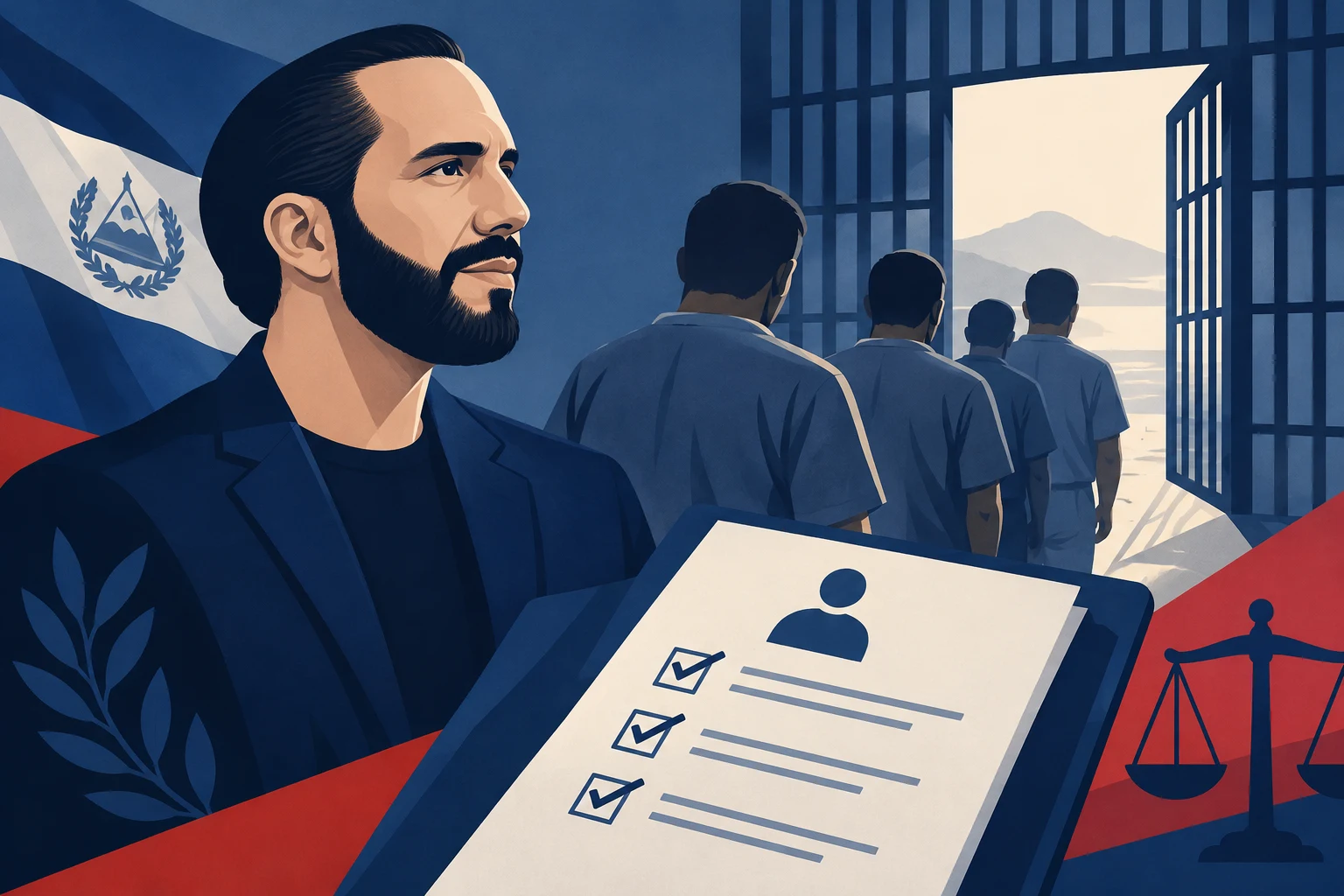
Salvadoran President Nayib Bukele announced a proposal Tuesday night that could lead to the conditional release of up to half the people detained under the country’s state of emergency. The measure would apply to people authorities classify as gang collaborators, a category that can include lookouts and people who paid extortion demands, according to the supplied report.
Bukele said officials would review individual cases and could impose monitoring on people released. He did not provide details about how the reviews would work or when the process might begin. The potential releases concern people arrested during an emergency that has been in force for more than four years.
Bukele described some detainees as having committed crimes by cooperating with gangs, while arguing that collaboration had been widespread in the country. He said the state could not imprison everyone who had collaborated. The proposal, as described, is conditional and does not mean that all eligible detainees would automatically be freed.
The emergency was declared in March 2022 after a day of violence in which more than 60 people were killed. Initially set for 30 days, it has been renewed repeatedly. Authorities have arrested more than 90,000 people under the measure over the past four and a half years, the report said.
The government has defended the emergency as a way to suppress the rival gangs MS-13 and Barrio 18. The period has coincided with a steep decline in the country’s homicide rate and a rise in its appeal as a tourist destination. At the same time, the emergency suspends or limits certain constitutional protections, including rights related to learning the reason for detention, consulting a lawyer and receiving visits.
Human rights organizations have criticized the policy, alleging that it has resulted in widespread arbitrary arrests and urging Bukele to end it. The report said organizations have logged more than 6,000 complaints during the emergency and documented at least 575 deaths in government custody. These are figures attributed to rights groups, not findings independently established in the supplied material.
Bertha Deleón, a Salvadoran lawyer living in exile, argued in a post on X that freeing detainees would not by itself address the effects of imprisonment. She said people who were arbitrarily detained should also receive compensation for physical and mental harm, family hardship and losses involving employment, education or reputation.
Bukele rejected broad criticism from domestic and international rights groups, saying they should support victims of gang violence. He has defended continuing the emergency while also indicating that he ultimately wants it to end.
Government figures cited in the report show the homicide rate fell from a peak of more than 100 murders per 100,000 residents in 2015 to 1.3 per 100,000 in 2025. The report also notes that the government’s homicide definition excludes killings by police, deaths in prisons and bodies found in unmarked graves. That qualification is important when interpreting the official trend.