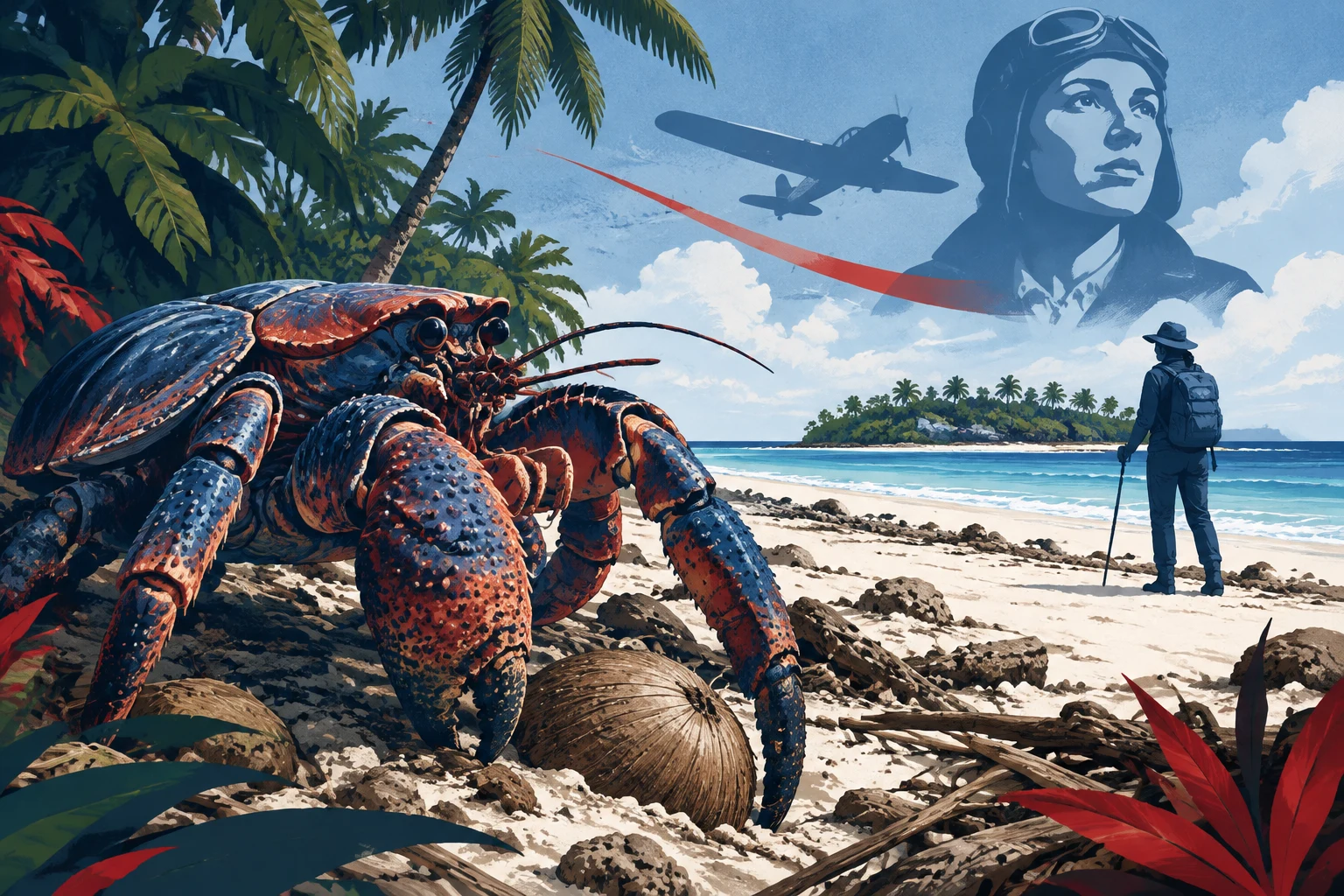
A research expedition looking into a possible clue to Amelia Earhart’s disappearance has begun work on Nikumaroro, a remote Pacific island, while taking precautions around its large coconut crabs. Purdue University said the 17-person team is sleeping aboard its vessel, the Marin Mainiku, rather than staying overnight on the island. The university cited several reasons for that arrangement, including the crabs’ size and nighttime activity.
The crew reached waters off Nikumaroro on a Monday evening after a five-day crossing of the Pacific and went ashore the next morning. On Tuesday, while clearing an overgrown route to the island’s lagoon, researchers encountered at least four coconut crabs, according to Purdue. The trail, which the team calls the “Gallagher Highway,” required about two hours of work with machetes and hand chainsaws. The university said the crabs did not interfere with the operation.
Purdue later told Fox News Digital that the animals had not created further difficulties for the crew. Rick Pettigrew, executive director of the Archaeological Legacy Institute and expedition leader, said the team was in “excellent spirits.” In an Oct. 9 university statement, team member Renato LaRocca, who had visited Nikumaroro before, noted the presence of both coconut and hermit crabs, while describing the island as a special place. Pettigrew also credited the Kiribati crew for looking after the expedition.
Coconut crabs are the largest terrestrial arthropods, according to a 2011 U.S. Geological Survey report cited in the source material. They are omnivorous scavengers that can climb trees and may live for more than 40 years. The USGS report also says they dig shallow burrows for mating and molting, sometimes keeping multiple burrows in their territory.
The Natural History Museum in London describes the crabs’ pincers as strong enough to crack coconuts. Its account says the claw edges are serrated and that tests on 29 wild crabs recorded a pinching force exceeding 1,765 newtons. The museum compared that figure with a stated human maximum bite force of 1,100 to 1,300 newtons. Purdue released a photograph of expedition member Sirisha Bandla holding a large crab.
The expedition is examining an anomaly identified in satellite imagery. Some researchers believe it could be the remains of Earhart’s Lockheed Electra, but the supplied information does not establish that identification. The search draws on the Nikumaroro Hypothesis, which proposes that Earhart’s aircraft came down near the island.
Earhart and navigator Fred Noonan disappeared on July 2, 1937, during an attempt to fly around the world. They had departed Lae, New Guinea, bound for Howland Island, on one of the final legs of the journey. The expedition’s investigation is aimed at assessing a possible lead in that longstanding mystery; the available account does not report that the team has confirmed the plane’s location.