


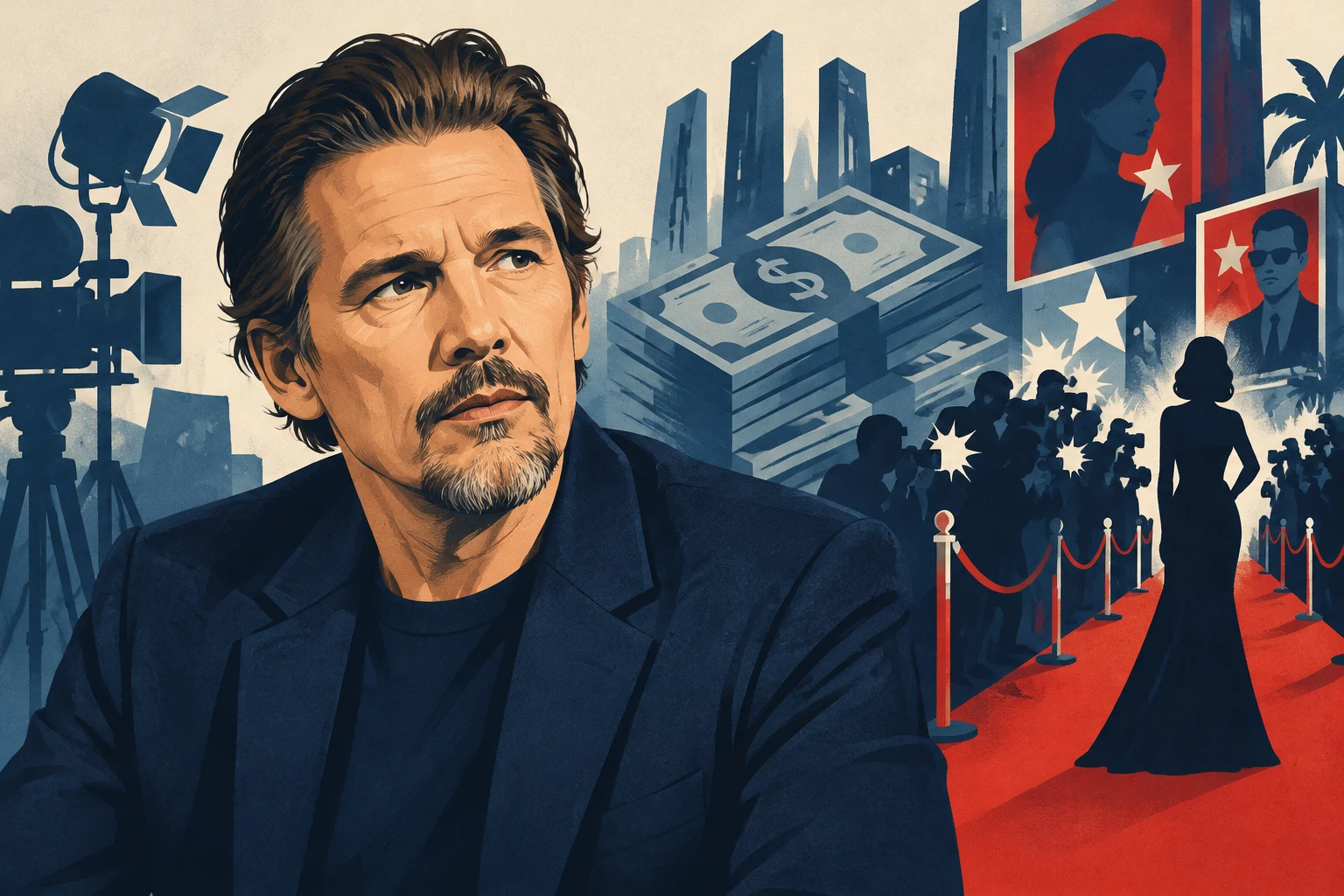
Actor Ethan Hawke used a GQ interview published Oct. 14, 2026, to criticize the influence of wealthy decision-makers in Hollywood and to predict that artists and audiences would push back against concentrated industry power.
Hawke said he believes people will organize in music and live theater and challenge those he views as controlling the entertainment business. He argued that financial power is not permanent and said he expects people to resist those who believe they can dictate the industry’s direction.
He also described a tension between creative ambition and compensation. In his view, actors may receive less money for the projects they care about most, while work designed to perform well with digital algorithms can be difficult to pursue on the same terms. The interview excerpt does not provide examples of particular projects, pay arrangements or companies behind the pressures he described.
Hawke’s comments extended beyond industry economics to the personal costs of fame. He said celebrity can become isolating, comparing it to being confined in a zoo. In his account, public attention and praise may make it harder for a famous person to receive candid, ordinary relationships. He said people can seek a sense of real life through different behaviors, including substance use or confrontations; he was speaking generally and did not identify any individual as engaging in those behaviors.
The GQ interview also revisited Hawke’s earlier comments about becoming famous young. The source reports that, in an appearance on “The Joe Rogan Experience” the previous year, he described celebrity as potentially harmful to a young actor’s mental development. Rogan compared childhood fame to concrete that cannot be repaired once it has set. Hawke agreed that difficult childhood experiences can take considerable work to overcome and reiterated his concern that fame can affect a person in ways that may be hard to recognize at the time.
The article places Hawke’s remarks alongside criticism from actor Dakota Johnson. In an appearance on “Hot Ones” the previous year, Johnson said Hollywood can be risk-averse when creative decisions are made by committees or by people she believes lack close familiarity with movies. She also argued that studios tend to repeat successful properties through remakes, while audiences want new stories and experiences. Those statements were Johnson’s assessment of the industry, as presented in the source.
Taken together, the comments describe concerns voiced by two actors about commercial incentives, creative decision-making and the consequences of celebrity. The source presents their views and does not provide independent data on industry pay, studio practices, audience preferences or the broader effects of fame.