


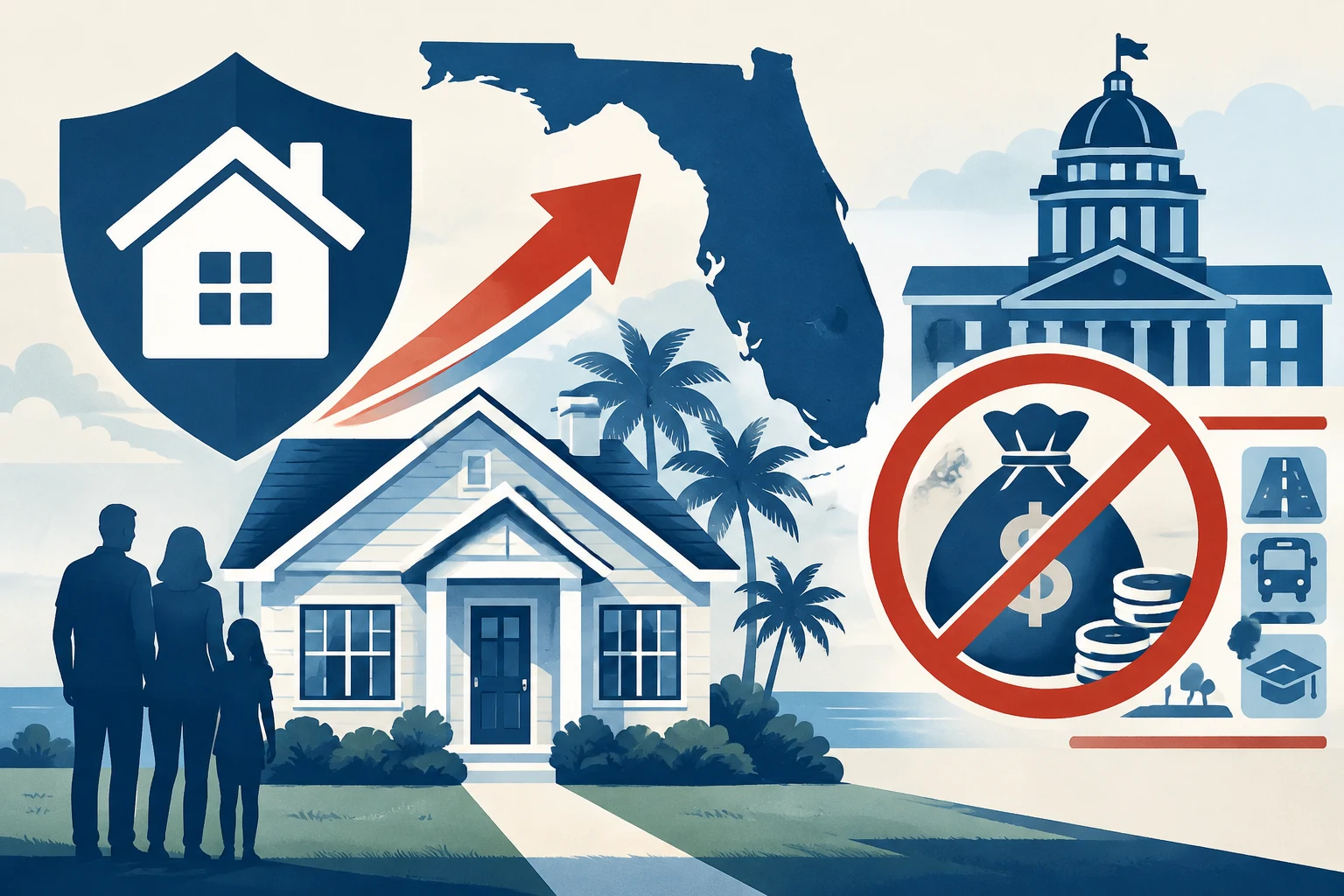
Florida’s Amendment 3 would change homestead property tax exemptions and set limits on how county and municipal governments can use property tax revenue. Voters were set to consider the legislatively referred constitutional amendment in the period leading up to Election Day on Nov. 3, 2026. It requires at least 60% support to pass. If approved, it would take effect Jan. 1, 2027.
The proposal would raise the homestead exemption for non-school property taxes to $150,000 in 2027 and $250,000 in 2028. The threshold would then be adjusted for inflation. It would also reduce the annual cap on increases in assessed value for non-homestead properties from 10% to 5%.
The measure includes a separate timeline for people moving to Florida after Dec. 31, 2026. New residents would have to live in the state for five years to qualify for the increased homestead exemption. During that period, they could receive the existing exemption of up to $50,000.
Amendment 3 would also establish constitutional limits on the uses of property tax revenue by counties and municipalities. Permitted spending would include public safety, infrastructure, natural-resource projects, flood control, local bond obligations and existing debt payments, employee retirement benefits, and local government operations.
The Tax Foundation estimated that the measure could reduce local governments’ property tax revenue by about $4.9 billion in the first year, when the $150,000 exemption would apply. It projected the impact could reach $8.7 billion in the second year, after the exemption rises to $250,000, and $11.8 billion annually starting in tax year 2031. The organization cautioned that the eventual fiscal impact is uncertain and could be higher than those estimates.
The foundation also argued that reducing taxes on homesteaded properties would not eliminate the costs of local services. In its assessment, some of those costs could shift to businesses, renters, new homebuyers and other property owners through taxes, fees or housing costs. It described the proposal as a broad change to local government financing, rather than solely a tax cut.
Gov. Ron DeSantis and many Republican state leaders support the amendment. At a roundtable backing the measure, DeSantis said property tax revenue across Florida’s 67 counties had risen nearly 100% over the previous seven years. He argued local governments could reduce spending, pointing to state budget reductions, and said the proposal would provide tax relief. He also said it could eventually eliminate property taxes for Floridians with homesteaded properties.
The Florida Democratic Party’s state executive committee opposes Amendment 3. Party Chair Nikki Fried said it could harm local communities and services, and criticized the tax benefits as favoring wealthy people and corporations. Fried warned that local governments might raise other taxes or lose funding for services, naming public hospitals, emergency medical response, fire and rescue, disaster preparedness, road maintenance, children’s services, libraries and parks.
The measure therefore presents voters with competing claims: supporters emphasize relief for homeowners, while opponents focus on local budgets and the possibility that costs could be shifted to other taxpayers. The Tax Foundation’s estimates underscore the potential scale of the revenue change, but the group said the full effect remains uncertain.