

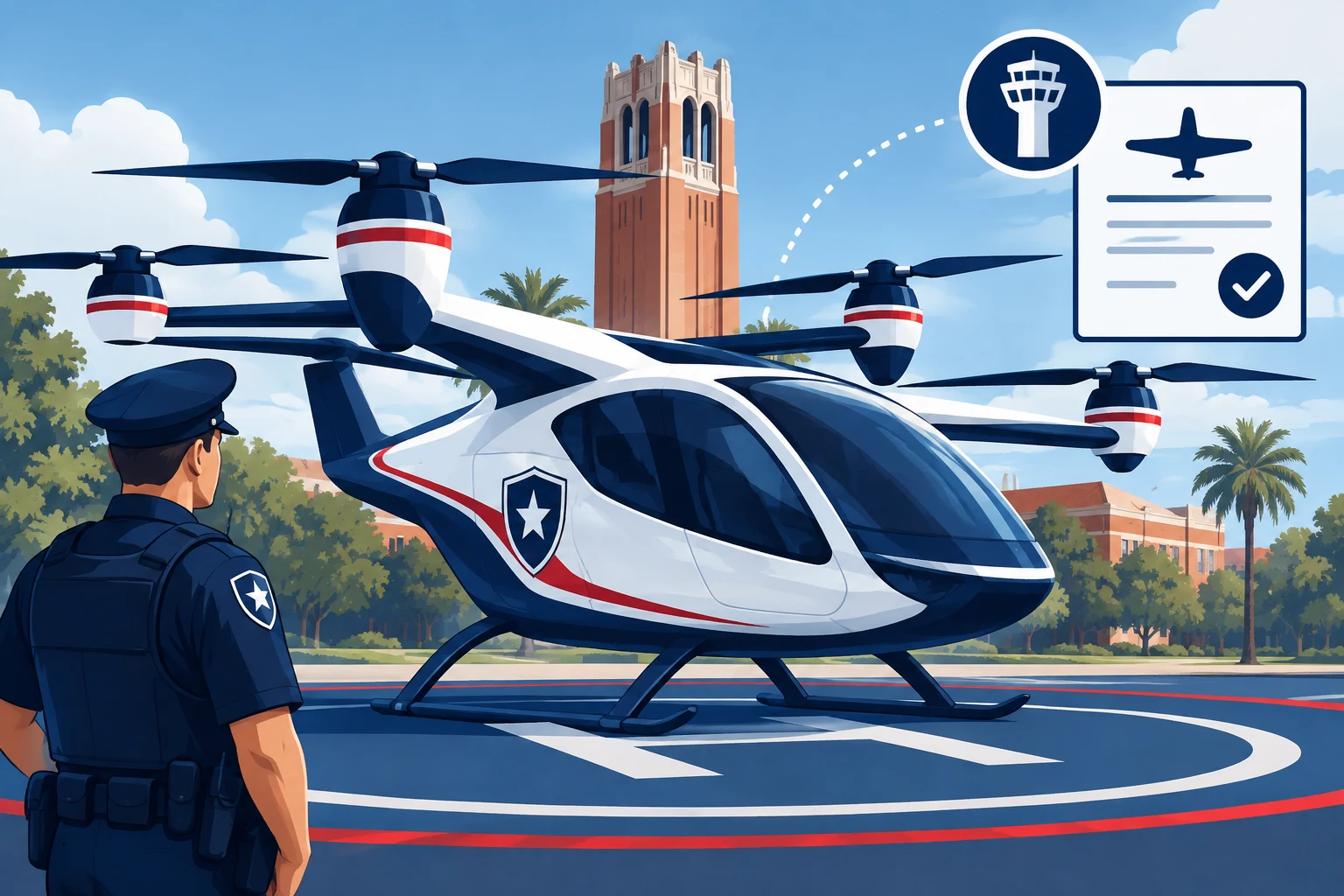
Florida Polytechnic University’s police department in Lakeland has added a single-seat electric aircraft to its fleet, but officers cannot yet use it for regular patrols. The university says the aircraft, called Astro, is the first of its type acquired by a U.S. law enforcement agency. Jetson, its manufacturer, describes it as a world first.
Astro is a Jetson ONE, a compact aircraft powered by eight electric motors and propellers. It can take off and land vertically, so it does not require a runway. Its frame folds for transport and storage, and a four-axis joystick controls its movement. The university received the aircraft in summer 2026, and police personnel, including Chief Aaron Murray, have completed flight training, Jetson said.
The aircraft has police lights, a handheld radio and mounts for action cameras, according to the manufacturer. Jetson says a pilot-controlled searchlight could be added later. The aircraft’s registration number is N911FP, a reference to emergency services and the university, the company said.
Jetson’s published specifications list a top speed of 63 mph and about 20 minutes of flight time per charge. Recharging takes roughly 90 minutes with a 240-volt connection or about three hours using a standard household outlet. Batteries can be swapped between flights, but each flight remains limited by the aircraft’s battery capacity. The company lists a maximum weight of 210 pounds, including the pilot and any gear or supplies. That limit constrains what the aircraft could carry on a mission.
The manufacturer lists safety systems that include the ability to keep flying after one motor fails, automatic landing and an emergency ballistic parachute. Jetson lists the aircraft at $148,000 before taxes and other fees.
University officials are exploring whether Astro could help officers assess areas that are difficult to reach by road, including after storms that leave flooding or debris. Murray said the department wants to evaluate campus monitoring, access to hard-to-reach locations and possible delivery of emergency supplies. The aircraft carries only its pilot, so it cannot transport an injured person. The weight limit also means the quantity of supplies would depend on the pilot’s weight and equipment.
The university plans to work with regional law enforcement agencies on possible emergency-response missions. It also intends to use the aircraft as a research platform for students in its aerospace engineering program, which began in fall 2026. Faculty and students plan to examine flight data for research and senior projects; the source also reports that the university is exploring virtual police-training simulations.
Federal rules remain a key hurdle. Jetson developed the ONE for recreational use under FAA Part 103, which permits qualifying ultralight vehicles to operate without traditional aircraft or pilot certification. But the source material says Part 103 does not allow police patrols or aerial surveying. Jetson says the university needs additional federal authorization under Part 91 for public-safety missions.
When the university announced the aircraft in mid-October, it said the authorization process was in its final stages and anticipated approval in November or December. The university has not publicly confirmed when operational patrols will begin. Astro’s acquisition and training therefore do not amount to approval for police use.
The aircraft’s short flight time and the need to land between battery changes may limit its usefulness for extended missions. Weather and airspace restrictions could also affect flights. The source material notes that the university’s work is separate from a statewide advanced-air-mobility testing effort expected to begin at the SunTrax facility by the end of 2026. That effort does not resolve Astro’s individual authorization requirements.