


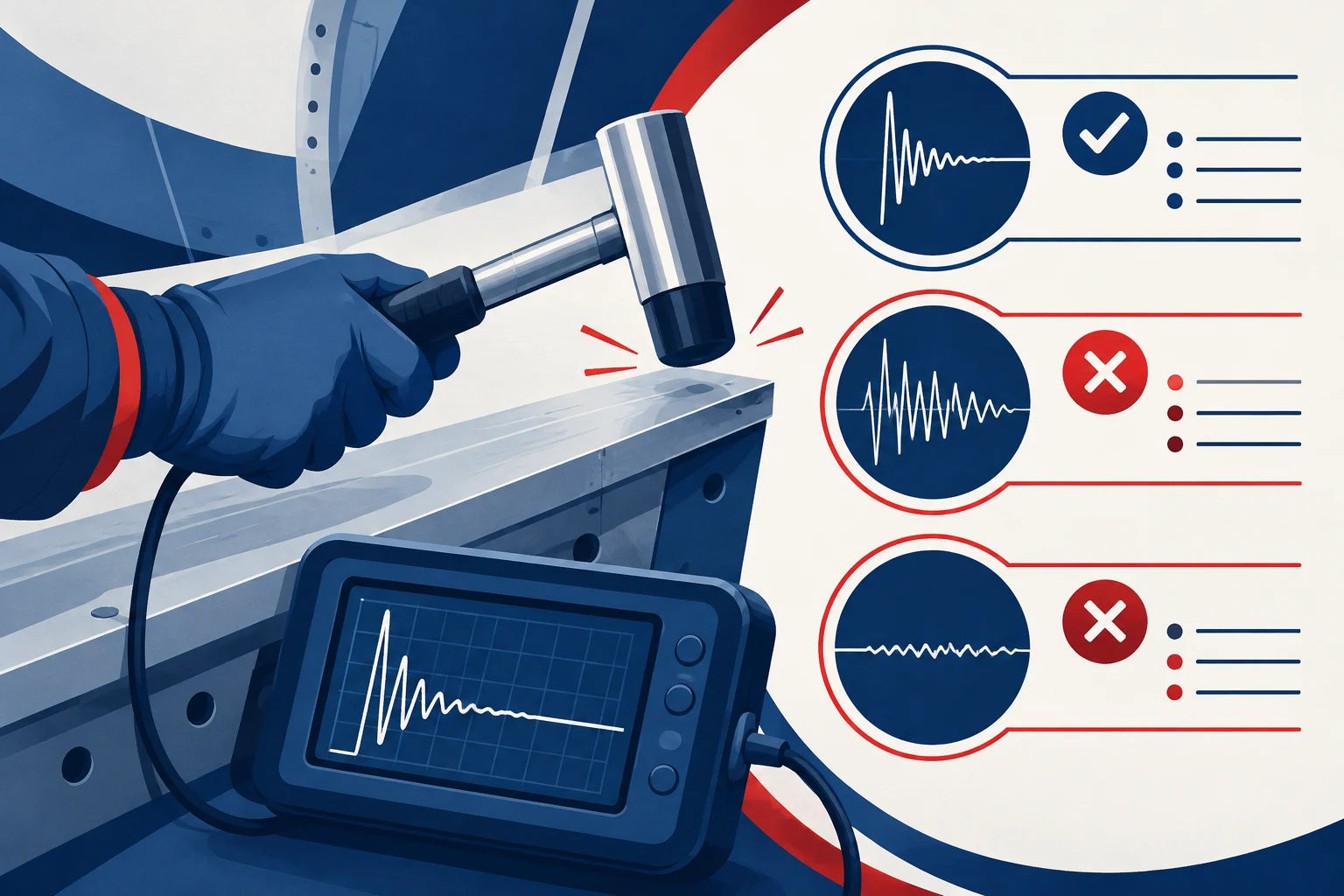
NASA’s Langley Research Center has published technical bulletin TB 26-09, which explains how engineers should assess instrumented hammer-tap tests. The bulletin says a force trace does not have to match an idealized half-sine shape for the test record to be useful. Its suitability depends on the quality and completeness of the measurements and on whether the test covers its stated purpose.
Hammer tests are used in modal analysis and may also be conducted before pyroshock testing, the bulletin says. In such a test, an instrumented hammer applies force to a structure while instruments record the force and the structure’s response. The force may include small ripples at its peak or consist of multiple contacts separated by periods with no applied force.
Those features affect the input to the structure but do not automatically make the record invalid, according to the bulletin. During a gap between contacts, the structure can continue vibrating. A later contact therefore acts on a structure already in motion. The bulletin describes the effects of a known measured force history as predictable for an exact model under matching initial conditions, while noting that an approximate model can respond differently depending on which frequencies, force levels or nonlinear behaviors the input excites.
The bulletin also cautions against judging excitation adequacy by the force trace’s appearance. A finite half-sine pulse contains a range of frequencies, but its spectrum has zeros at certain frequency ratios. The document says the visual shape alone cannot show whether the input adequately excites the structure for the test objective.
Other force histories have their own spectral characteristics. Ripples in the force crest can add frequency content and may fill gaps in the half-sine spectrum. With separate contacts, the time between impacts affects how their contributions combine. For these reasons, NASA advises examining the spectrum of the measured force without normalizing it, as well as the signal-to-noise ratio in the response measurements.
The recommended checks include measuring the full applied force with sufficient bandwidth, calibration, dynamic range and timing synchronization. Response sensors should also have adequate bandwidth and signal-to-noise performance, and their records should not be clipped or saturated. Engineers should then verify that the input covers the frequencies, force amplitudes and nonlinear-response ranges needed for the particular test.
The bulletin recommends rejecting or repeating a test only when a specific shortcoming has been identified in the measurements, excitation or coverage. Its central guidance is that a smooth-looking half-sine does not by itself establish test validity, and a less ideal-looking trace does not by itself demonstrate failure. The relevant question is whether accurate, complete measurements support the intended engineering objective.
The document cites prior work on measured hammer inputs and structural systems, along with references on modal testing, mechanical vibration, nonlinear oscillations and NASA pyroshock test criteria. It lists Joel W. Sills of Langley Research Center as the contact for further information.