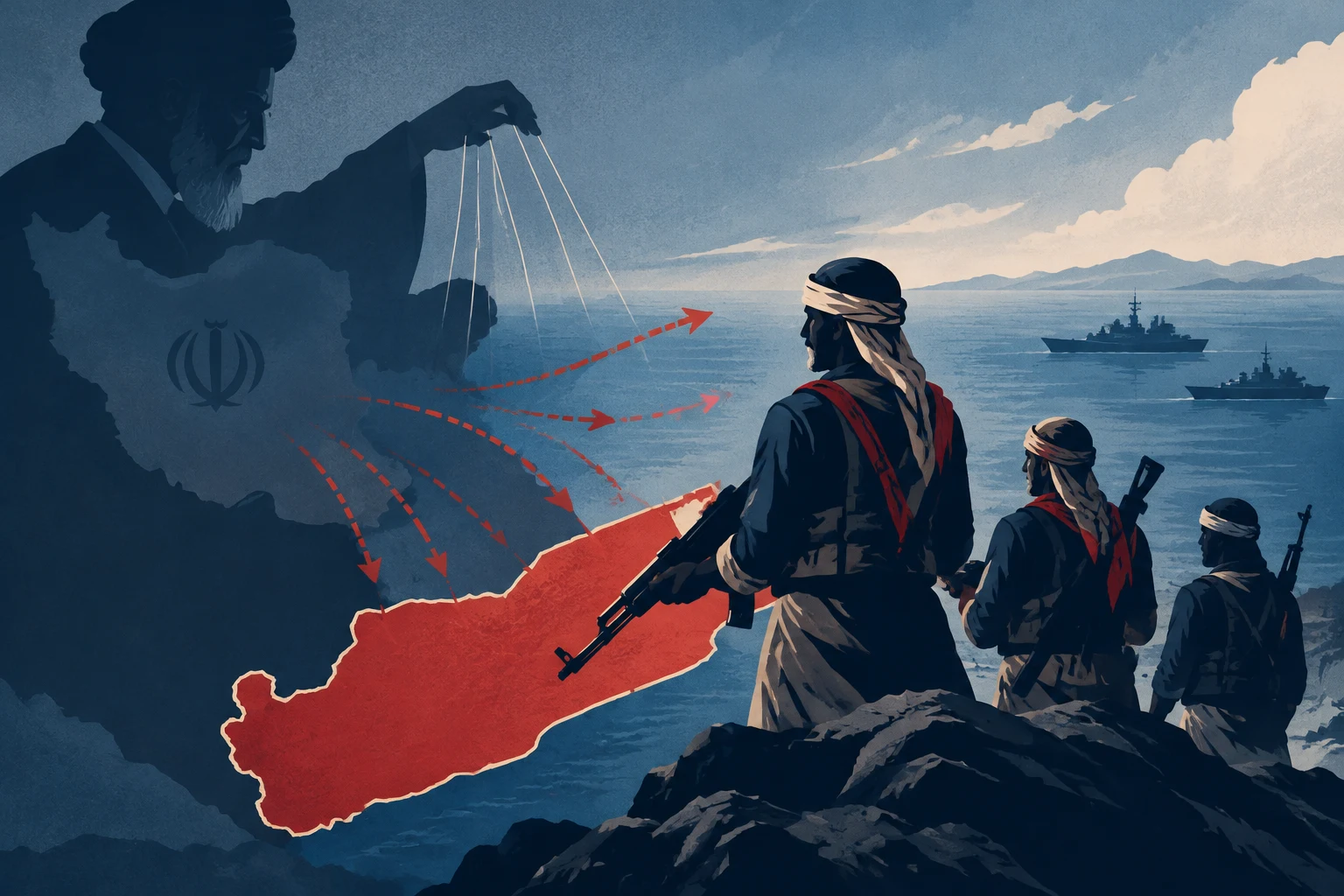
Former U.S. special envoy for Yemen Tim Lenderking warned Thursday that the Houthis have become capable of operating with less dependence on Iran, while retaining a significant relationship with Tehran. He described the group as an international security threat, citing its weapons capabilities, supply networks and attacks beyond Yemen.
The warning followed a series of attacks in Saudi Arabia. Turki al-Maliki, spokesperson for the Saudi-led coalition in Yemen, said at a Thursday news conference in Riyadh that Houthi attacks on King Khalid International Airport killed 17 people and injured 333 between Oct. 7 and Oct. 11. He said the airport had been attacked 20 times since Oct. 1, and that an Oct. 10 incident involved 10 drones, missiles and other projectiles.
Lenderking served as U.S. special envoy for Yemen from 2021 to 2025 and was stationed in Saudi Arabia from 2013 to 2016. He said Saudi officials had warned U.S. leaders more than a decade ago that the Houthis could become a major threat. The movement arose in Yemen during the 1990s; its relationship with Iran developed into a military partnership after 2014, when Tehran expanded assistance and training during Yemen’s civil war.
Lenderking said Iran’s support helped build the Houthis into a powerful force, but argued the group has since established indigenous capabilities. At a Middle East Institute briefing, he said the Houthis can strike targets across the region, including areas near the northern Red Sea. He pointed to the reported precision of the Riyadh airport attack as evidence that the group’s capabilities have grown.
The source cited Associated Press reporting, based on regional officials, that the attack involved drones followed by cruise and ballistic missiles that traveled more than 620 miles to Riyadh. The report said Saudi authorities were investigating possible air-defense failures. Reuters reported that Saudi forces intercepted two further ballistic missiles aimed at Riyadh on Monday, and that a Houthi strike on Tuesday damaged Aramco’s headquarters in Dhahran and started a fire that spread across several floors.
Lenderking said the Houthis can obtain supplies through commercial channels and smuggling networks, and maintain domestic sources of revenue. He cited black-market oil sales, taxes and extortion, as well as forced recruitment, as ways the group sustains its operations. He said these resources could allow it to keep fighting even if Iranian assistance were reduced, while also noting that past Iranian support had provided the group with resources.
Yemen’s government has accused the Houthis of seeking Chinese components for medium-range ballistic missiles. Lenderking warned of a Chinese connection and said front companies had helped the group acquire weapons through commercial channels. Those allegations were presented in the source as claims, not independently established findings.
Lenderking also warned that Saudi pipelines, energy facilities and desalination plants could be targets. He said attacks on such infrastructure could affect energy markets, maritime trade and regional stability. The Houthis’ control of Yemen’s western coastline places them near the Red Sea, a shipping route connecting Europe and Asia.
The source also reported that President Donald Trump was asked whether the United States would defend Saudi Arabia against further attacks and replied, “You’ll find out soon.” It said the Riyadh airport attack raised concerns that Washington could be drawn into a broader regional conflict as Saudi Arabia sought U.S. assistance. The supplied material does not establish what U.S. policy response, if any, followed.