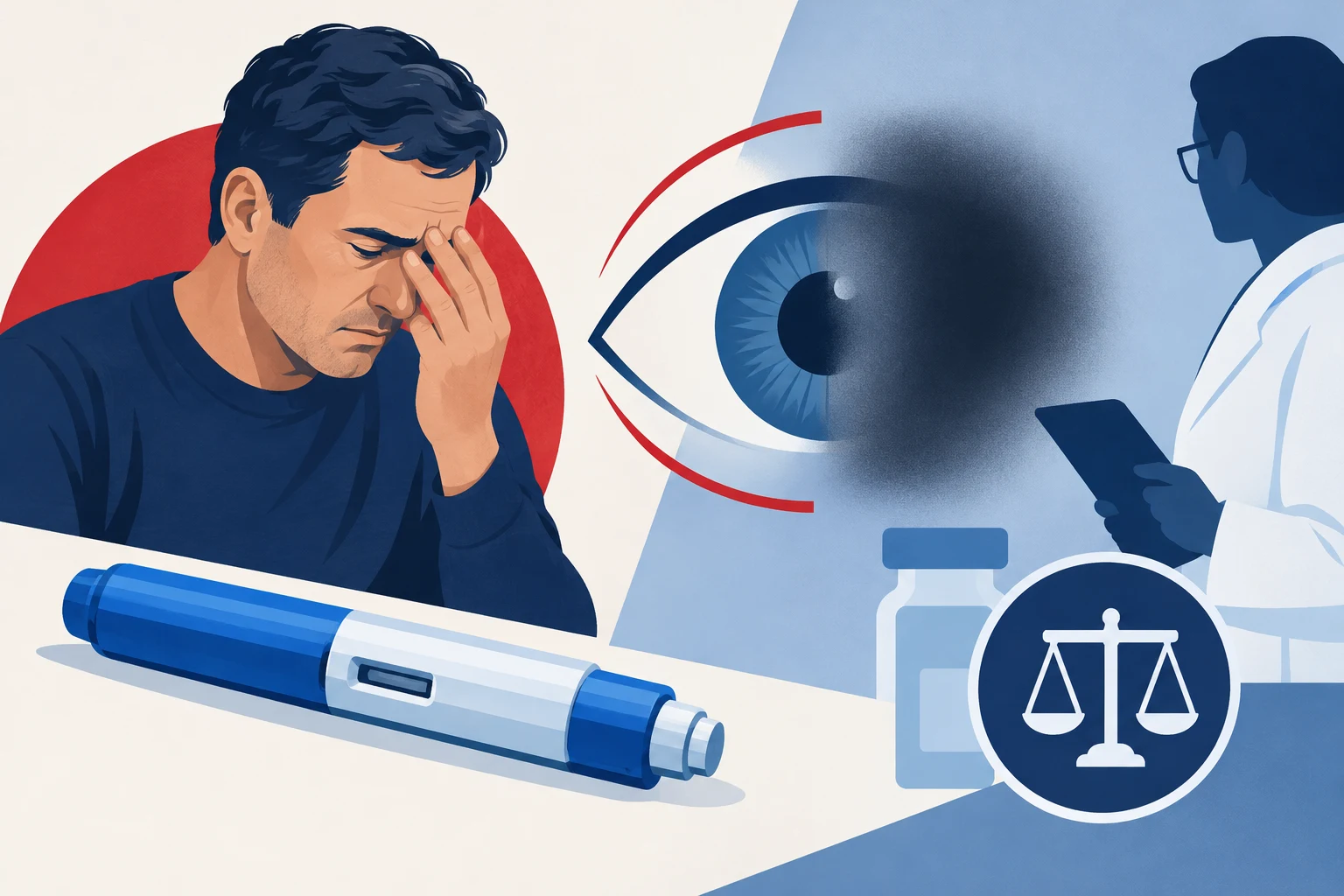
Todd Engel, a Maryland man who says he became legally blind after taking Ozempic, has sued the drug’s manufacturer, Novo Nordisk. His lawsuit alleges that the company failed to adequately warn patients and doctors about a possible risk of vision loss. The reported account does not establish that Ozempic caused his condition, and Novo Nordisk disputes that a causal link has been confirmed.
Engel, 63, said he was prescribed Ozempic in 2023 to help manage type 2 diabetes. The medication contains semaglutide and is approved for treating that condition; it is also prescribed off-label for weight loss. About four months after beginning treatment, he was diagnosed with nonarteritic anterior ischemic optic neuropathy, or NAION, a condition involving reduced blood flow that can damage the optic nerve and result in sudden, lasting vision loss.
Engel told Fox News Digital that on New Year’s Eve in 2024, he realized his right eye had gone dark. He underwent additional testing, including at Johns Hopkins’ Wilmer Eye Institute, and said doctors described the event as an “eye stroke.” He reported that tests showed normal blood work and blood pressure and that he was told he could return to work.
According to the family’s account, Engel and his doctors were not then aware of a possible association between semaglutide and NAION. He continued taking Ozempic. Roughly 10 months later, he said, he suddenly lost vision in his left eye as well. Doctors told him there was no medication or surgery that could restore his sight, according to the report. His wife, Shelley, said testing had not identified another common factor besides Ozempic. Engel stopped using the medication after the second episode.
The vision loss brought major changes to Engel’s work and daily life. He had worked for about four decades as a heavy-equipment operator and truck driver for Howard County Highways and held a commercial driver’s license for nearly as long. He said he could no longer do the mechanical work he had enjoyed or continue his job.
Engel also said he can no longer read books, newspapers or magazines. At home, he navigates familiar areas partly by counting steps; outdoors, he uses a white cane. He said he depends on family members for assistance, including his grandchildren, who guide him at gatherings. Shelley Engel told Fox News Digital that his condition had affected all parts of family life.
The lawsuit is part of legal action by hundreds of patients against manufacturers of GLP-1 medicines, including Ozempic and Wegovy, over alleged links to NAION, according to the source report. The plaintiffs contend that manufacturers did not provide sufficient warnings about potential vision risks. The report emphasizes that a causal relationship between these medicines and NAION has not been definitively established.
The Engels’ attorney, Jonathan Orent, said the legal team is seeking a U.S. Ozempic label warning similar to information provided to patients and doctors in Europe. That is the attorney’s stated position in the litigation, not a finding that the drug caused Engel’s injury.
Novo Nordisk said the totality of available data does not confirm a causal relationship between GLP-1 receptor agonists, including semaglutide, and NAION. The company said an analysis of randomized, placebo-controlled clinical trials identified very few confirmed NAION cases and found no increased incidence among semaglutide users. It also said it monitors NAION through routine drug-safety surveillance and considers the U.S. personal-injury lawsuits without merit, adding that it is defending them in court.
Engel said he would not have taken Ozempic had he known of a possible connection with vision loss. He and his wife said they are speaking publicly to alert others. Their account describes one patient’s experience and the allegations in his lawsuit; it does not resolve whether Ozempic caused his NAION.