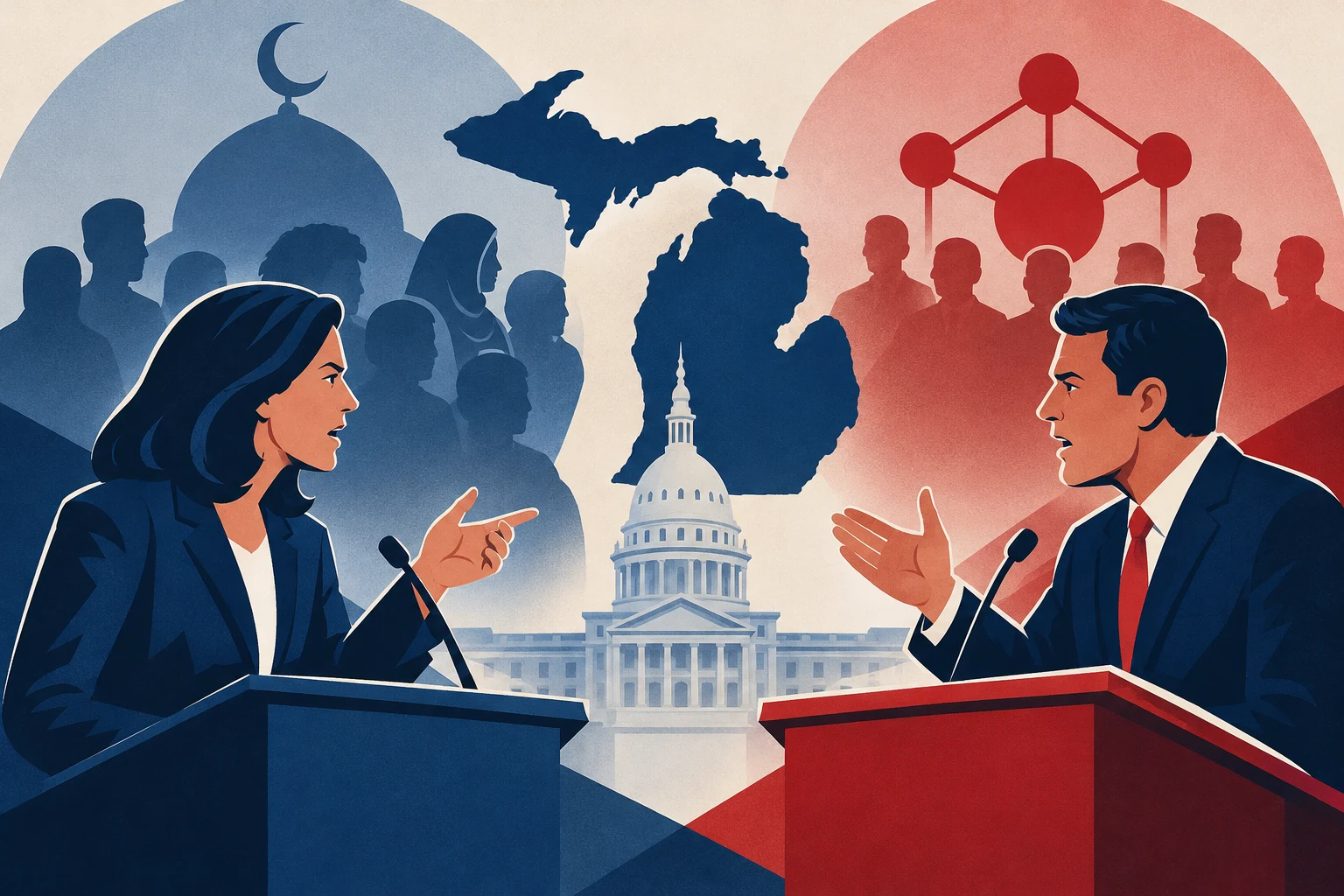
Eleven days before Michigan’s Nov. 3 election, Senate candidates Abdul El-Sayed and Mike Rogers addressed allegations about the Muslim Brotherhood and their policy differences in separate interviews with Fox News anchor Bret Baier in Detroit. The interviews aired Friday on “Special Report,” according to the source report.
Baier asked El-Sayed about a 2012 statement related to former Egyptian President Mohamed Morsi, who was affiliated with the Muslim Brotherhood. El-Sayed objected that the question raised doubts about his loyalty to the United States. He said he would be loyal to the U.S. Constitution and accused Rogers of making his Muslim faith a campaign issue. Baier said he was asking about claims made by Rogers’ campaign; El-Sayed urged him to act as a journalist, and Baier replied that he was doing so.
The report said the dispute partly involves a 2012 letter that The Washington Free Beacon reported El-Sayed signed in support of decisions by Morsi, including calls to remove officials from Egypt’s police and media. El-Sayed has denied having personal or family ties to the Muslim Brotherhood. He has also said he was raised by his father and stepmother, following scrutiny of social media posts by his half-sister describing their mother’s alleged involvement in Brotherhood activism during the 1970s.
The report also referenced an Oct. 17 Fox News interview in which El-Sayed said his sister-in-law was a plaintiff in a lawsuit challenging her alleged placement on a terrorist watchlist. He said she had done nothing wrong. The FBI declined to confirm or deny whether she was on the list, and the lawsuit itself does not establish wrongdoing, the report noted. At an Oct. 17 town hall, El-Sayed explicitly disavowed the Muslim Brotherhood, responding, “Sure. Yeah, absolutely,” when asked whether he did so.
Rogers rejected El-Sayed’s description of the controversy as an attack on his faith. Rogers said his family members had served in the U.S. military and that El-Sayed could pray as he wished, but argued the concern was about his thinking. Rogers alleged that El-Sayed had adopted the Muslim Brotherhood’s ideology. When Baier noted El-Sayed’s denial of membership and his pledge of allegiance to the Constitution, Rogers questioned whether El-Sayed had truly disavowed the organization.
The candidates also disagreed over the war with Iran. El-Sayed linked the conflict to higher gasoline and grocery prices and called for a war powers resolution to stop what he described as an illegal and unjustifiable war. Rogers defended the initial rationale for military action, while saying he had urged President Donald Trump to bring the conflict to an end.
On Michigan’s economy, Rogers said the state had lost 27,000 manufacturing jobs and faced some of the country’s highest auto insurance costs. He also claimed about two-thirds of fourth graders could not read at grade level. Rogers credited Trump’s trade policies with encouraging General Motors to return Silverado pickup production to Michigan, while criticizing the administration’s approach to tariffs on Canada.
Health care was another point of disagreement. El-Sayed said people who wanted private insurance could keep it, while arguing for guaranteed public insurance for everyone. Rogers contended that Medicare-for-all would eliminate private coverage and increase costs for Michigan families.
El-Sayed promoted planned campaign appearances with former President Barack Obama and Sen. Bernie Sanders of Vermont, and questioned whether Trump would help Rogers in Michigan. The report said Trump and Obama were expected to campaign in the state over the weekend as both candidates made their final appeals before Election Day.