
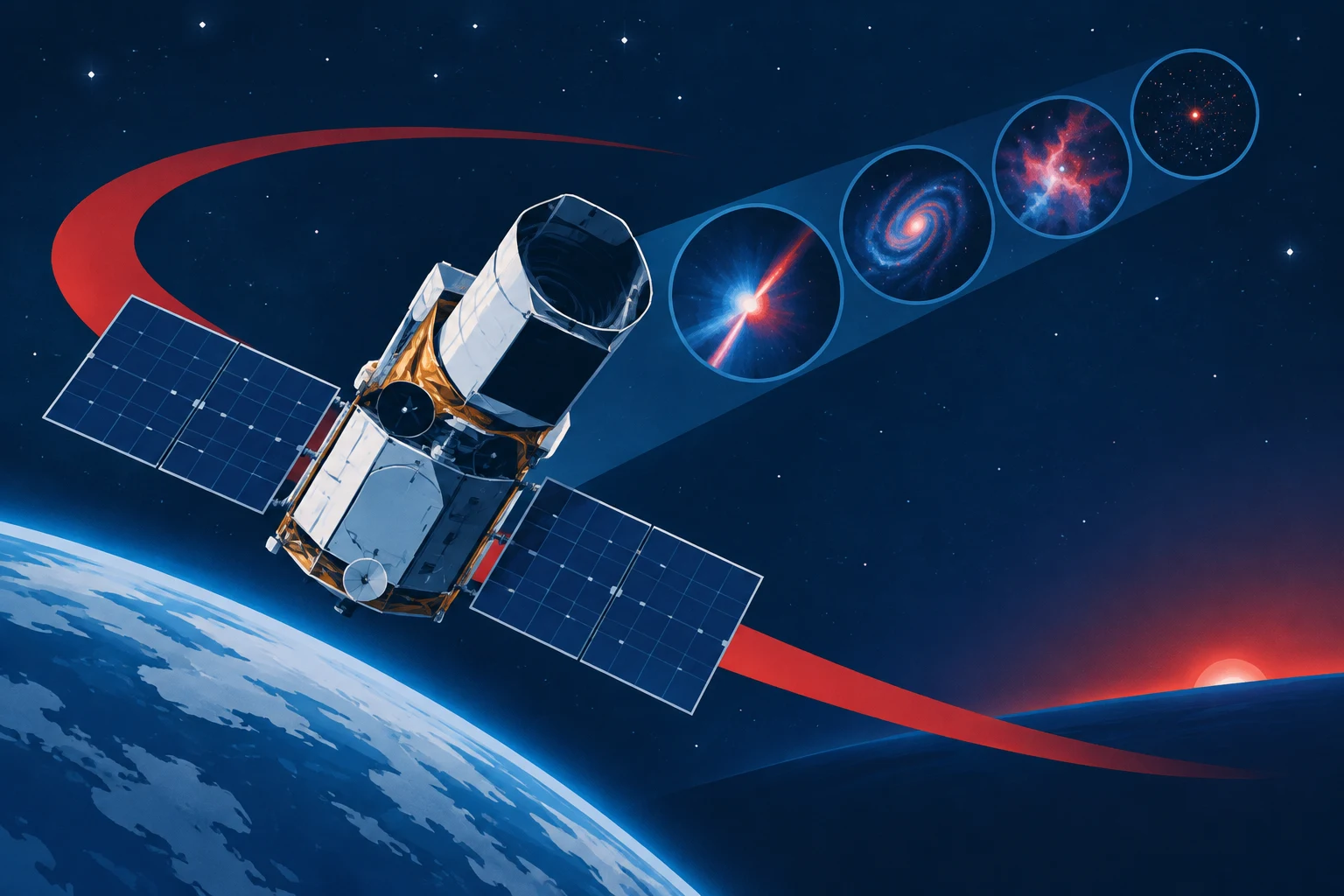
NASA has ended the science operations of its Neil Gehrels Swift Observatory, saying the spacecraft’s orbit has fallen to below 171 miles (275 kilometers) above Earth. At that altitude, atmospheric drag interferes with the steady pointing needed for its telescopes to observe astronomical targets. Swift made its last observation on Oct. 20, 2026, and NASA expects it to re-enter the atmosphere in the coming weeks.
The observatory launched on Nov. 20, 2004, and began operating the following month. Its primary mission was designed to last two years, according to NASA, but the spacecraft continued collecting data for nearly 22 years. The agency renamed it in 2018 to honor Neil Gehrels, its first principal investigator, after his death.
Swift was built to detect gamma-ray bursts, brief and powerful cosmic explosions, determine their locations and quickly turn its instruments toward them. Mission principal investigator S. Bradley Cenko, of NASA’s Goddard Space Flight Center, said the observatory could typically locate an event, alert other observatories and begin imaging its position in about a minute. That speed allowed scientists to study the bursts’ afterglows before they faded.
The observatory’s rapid response was particularly important for short gamma-ray bursts, which can reach peak brightness in less than two seconds. NASA cites a May 2005 observation of GRB 050509B, a burst lasting 0.03 seconds, as a milestone. Swift detected 11 X-ray photons from its afterglow, marking the first such detection for a short burst. The observations supported models linking short gamma-ray bursts to the merger of two neutron stars, extremely dense objects.
Swift’s work extended well beyond gamma-ray bursts. NASA reports that it observed more than 2,000 of those events and studied over 1,400 supernova explosions. It also observed stars being torn apart by black holes, monitored active galaxies, completed an all-sky X-ray survey, and studied asteroids and comets. The agency says Swift data has contributed to about 7,000 published scientific papers.
A flexible scheduling system helped make the observatory useful for a wide range of research. Astronomers could request observations of newly detected events or arrange monitoring of selected objects, with programs ranging from minutes to months. NASA says the system could schedule as many as 75 independent targets per day.
The mission’s publicly available archive contains nearly 22 years of brightness measurements and multiwavelength spectra, as well as more than 1.5 million images from its Ultraviolet/Optical Telescope. NASA puts the archive at approximately 12 terabytes. Shawn Domagal-Goldman, director of NASA’s Astrophysics Division, said the data could support discoveries for decades. He also said the agency is exploring ways to respond quickly to future cosmic events, including making use of existing space telescopes and considering new mission approaches.
NASA says it will continue prioritizing options for rapid observations, using current missions to help address the gap after Swift’s science operations end. The agency’s announcement does not specify a date for the spacecraft’s atmospheric re-entry, only that it is expected within the next few weeks.