

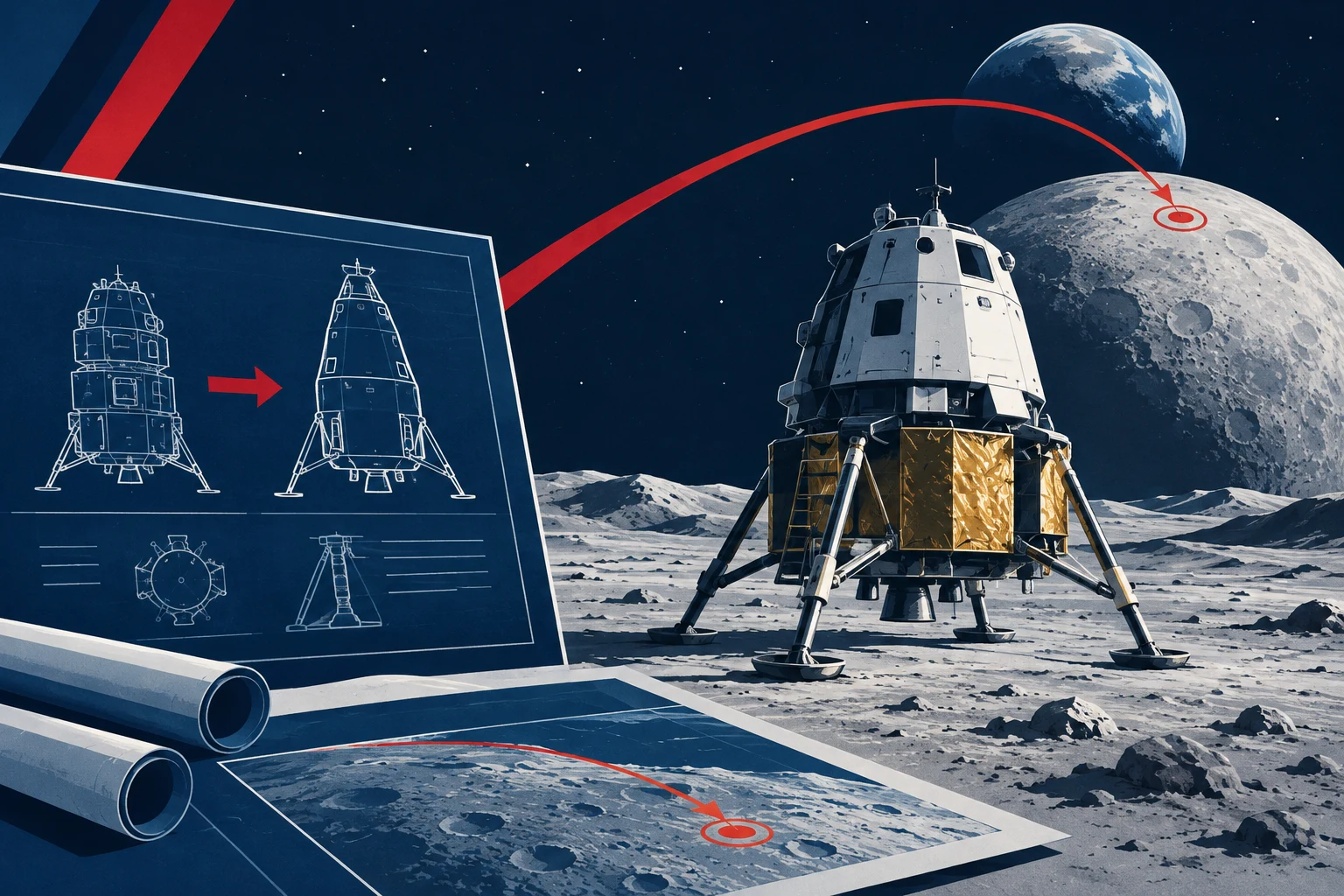
NASA says it has revised plans for its Artemis human landing systems, with Blue Origin and SpaceX developing different mission approaches as the agency works toward returning astronauts to the lunar surface in 2028. The agency’s account, published Oct. 23, 2026, says Artemis III will demonstrate rendezvous and docking between test versions of both companies’ landers and NASA’s Orion spacecraft in low Earth orbit next year.
The change shifts the initial lander-Orion meeting away from a planned orbit around the Moon. NASA says the companies’ systems will use different lunar orbits suited to their designs. Both providers must complete an uncrewed demonstration before their landers can carry astronauts, and NASA will certify each system before crewed use.
For crewed missions, astronauts will launch aboard Orion on the Space Launch System rocket from Kennedy Space Center in Florida. A commercial lander is expected to connect with Orion, carry two astronauts to the lunar surface, and return them to Orion; two other crew members will remain aboard the spacecraft, according to NASA.
SpaceX’s plan relies on assembling propellant in low Earth orbit. The company intends to launch Starship vehicles that will transfer cryogenic fuel to an orbiting depot before the Starship Human Landing System launches from Florida. Under the revised plan, the lander would meet Orion in Earth orbit. The combined spacecraft would then travel toward the Moon after a maneuver by Starship, with NASA working on Orion modifications to enable the lander to push it. Two astronauts would descend to the surface for several days and later return to Orion.
NASA says conducting that departure maneuver with Starship and using low lunar orbit could reduce the propellant Starship needs to accumulate and shorten the time for astronauts to reconnect with Orion after leaving the surface. SpaceX is expected to test its propellant-aggregation method during its uncrewed demonstration.
Blue Origin’s accelerated plan for a 2028 crewed mission postpones propellant transfer. Instead, three transfer stages would carry its Blue Moon Mark 2 Alpha lander toward the Moon. The stages and lander would launch separately to low Earth orbit, dock, and depart together for an elliptical polar lunar orbit. The stages would separate as their fuel is used.
NASA says this orbit, compared with the previously planned near-rectilinear halo orbit, could allow a quicker return from the surface to Orion, reduce lander propellant needs, and make use of SLS performance. The planned sequence has Orion and its crew meet the lander in elliptical polar orbit; two astronauts would descend to the lunar South Pole and return to Orion after surface work. Blue Origin plans an uncrewed demonstration of the transfer-stage mission profile and says it will draw on robotic Mark 1 mission experience.
NASA Administrator Jared Isaacman said the agency is working toward the 2028 return and a longer-term lunar presence. NASA’s Artemis program manager, Jeremy Parsons, said revised contracts align provider requirements and milestones with the agency’s updated mission architecture. The agency says both companies added development milestones intended to improve NASA’s visibility into progress and support crew safety. SpaceX is adding two crew-cabin demonstrations, while Blue Origin is adding human-in-the-loop tests and hardware-readiness milestones.
NASA will decide which company is ready to carry the first crewed landing in 2028; the other provider could have a later opportunity. The agency says initial surface missions are expected to include two moonwalks of about two hours each, with astronauts collecting samples and testing spacesuits supplied by Axiom Space. The original contract assignments had placed SpaceX on Artemis III and IV and Blue Origin on Artemis V. NASA says those assignments have been realigned: both companies are involved in Artemis III’s Earth-orbit test, and neither is currently assigned to a specific lunar landing mission.