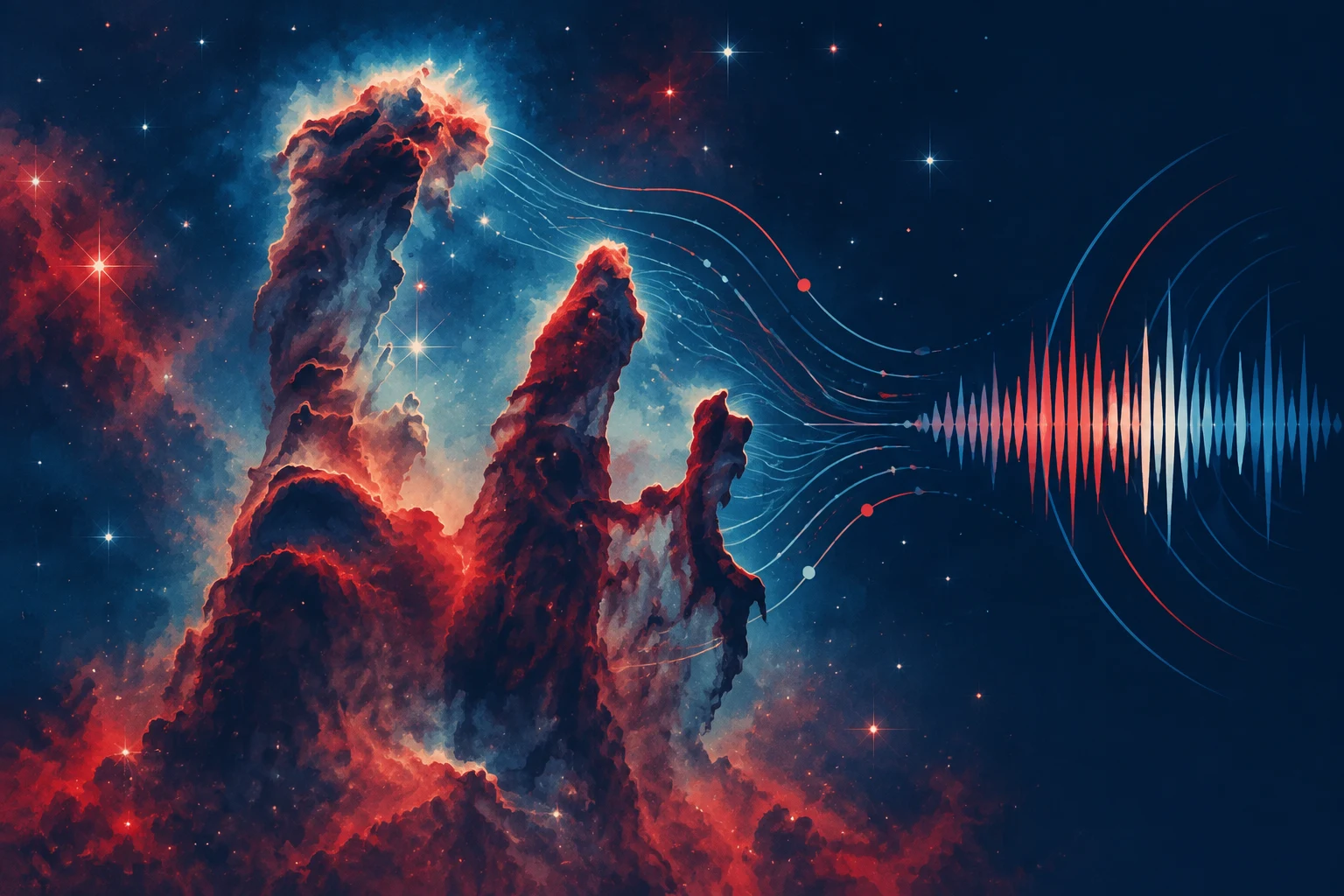
NASA’s Astronomy Picture of the Day on Oct. 18, 2026, presented a sonified view of the Eagle Nebula’s pillars, inviting audiences to experience the astronomical image through sound as well as sight.
The featured image combines visible-light observations from the Hubble Space Telescope with X-ray data from the Chandra X-ray Observatory. NASA’s accompanying explanation identifies the object as M16, also known as the Eagle Nebula, and places it about 6,500 light-years from Earth in the direction of Serpens, the Serpent constellation.
The image shows young, bright stars forming within towering structures of dark gas and dust. The columns extend for light-years, according to NASA. The agency explains that ultraviolet radiation and powerful winds from a cluster of massive stars are eroding and shaping the pillars. It describes their eventual destruction as part of that process.
The video translates features in the image into sound. As the sonification line moves from left to right across the picture, the vertical location of a feature determines its pitch. NASA’s caption invites listeners to pay attention to sounds associated with stars and dust. The source does not provide additional technical details about the audio’s production or how individual objects are assigned particular sounds.
NASA also points to the nebula’s active star-forming environment as a possible parallel to the conditions in which the Sun formed. The explanation characterizes the setting as likely similar, rather than asserting that the Eagle Nebula reproduces the Sun’s precise origins.
The image credit names NASA, the European Space Agency and the Hubble Heritage Project, associated with the Space Telescope Science Institute and the Association of Universities for Research in Astronomy. The sonification credit lists NASA, the Chandra X-ray Center, the Smithsonian Astrophysical Observatory, and K. Arcand, M. Russo and A. Santaguida. The Oct. 18 entry lists Robert Nemiroff, Jerry Bonnell, Cecilia Chirenti and Keighley Rockcliffe as authors and editors.
NASA’s Astronomy Picture of the Day features a different image or photograph each day with an explanation written by a professional astronomer, according to the page. The Oct. 18 feature was one entry in that ongoing series.