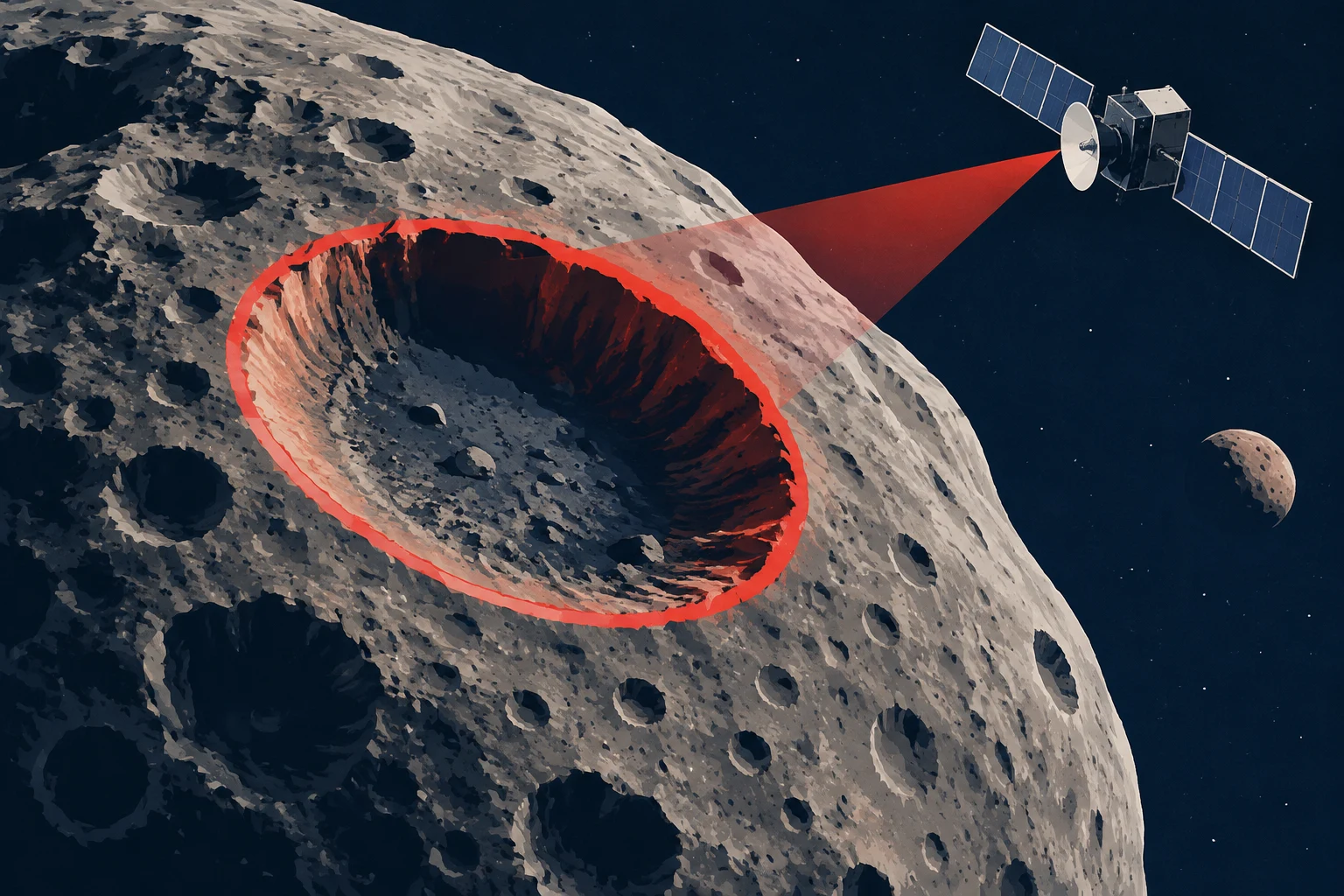
NASA’s Astronomy Picture of the Day featured Stickney Crater on Phobos on October 9, 2026, sharing an enhanced-color image taken by the HiRISE camera aboard the Mars Reconnaissance Orbiter in March 2008.
Stickney is more than 9 kilometers across and spans nearly half the diameter of Phobos, according to NASA’s explanation. The crater is named after Chloe Angeline Stickney Hall, a mathematician and the wife of astronomer Asaph Hall. He discovered Phobos and Deimos, Mars’ two moons, in 1877.
NASA said the impact that formed Stickney may have come close to breaking apart the small moon. The image also shows streaks that suggest loose material has moved down the crater’s walls, despite Phobos having less than one-thousandth of Earth’s surface gravity.
The explanation notes that pale blue areas near the crater rim may mark relatively fresh exposures of the surface. The grooves visible across Phobos remain unexplained; they may be connected to tidal stresses on the moon or to the impact that created Stickney, NASA said.
The Mars Reconnaissance Orbiter captured the image while passing about 6,000 kilometers from Phobos. NASA’s daily astronomy feature presents a different space image or photograph with an accompanying explanation.