

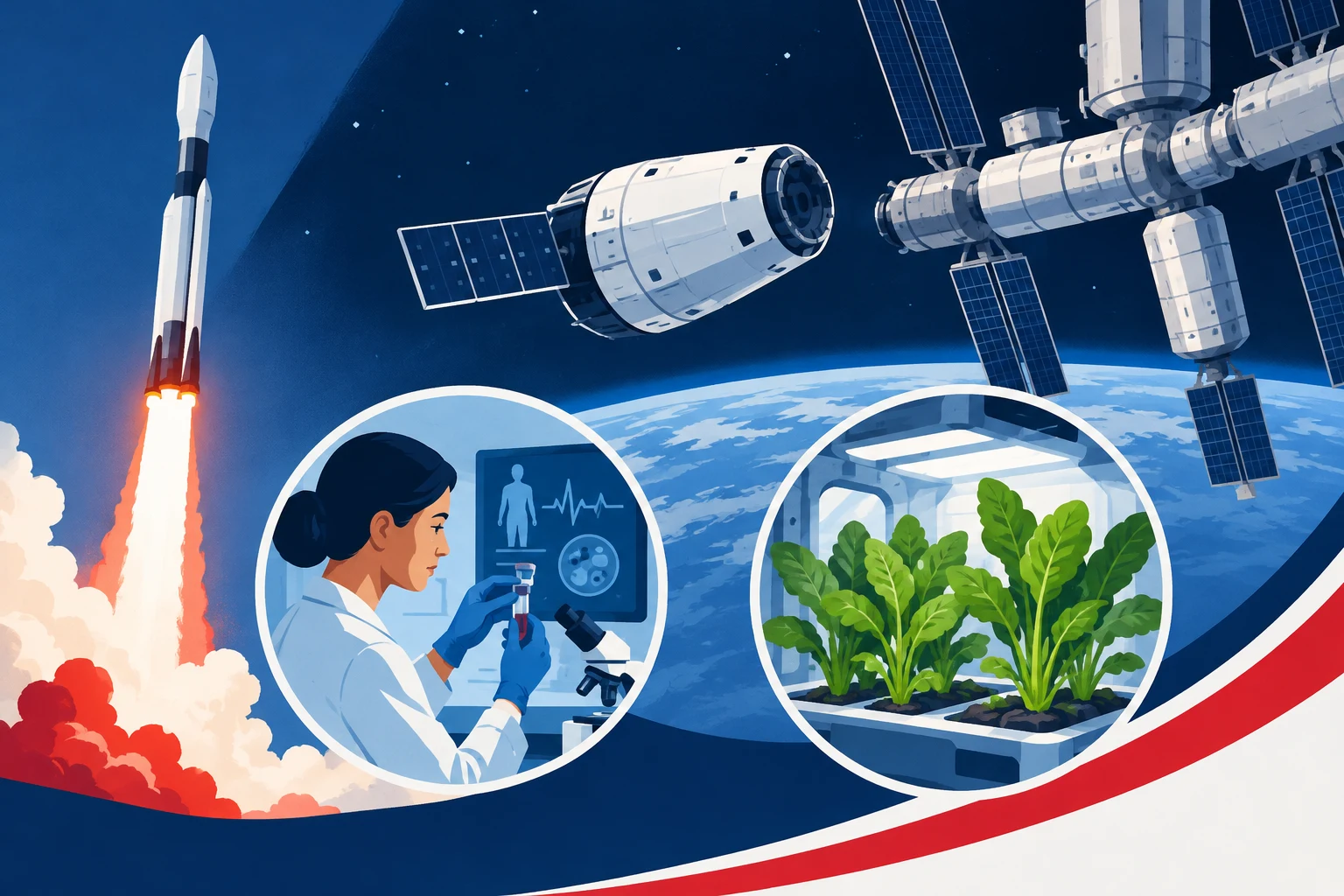
NASA said Oct. 12, 2026, that four investigations focused on health and agriculture are scheduled to fly to the International Space Station aboard SpaceX’s 35th Commercial Resupply Services mission from Cape Canaveral Space Force Station in Florida.
One study will send lab-grown human brain tissue models to the station for five weeks. Researchers plan to compare them with matching models kept on Earth to examine cellular effects of short-term spaceflight.
Another experiment will study whether a fungus that causes crop disease behaves differently in microgravity. It will compare infected plants grown in space with those grown on Earth. NASA says the results could inform efforts to develop disease-resistant crops and support future space agriculture.
The cargo also includes a test of a compact microplate reader previously delivered to the station. The device will be evaluated for its ability to measure biomarkers, including antibodies, antigens and proteins. NASA says conducting such analyses in orbit could provide researchers with results sooner than waiting for samples to return to Earth.
A fourth investigation, making its final planned stay aboard the station, will examine antibiotic-resistant bacteria in microgravity. Astronauts will take repeated surface samples around the station to monitor for drug-resistant organisms.
NASA describes the work as part of research intended to support astronaut health on extended missions, while some findings may also have relevance to crop production and health research on Earth. The agency’s announcement outlines planned investigations and potential benefits; it does not report results from the experiments.