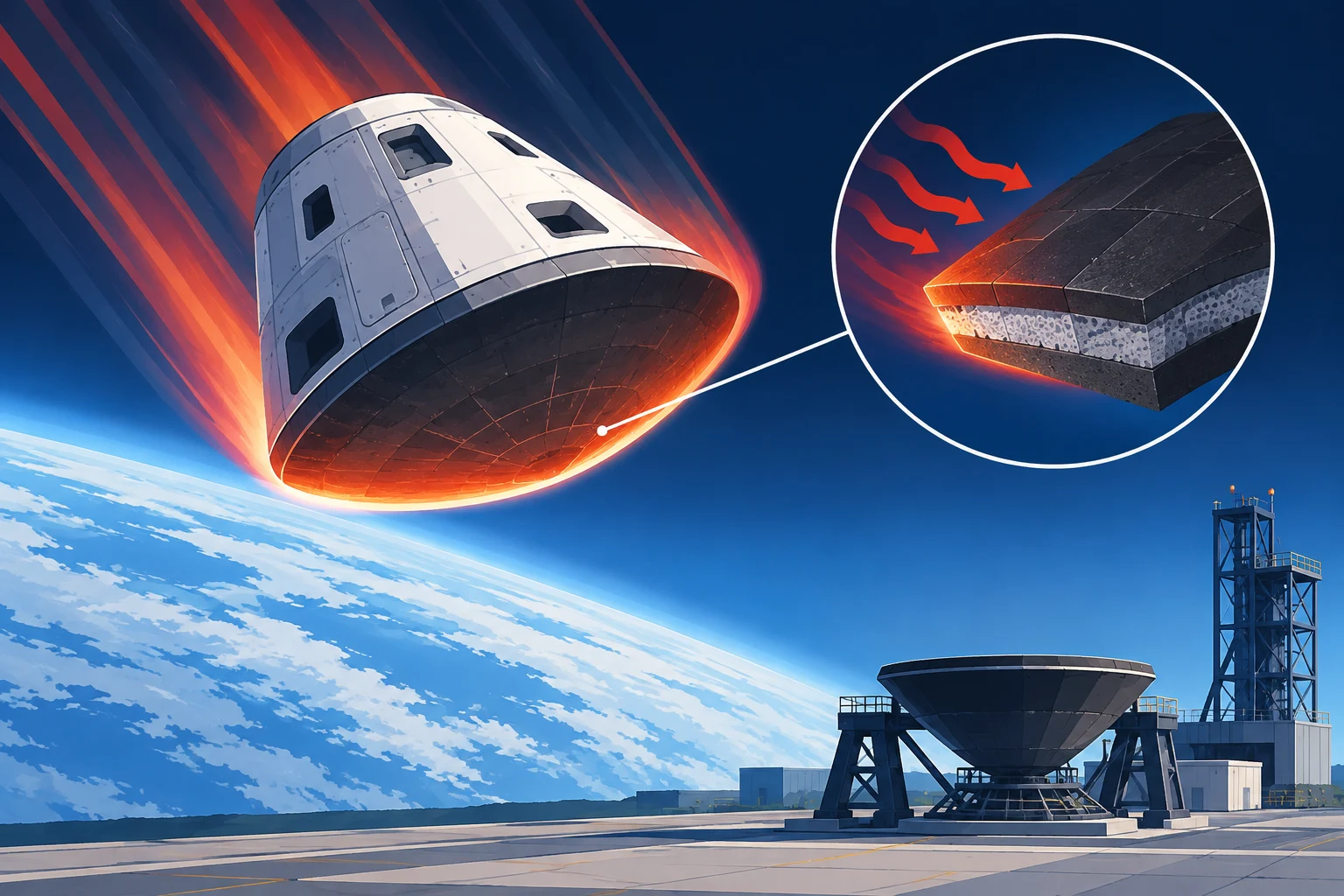
NASA reported Oct. 9, 2026, that 12 small experimental capsules were carried aboard Northrop Grumman’s 24th cargo resupply mission after it departed the International Space Station. The capsules are part of the Kentucky Reentry Probe Experiment, known as KREPE-3, which uses the cargo vehicle’s return trip to gather data on heat-shield technologies.
NASA says the capsules, designed by University of Kentucky students, contain sensors to measure conditions including temperature, pressure and motion during re-entry. The agency said they are expected to separate from the spacecraft as it breaks apart in Earth’s atmosphere, then transmit measurements to researchers by satellite. The source describes the mission’s intended data collection; it does not report the experiment’s results.
The capsules carry a range of protective materials and designs. These include ceramic tile material used on the space shuttle, a 3D-printed heat shield developed through work involving NASA’s Johnson Space Center and Oak Ridge National Laboratory, and flexible layered materials being studied by NASA Ames. Other tests examine a dual-cone design, an aeroshell shape relevant to NASA’s Dragonfly mission to Saturn’s moon Titan, and a deployable shield concept.
NASA describes KREPE-3 as a collaboration involving the University of Kentucky, the state of Kentucky, NASA’s EPSCoR program, NASA centers and other partners. The project is the third in a series of experiments using the final flight of cargo spacecraft to obtain low-cost research data, according to the agency.
The tests are aimed at informing future heat-shield development for missions, including potential trips to the Moon and Mars. NASA materials engineer Keith Peterson said the approach provides a way to obtain flight data on materials still under development.