
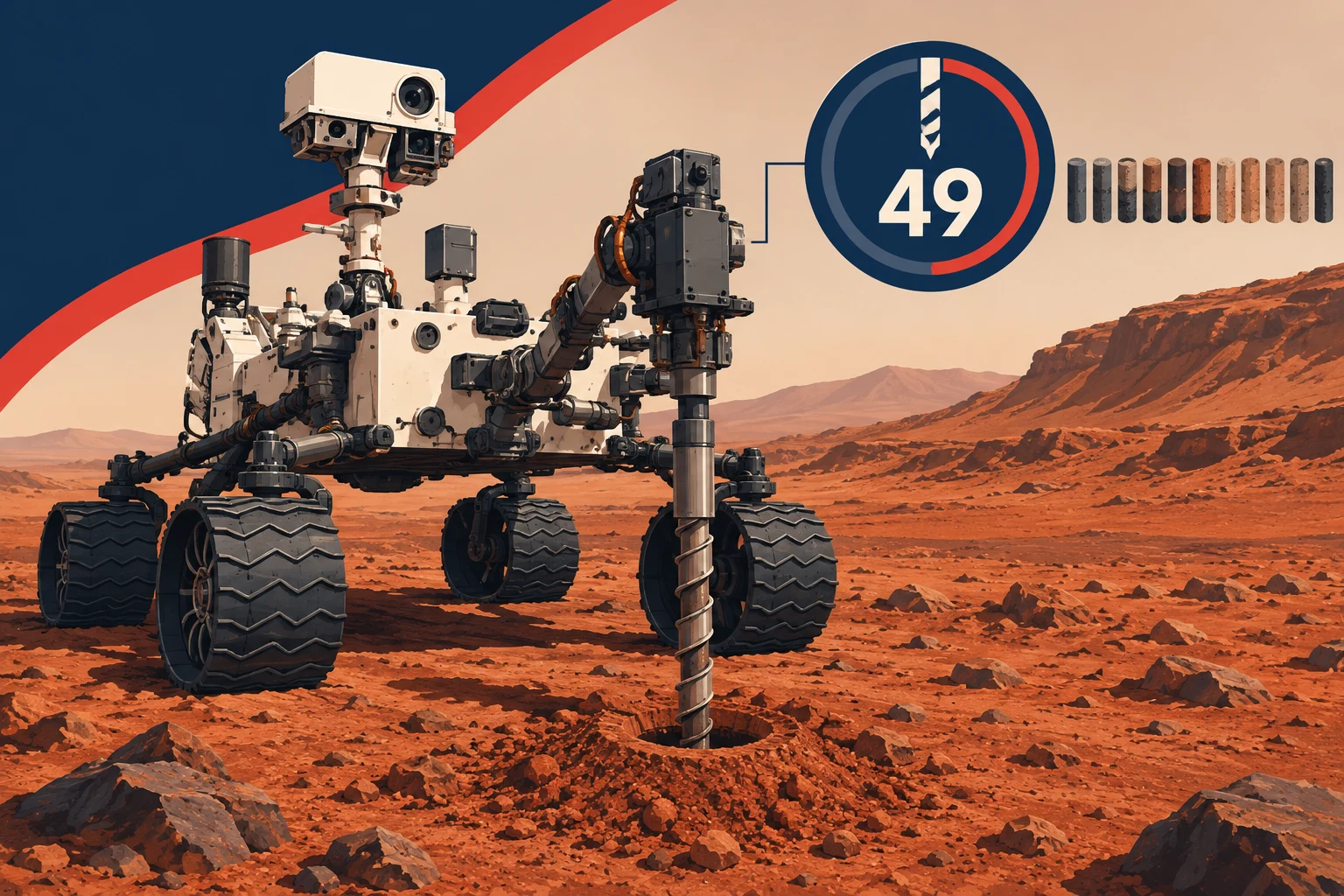
NASA’s Curiosity rover completed its 49th rock-drilling operation at a target called Nazca, according to a mission update written by planetary mineralogist Susanne P. Schwenzer of The Open University. The blog describes planning for rover activity from Oct. 23, 2026, and identifies the drilling as part of an investigation into disc-shaped features in rocks at the site.
The science team returned to the area because those features could be crystals, Schwenzer wrote. If that interpretation is correct, comparisons with crystals on Earth may help scientists assess the environmental conditions in which the rocks formed. The blog presents the crystal identification as a possibility, not a confirmed finding.
Before extending Curiosity’s robotic arm, the team confirmed that the rover was stable on the ground. It also carried out a preload test to assess the rock’s stability and the forces on the arm as the drill pressed into the surface. The team reported passing both checks before drilling the Nazca block.
The campaign included measurements both before and after the drill operation. Before drilling, the rover examined Nazca with three instruments: APXS, MAHLI and ChemCam. Afterward, it delivered collected material to CheMin, an instrument used to examine mineral composition. The blog said the analysis results were still being transmitted from Mars and were expected to arrive over the following weekend. It did not provide results.
ChemCam also examined the drill cuttings, known as tailings, using passive spectral observations and active laser-induced breakdown spectroscopy, or LIBS. Another LIBS measurement was taken along the wall inside the drill hole.
The rover team continued studying dark pebbles in the area. ChemCam took a LIBS measurement of a pebble named Palpala. Schwenzer said the pebbles do not all appear to have the same composition, and the team is measuring accessible examples to investigate their origins. The blog notes that a pebble must be large enough for this work because a smaller one could shift when struck by the instrument’s laser.
A second pebble, Puna, was selected for measurement during Friday’s planning. The team also planned a LIBS depth profile at a target called Llama, intended to check whether an earlier observation of variation with depth is consistent at another location.
At Pacaya, ChemCam was slated to investigate another example of the disc-shaped features that prompted the rover’s return to the region. The plan also included long-distance images from ChemCam’s Remote Micro-Imager, focused on two buttes, Mishe Mokwa and Cordillera. Schwenzer said the formations have attracted the team’s interest because of the sedimentary structures and textures visible there.
The update documents a sequence of planned and completed rover investigations, but it does not report the CheMin findings or establish whether the disc-shaped features are crystals. The sample analysis was still pending at the time of publication.