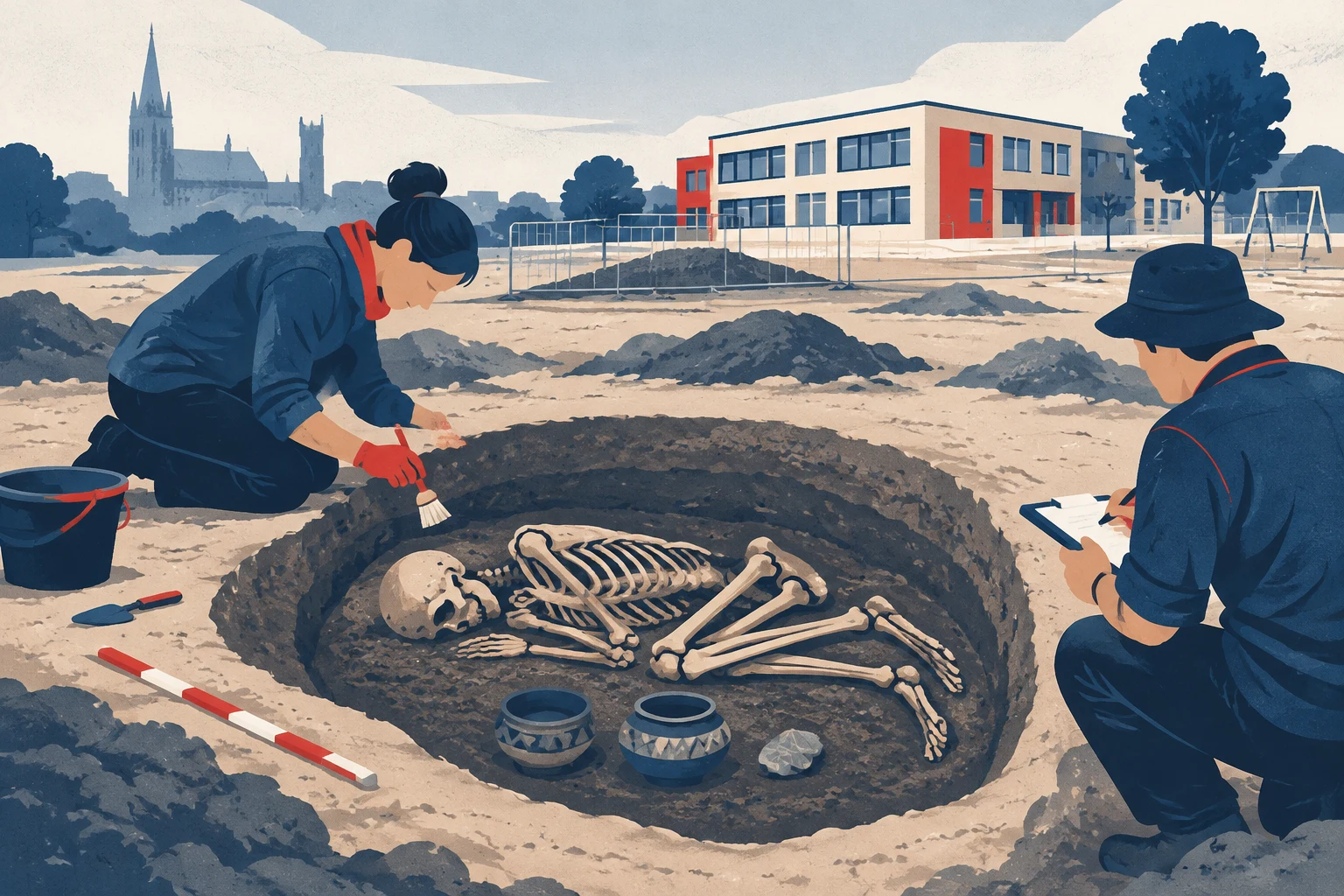
Archaeologists excavating land designated for an elementary school in Leipzig, Germany, found a burial estimated to date back roughly 7,000 years, according to the Saxony State Office for Archaeology. The agency announced the discovery in late September and described it as the oldest known grave found within Leipzig’s city limits.
Archaeological work began before construction because the site is near a previously identified Bronze Age location. Officials also said the ground’s position near the White Elster River, in the fertile Leipzig Lowland Basin, made prehistoric remains likely. The area is above flood levels and has yielded archaeological finds, according to the agency.
Rather than isolated objects, the excavation revealed remains of a Neolithic settlement. Among the finds was a wooden house measuring about 98 feet long, along with evidence of at least two additional houses. The burial was an unexpected element of the settlement, officials said.
The person’s sex and age at death have not been determined. The skeleton was lying on its left side, with the legs bent toward the body. No grave goods were found. Archaeologists dated the burial by considering the body’s position and the grave’s stratigraphic relationship to the settlement and one of its houses, the state office said.
Officials attributed the burial to the Linear Pottery culture, named for the characteristic spiral and wavy designs on pottery associated with the group. The grave dates to a period when communities were moving away from hunting and gathering toward permanent settlement, farming and livestock raising, according to the agency.
The discovery is notable because bone preservation is poor in many parts of Saxony. Officials said graves in those areas can sometimes be recognized only through burial pits or objects placed with the dead. In Leipzig, the skeleton itself was preserved well enough to help identify the burial and its position.
The excavation was expected to continue until mid-October, after which the state archaeology office planned to begin scientific analysis. State archaeologist Regina Smolnik said the work illustrates why archaeological investigations remain important in built-up areas. She noted that evidence of early settlement may still survive beneath places that have been incorporated into cities and developed over time.
The source report also referenced other European burial discoveries: an 11th-century grave in Poland that archaeologists said had been reopened in the medieval period, and Roman-era graves found beneath Zadar, Croatia. Those sites are separate from the Leipzig excavation.