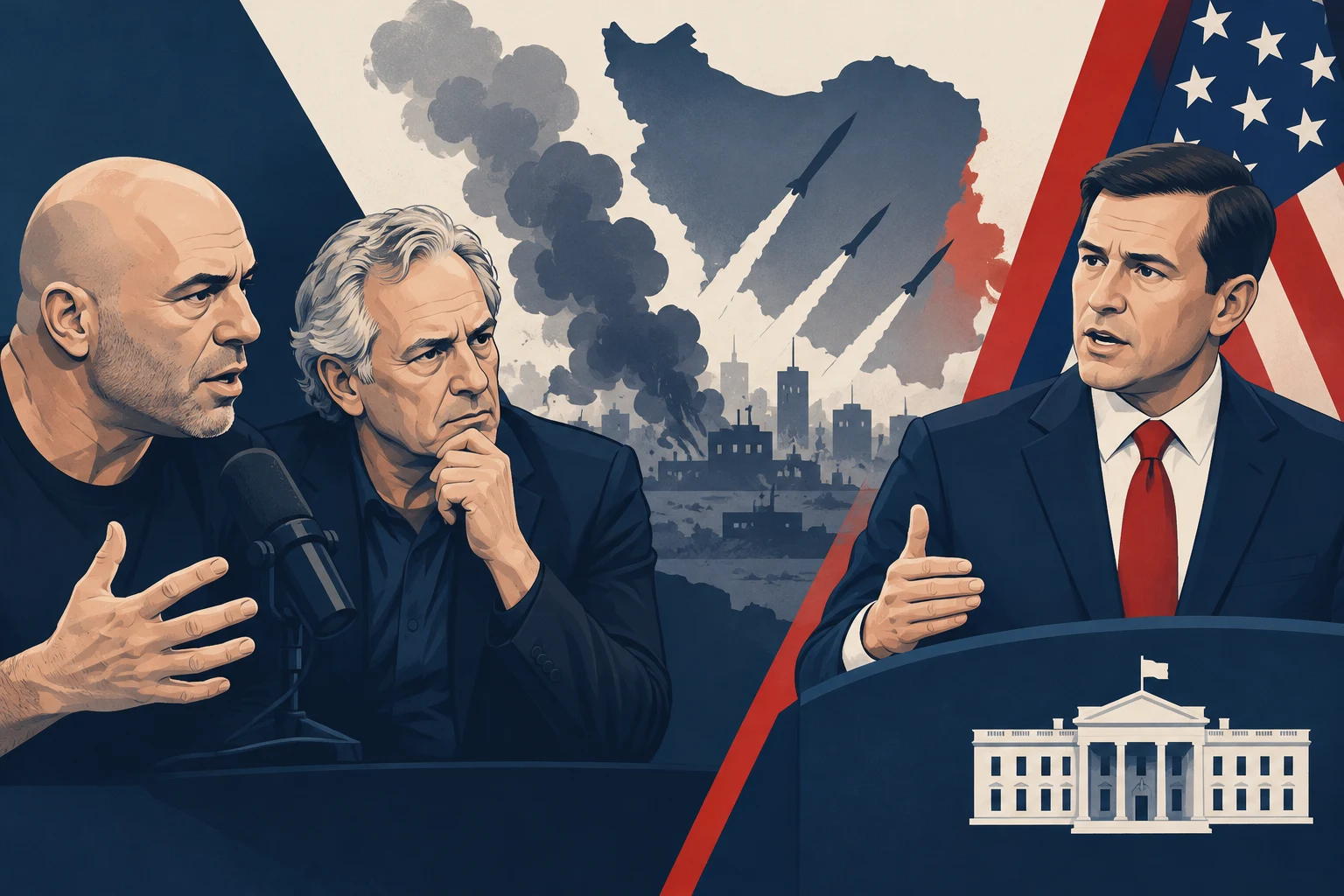
Podcaster Joe Rogan and actor Michael Douglas criticized the Iran war during a conversation on Rogan’s podcast Wednesday, with Rogan arguing that the conflict has upset some voters who backed President Donald Trump partly because he promised to avoid new wars.
Rogan said he opposed the war and questioned whether the administration’s expectations for how it would unfold were realistic. He described the conflict as increasingly difficult to resolve and said many Trump voters had supported a message focused on ending deaths and avoiding further wars. Douglas agreed that the conflict was a mistake and echoed Rogan’s concern that there was no straightforward path out.
The conversation also addressed the rationale for the war and the risks posed by Iran. Rogan acknowledged that Iran has been accused of supporting armed groups and terrorism, and noted concerns experts have raised about the country’s missile development and the possibility of it obtaining nuclear weapons. He also recalled reports of crackdowns and arrests of protesters in Iran.
Douglas said he was concerned about the conflict spreading after an attack on an airport in Riyadh, Saudi Arabia. He questioned whether Western and Israeli intelligence had adequately assessed the situation. Douglas further suggested that Israel had helped spur the war by presenting an opportunity to target Iranian leaders gathered in one place. Those comments were his assessment; the supplied report did not independently establish the claim.
Rogan said the account he had heard of how the war would proceed did not appear accurate, while cautioning that he was not an international-relations expert. He compared arguments made in support of the Iran war with past defenses of U.S. involvement in Vietnam, referring to the disputed account of an attack on the USS Maddox in 1964 that helped escalate that conflict.
Trita Parsi, co-founder and executive vice president of the Quincy Institute, told Fox News Digital that he agreed the war had frustrated the anti-war voters in Trump’s 2024 coalition. Parsi argued that the gap between Trump’s promise of “no more wars” and the decision to fight Iran could make it difficult to regain those voters. He also said the conflict had created divisions within the Republican Party and could lead some anti-war voters to support Democrats again. These were Parsi’s political assessments, not findings independently demonstrated in the report.
A White House spokesperson, Davis Engle, defended the president’s decision, saying the administration’s priority was protecting Americans by eliminating threats. Engle said Trump had campaigned on preventing Iran’s government from developing a nuclear weapon and maintained that Americans were safer because of the president’s actions. He added that Trump makes national-security decisions based on what he considers the country’s interests.
The exchange included competing characterizations of the war’s rationale, likely consequences and political effects. Rogan and Douglas expressed opposition and uncertainty about the course of the conflict; Parsi predicted damage to the Republican coalition; and the White House presented the operation as a necessary security measure.