
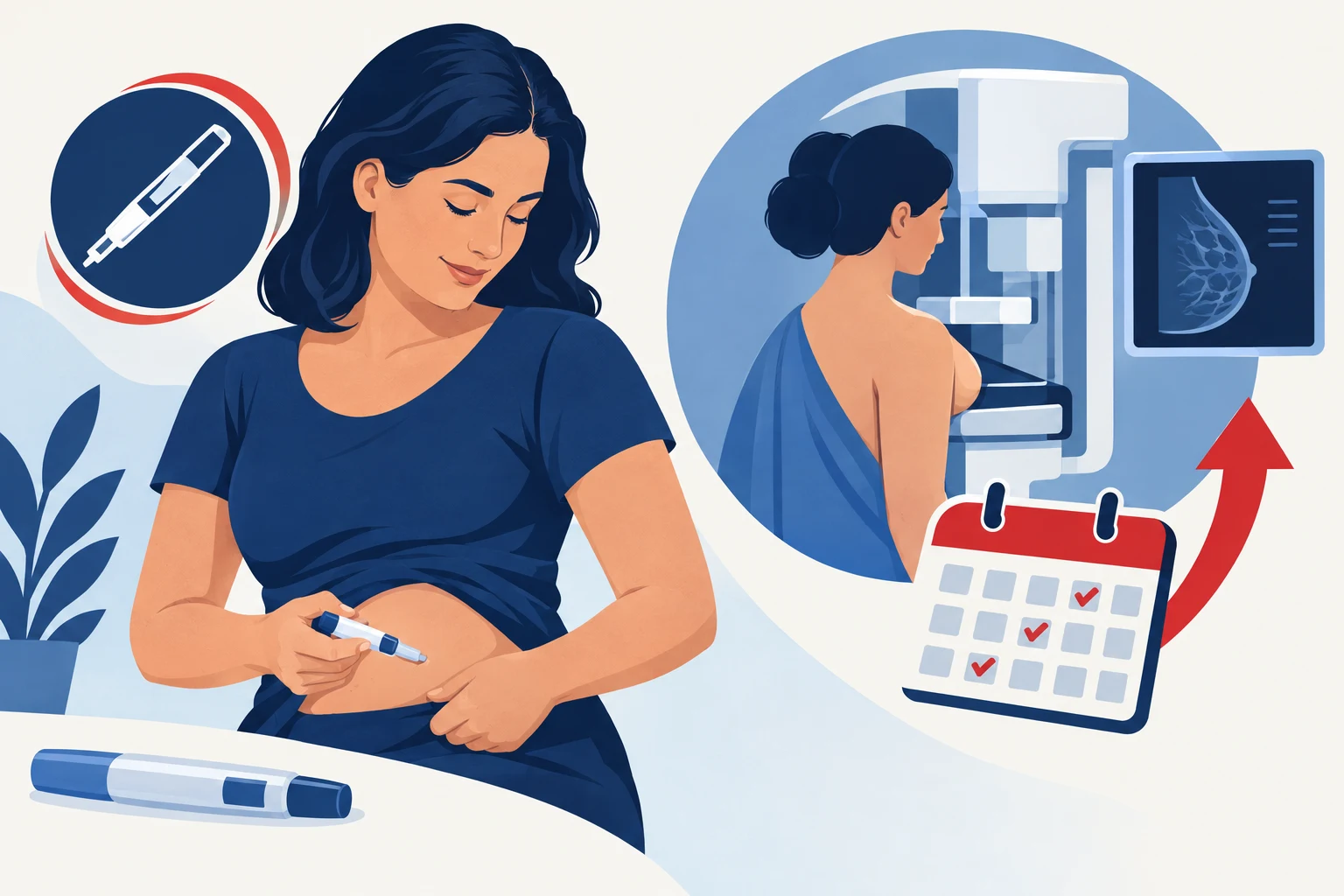
A study scheduled for presentation at the Radiological Society of North America’s annual meeting in Chicago examined mammograms from women who used GLP-1 receptor agonists, a drug class that includes Ozempic and Wegovy, for weight loss. The meeting is set for Nov. 29 through Dec. 3, 2026. The study’s findings have not yet been established as evidence of a change in breast cancer risk.
Researchers reviewed records for 107 women ages 34 to 79 who had taken the medications for at least a year. They compared 214 screening mammograms taken before and after treatment. Participants lost between 6 and 107 pounds, with an average loss of 40 pounds.
Using specialized software, the researchers found that breast density rose by at least one category in 62.5% of the women. Eight participants increased by two categories, and the study reported no decreases in density. Reviewers also observed smaller breast size in roughly 58% to 79% of participants, depending on the reviewer. Skin thickening appeared in about 9% to 18% of cases.
Higher breast density is associated with increased breast cancer risk and can make tumors more difficult to see on X-rays. But lead author Dr. Eva C. Gombos, a diagnostic radiologist at Brigham and Women’s Hospital in Boston, said the observed pattern may result from changes in the proportion of breast tissue rather than growth in dense tissue.
Gombos said the findings were unexpected given the participants’ substantial weight loss. She proposed that breast fat may have decreased more than fibroglandular tissue, the tissue that includes milk ducts and supportive structures. As a result, that tissue could account for a greater share of the mammogram even if its total volume declined. Loss of breast fat and volume may also leave skin folds or make connective tissue more noticeable on scans, she said.
Nearly 22.4% of the women were called back for additional imaging, compared with an average U.S. recall rate of about 10%, according to the study. Two callbacks were technical, to repeat images because of positioning or imaging issues. Four women were referred for biopsies; all four results were benign. The other callbacks were also reported as benign or negative, including three simple cysts.
Gombos said the results should not alarm women taking GLP-1 medications or lead them to avoid routine screening. She said it remains unknown whether the imaging shifts have any lasting effect on breast cancer risk, and that further research is needed.
The study was retrospective, relying on medical records rather than following participants prospectively in a controlled trial. It therefore did not determine whether the changes seen on mammograms affect cancer risk over time.
Gombos recommended that women tell their breast imaging team if they take GLP-1 drugs or have recently lost substantial weight. That information, she said, can help imaging staff compare current scans with earlier images.
Novo Nordisk, which makes Ozempic and Wegovy, told Fox News Digital that it monitors the safety of its medicines and reviews new data as it becomes available. A company spokesperson said individual responses to treatment vary and advised patients to stay in contact with their health care professionals about questions, concerns and monitoring.