
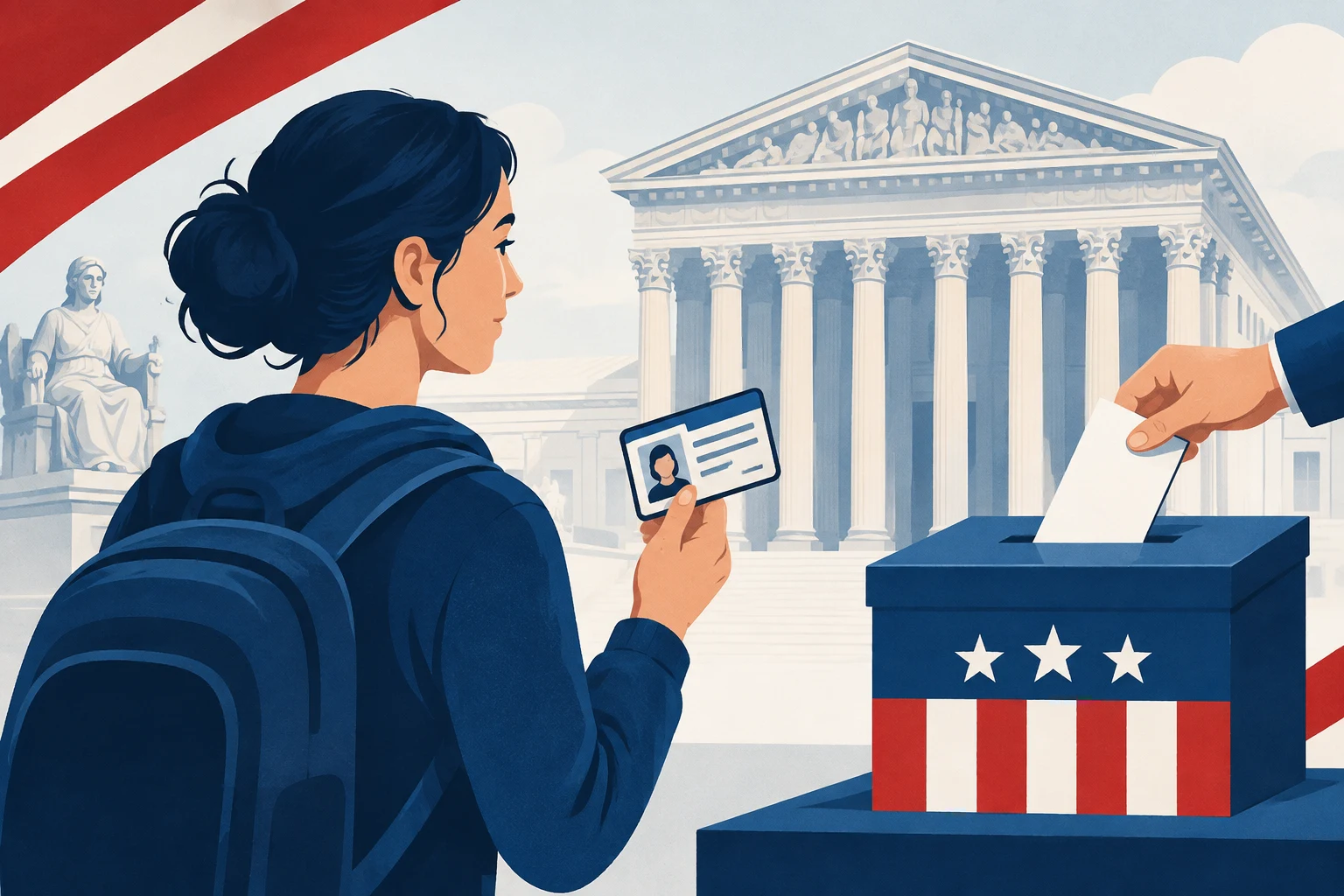
The U.S. Supreme Court on Thursday permitted New Hampshire election officials to reject student identification cards as a form of voter ID in next month’s midterm elections. The order blocks, for now, a lower-court ruling that required officials to consider student IDs along with other evidence when a voter lacked another way to verify identity. The underlying challenge to the state law is still pending, and the Supreme Court did not decide its merits.
The lower-court judge had concluded that state officials interpreted a new law too broadly. Although the law removed student IDs from the types of identification expressly accepted to obtain a ballot, the judge said officials still had to weigh such cards alongside other evidence in cases where voters had no other means of confirming who they were.
The Supreme Court’s majority focused on the timing of the lower-court intervention. It invoked the Purcell principle, under which courts have cautioned that election-related orders issued close to voting can create confusion for voters and election administrators. The majority also referred to recent litigation involving Missouri’s redistricting maps, and said the lower court had not identified a reason to depart from that principle in this case.
Justice Ketanji Brown Jackson dissented. She argued that the principle did not apply because the lower court was seeking to ensure voters received accurate information about election requirements. Jackson wrote that an order barring material misrepresentations of state election rules would prevent confusion rather than cause it. She said she would have left the lower-court order in place.
The dispute follows New Hampshire’s enactment of House Bill 323. Republican Gov. Kelly Ayotte signed the measure in April, and it took effect June 2. The law removed student IDs from the list of identification expressly recognized as valid for obtaining a ballot. After the effective date, Secretary of State David Scanlan issued guidance to election officials, and the state held multiple training sessions on the change.
Republican Attorney General John Formella said the state has a duty to protect election integrity and apply its laws as written. He described the Supreme Court’s action as a victory for the state’s effort to defend the law and said last-minute court orders could create uncertainty for voters and election officials. Formella said his office would continue defending the state’s election rules.
The Supreme Court’s order concerns the lower-court ruling in advance of the election; it does not resolve whether the law itself is lawful. The litigation over New Hampshire’s voter-identification rules therefore continues, while officials may reject student IDs under the Supreme Court’s action.