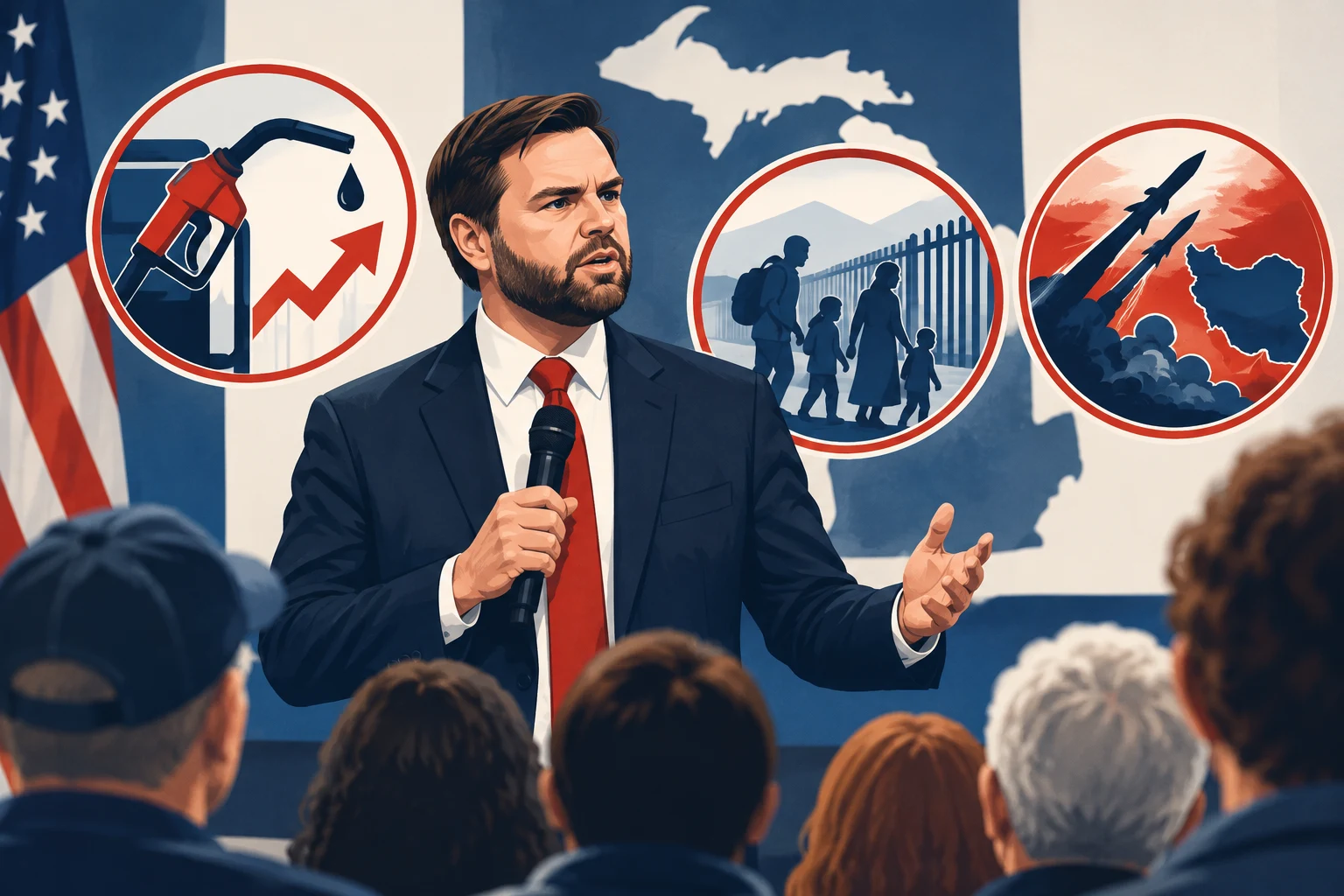
Vice President JD Vance took questions from Michigan voters at a CBS News town hall in Flat Rock, held weeks before the midterm elections. Michigan is described in the source as a key battleground for control of the Senate. The state’s open Senate seat is being sought by Democrat Abdul El-Sayed and Republican Mike Rogers, a former House member. Anchor Tony Dokoupil moderated the discussion and challenged Vance on several of his answers.
A Detroit barber asked why gasoline costs remained higher than during President Donald Trump’s first term. Vance cited Iranian attacks on commercial shipping and disruption to energy markets. He also attributed high prices in part to the loss of refining capacity during the Biden administration, saying about one-fifth of U.S. capacity had gone offline while Biden was president. Vance said the Trump administration was using the Defense Production Act to support the restoration of domestic refining capacity, while acknowledging that rebuilding would take time. Dokoupil responded that Trump and Vance had been in office for nearly two years while fuel remained expensive.
The discussion then turned to corruption in Washington. Dokoupil cited a Fox News poll in which 60% of voters were described as extremely concerned about corruption, and asked whether Vance had seen anything in the White House that troubled him. Vance said he had seen evidence of corruption in Washington generally but not by Trump or his administration.
Dokoupil raised allegations involving Kimberly Guilfoyle, who had resigned as U.S. ambassador to Greece. The source reports an allegation that she sought $100,000 from a donor seeking access to administration officials; Guilfoyle has denied wrongdoing. Vance said selling access to the White House would be unacceptable and that anyone responsible should face consequences. He also said he would comply with subpoenas in a potential Democratic-led congressional investigation, adding that he followed the law. Dokoupil additionally asked about limits on IRS scrutiny of Trump’s tax returns and the president’s cryptocurrency earnings, but the supplied account does not detail a separate Vance response to those points.
On immigration, a naturalized citizen who said she had voted for Vance challenged what she viewed as the administration’s scapegoating of immigrants. She asked about his description of some H-1B visa workers as “foreign indentured servants.” Vance acknowledged that his rhetoric could have been imperfect, then argued his criticism was directed at employers, not visa holders. He said the visa system can leave workers dependent on their employers and allow companies to replace American employees with foreign workers.
Dokoupil asked whether Vance’s language and the administration’s rhetoric dehumanized immigrants. Vance denied that was his goal. He also argued that rapid immigration could weaken social cohesion and change communities, saying some Americans want neighbors with whom they share common ground. After the prerecorded town hall aired, Vance posted on X about riots and a burning building in France, presenting the events as a warning about immigration, assimilation and social compatibility.
Vance also addressed the war with Iran. Asked why the conflict had lasted longer than anticipated and why the United States had not won decisively, he said the country had “in some ways” already prevailed. He asserted that U.S. strikes had destroyed Iran’s nuclear program, which he described as the central reason Trump began the operation. Vance said the administration was still seeking a long-term, verifiable commitment that Iran would not rebuild its nuclear capabilities, while trying to prevent Tehran from disrupting energy supplies. He blamed Iranian actions against commercial shipping in the Strait of Hormuz for affecting oil flows and said prices would be three times higher without U.S. Navy protection. These statements are Vance’s claims as presented in the source; the supplied material does not independently verify them.
A voter, Eddie Rubin, asked Vance to condemn antisemitism among figures in his political base, including prominent conservative voices. Rubin was described as a lifelong Democrat whose two young children survived an attack at Temple Israel in Michigan in March. The source says a Lebanese-born U.S. citizen drove a pickup through the synagogue entrance and exchanged gunfire with security; the attacker was killed, and no children or synagogue staff were injured. Vance condemned antisemitism and hatred of Jews.
Vance then criticized El-Sayed over the candidate’s response to the synagogue attack, citing his phrase “hurt people hurt people.” The source says El-Sayed condemned the attack and later apologized for the wording, saying he had not meant to justify the violence.