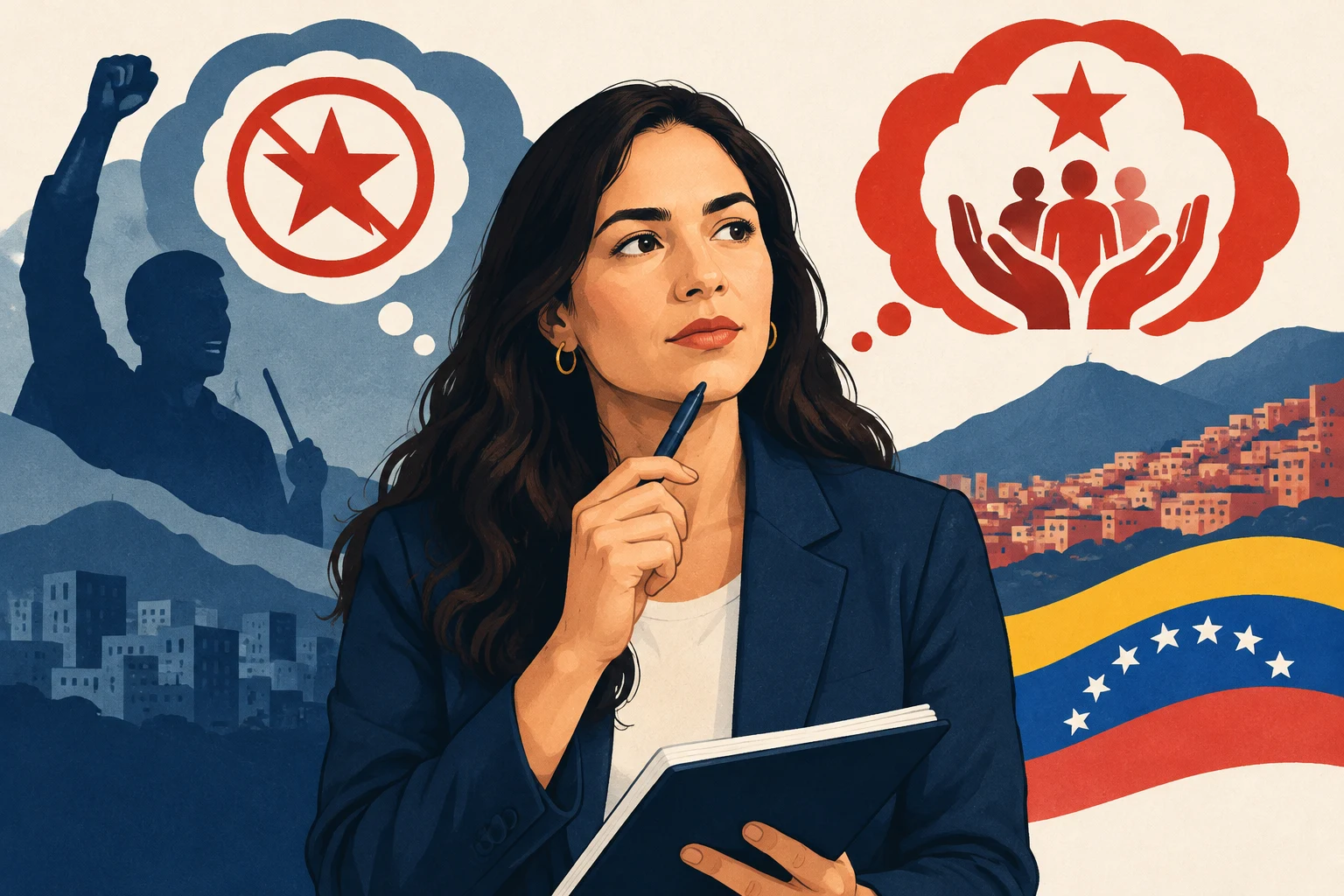
Germania Rodriguez Poleo, a Venezuelan-American journalist who moved to the United States at age 11, said she once supported some socialist policies and voted for Bernie Sanders. She told Fox News Digital that her views changed after she concluded that policies promoted as democratic socialism resembled Chavismo more than the social-democratic systems she associated with Scandinavia.
Chavismo takes its name from Hugo Chávez, the Venezuelan leader who founded the movement. The source describes the program as involving nationalism, a centralized economy and military participation in public projects. Poleo said Venezuela’s experience led her to warn young Americans about what she sees as the consequences of socialist policies.
She argued that describing socialism as “democratic” can obscure the distinction between social democracy and a system that aims to replace capitalism. Poleo said she regards social democracy as operating within capitalism, while socialism seeks to end it. Those are her political characterizations, offered in the interview; the source does not provide responses from supporters of democratic socialism or independent analysis of the competing definitions.
Poleo recalled that her immigrant experience and the pressure to adapt to a new culture contributed to her earlier attraction to socialist ideas. She also pointed to her time at New York University, where she said professors and courses addressing inequality and feminism shaped her understanding of capitalism and socialism. She said she came to believe that the policies she supported were comparable to those in Scandinavian countries, rather than to the systems in Venezuela, Cuba and Nicaragua.
The source identifies Poleo as the narrator of “Escaping Venezuela,” a documentary by Reason. In the interview, she said the accounts of immigrants and people who lived under dictatorships are often overlooked in debates over socialism. She accused some progressives of dismissing those experiences when they argue that such governments did not represent “real socialism.”
Poleo framed Venezuela as a warning, saying the country’s political decline followed a democratic vote and that its future remains uncertain. Her statements reflect her personal views and recollections; the supplied material does not establish a broader assessment of Venezuela’s political or economic history.
She urged young Americans to hear from people who experienced governments they consider socialist and to judge political systems by their real-world outcomes rather than by idealized promises. The interview’s central argument is Poleo’s account of changing her mind: she said she became more critical after seeing what she regarded as warning signs in the policies and political movements she had once supported.