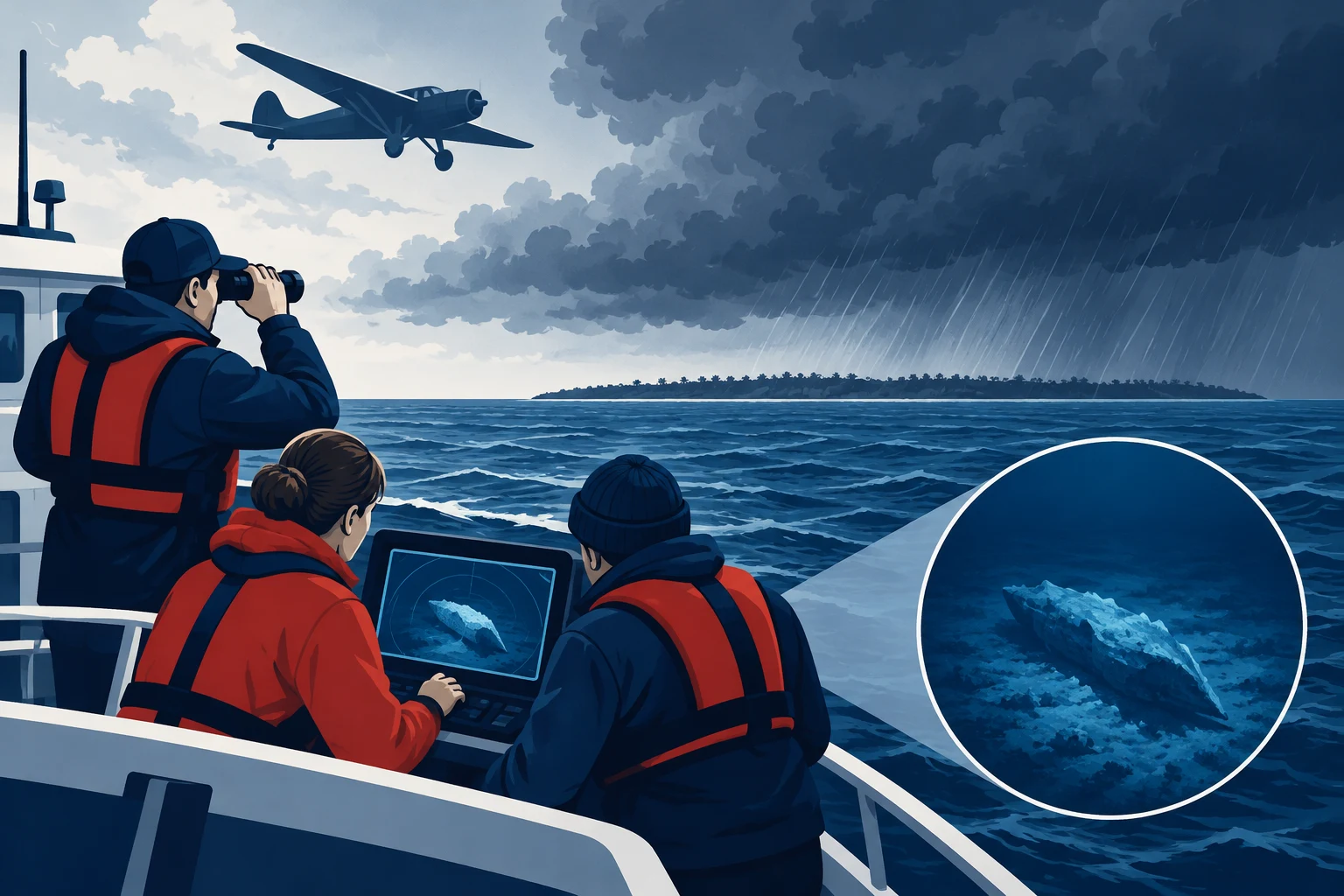
A research expedition investigating whether an underwater feature near Nikumaroro could be Amelia Earhart’s missing airplane paused field operations after severe weather made travel to the island unsafe, Purdue University said in a Thursday update. The 17-person team was unable to reach the site by transport boat because of high winds and rough seas.
Researchers are examining the Taraia Object, a visual anomaly in Nikumaroro’s lagoon that they believe may be the wreckage of Earhart’s Lockheed Electra 10-E. Purdue said the expedition had started gathering data about the feature, while cautioning that investigators had not yet reached a conclusion about its identity.
The university said the weather interruption had not changed the expedition’s overall schedule. It planned to conduct two additional days of fieldwork before the team left the atoll and returned to Tarawa, Kiribati. Purdue said an update on the object’s identification was expected before departure, but did not provide a specific release time. Because Nikumaroro is 17 hours ahead of Eastern time in the United States, the update could arrive as early as Saturday, according to the report.
Rick Pettigrew, executive director of the Archaeological Legacy Institute and a leader of the expedition, said the work requires collecting and analyzing evidence before researchers can draw sound conclusions. He thanked the public for its patience and described the investigation as a complex scientific process, rather than one that can be resolved immediately upon reaching the site.
Earhart and navigator Fred Noonan disappeared on July 2, 1937, during a flight from Lae, New Guinea, to Howland Island. Earhart was attempting to become the first woman to fly around the world. The Taraia Object investigation is one effort to examine what may have happened to the aircraft, but the expedition’s data collection remains preliminary.
Purdue’s involvement in the current search began in February 2025, after Pettigrew approached the Purdue Research Foundation about investigating the lagoon feature. A Purdue spokesperson previously told Fox News Digital that if the object proves to be Earhart’s plane, the team hopes to carry out a full archaeological excavation the following year, subject to obtaining the necessary permissions.
The spokesperson also said discussions had taken place with the Republic of Kiribati about eventual care of any recovered wreckage. No arrangement has been finalized. The Archaeological Legacy Institute and Purdue Research Foundation share an aspiration to return the aircraft to Purdue for display, in keeping with what they described as Earhart’s original wishes. That possibility depends on identifying the object and securing approvals; the university’s update did not establish that the lagoon feature is the missing aircraft.