

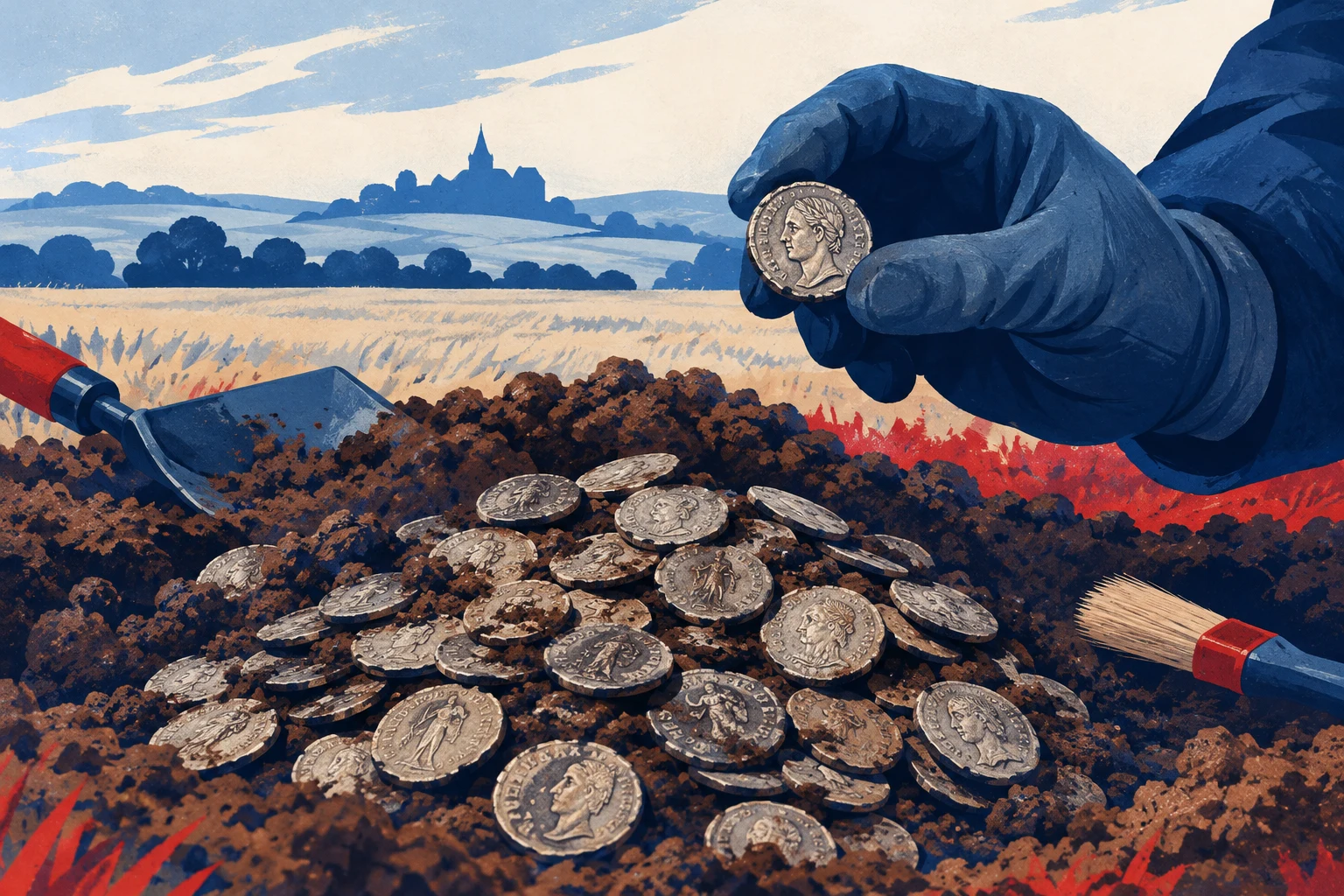
A metal detectorist uncovered 934 Roman silver coins in a field near Wesseling, south of Cologne, according to reporting by The Associated Press and information from German archaeological authorities. The hoard was found last year; officials announced it recently.
The LVR Office for the Preservation of Archaeological Monuments in the Rhineland said the coins were likely buried between 125 and 150 A.D. The collection weighs about 6.8 pounds and is on display at the LVR-LandesMuseum Bonn. Authorities described it as the largest coin hoard from the reign of Emperor Hadrian ever found in Germany.
The finder, Oliver Riedl, is a licensed metal detectorist. After detecting signals that suggested more coins were underground, he contacted archaeological authorities, according to the AP.
Johannes Wienand, an ancient-history professor at the Technical University of Braunschweig who was not involved in the discovery or its research, said the hoard could represent one person’s savings. He estimated its value at roughly three years of a Roman legionary’s gross salary, while noting that the owner’s identity is unknown.
The find was made near the Rhine frontier, which marked a boundary of the Roman Empire in that period. Its proximity to Cologne and a Roman legionary fortress in Bonn leaves open a possible military connection, but no link to a particular owner or military personnel has been established.
Wienand praised the reporting of the find and its orderly archaeological examination. The coins’ discovery and preservation provide material evidence of money used during the Roman period.