


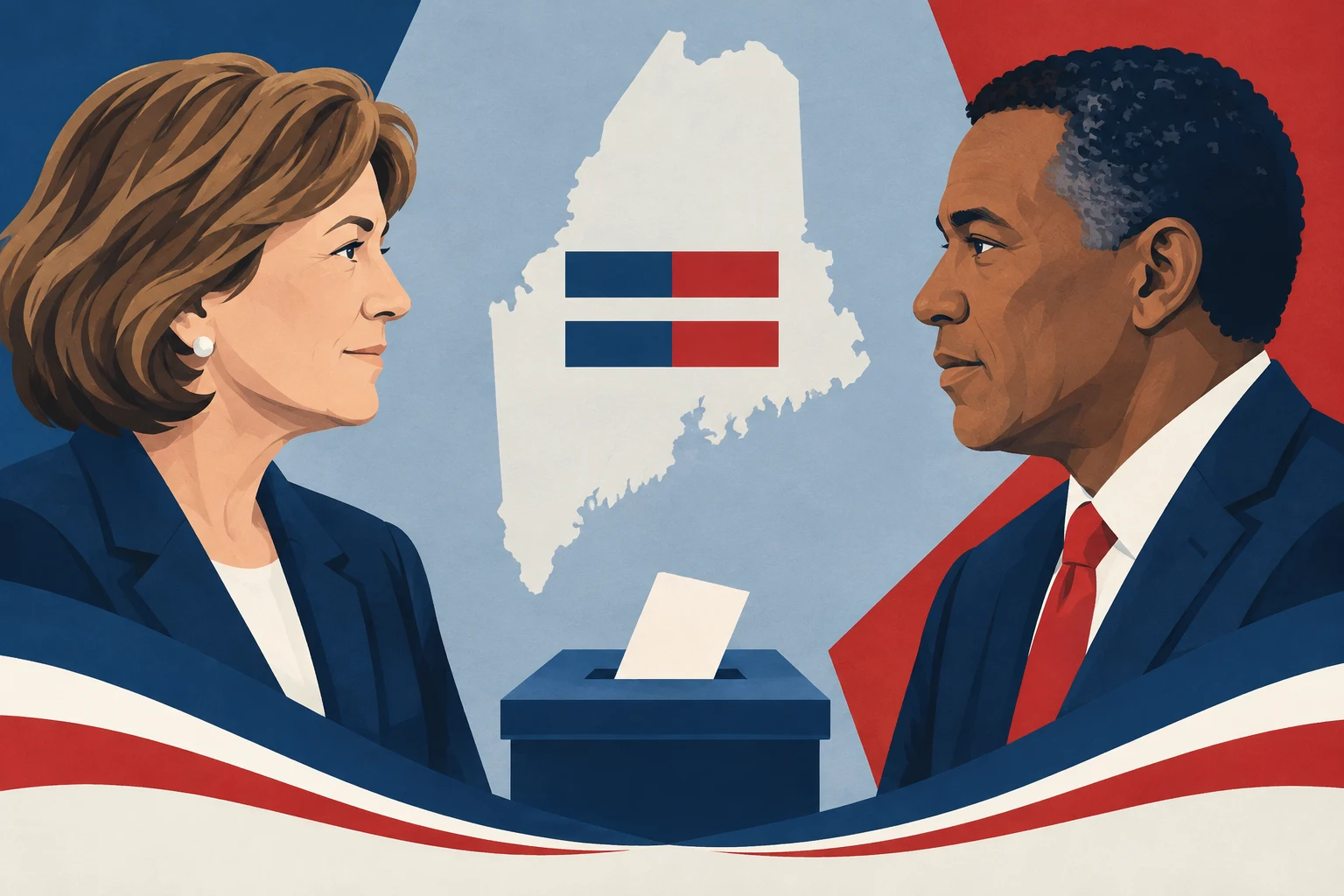
Republican Sen. Susan Collins and Democrat Troy Jackson entered their final debate in a closely contested Maine Senate race, with a Suffolk University poll showing Jackson at 49% and Collins at 47% among likely voters. The poll was conducted Oct. 8-11 and released shortly before the debate. Its two-point difference was within the margin of error, according to the source, and other recent surveys also indicated a tight contest.
The race is viewed as a potential Democratic pickup as the party seeks to regain control of the Senate in the midterm elections. The Fox News Power Rankings and three nonpartisan handicappers cited in the source—the Cook Political Report, Inside Elections and Sabato’s Crystal Ball—rated it a toss-up.
Collins, seeking a sixth Senate term, made her experience and position as chair of the Senate Appropriations Committee central to her case. In an interview with Fox News Digital in Bangor, she said replacing her could cost Maine federal support, arguing that Jackson would have little seniority and that funding directed to the state would diminish. Jackson’s campaign did not provide a direct response to that particular funding argument in the supplied material.
Jackson has instead criticized Collins over the cost of energy, food and housing, saying she has not used her influence to protect Maine families. At a debate, he argued that political power matters only when it is exercised on behalf of residents. He and other Democrats have also sought to tie Collins to President Donald Trump, whom the source says is facing declining approval ratings in Maine and nationally ahead of the midterms.
Collins rejected the characterization that she is aligned with Trump on nearly every issue. She pointed to disagreements over tariffs on Canada, a deal involving Russian President Vladimir Putin, and Trump’s major legislative package, which she opposed because she said Medicaid cuts would harm Maine. She also cited her vote against Attorney General Todd Blanche’s confirmation. Collins said she supports Trump when she agrees with him and opposes him when she does not.
The candidates have clashed over Collins’ past votes and law enforcement. Democrats have criticized her for not regretting her 2018 vote to confirm Supreme Court Justice Brett Kavanaugh, whose vote later helped overturn Roe v. Wade, and for supporting funding for Immigration and Customs Enforcement after a fatal shooting in Maine involving ICE agents this summer, according to the source.
Collins, speaking after receiving an endorsement from the Maine chapter of the Fraternal Order of Police, said she had secured $46 million for police and sheriff’s departments to improve equipment, facilities and communications. She also accused Jackson of failing to criticize former Democratic Senate candidate Graham Platner, whom Jackson had supported during the primary campaign. Platner left the race after a report containing an allegation of rape by a former partner; Platner denied the report.
Jackson’s campaign said he is not a Democratic Socialist and does not support defunding the police. It said he called for Platner to leave the race and would not accept his endorsement. The campaign also accused Collins of misrepresenting Jackson’s record and criticized her votes on health care, Kavanaugh’s confirmation, Iran and tariffs. Those statements are campaign claims; the supplied material does not independently substantiate them.
The campaigns also disputed a statistic about Collins’ voting record. Jackson’s campaign said Collins had voted with Trump 96% of the time. Collins rejected that figure, saying it relied on a study covering only about one-third of her Senate votes. She cited another study that, she said, examined 90% of votes and found she supported Trump 72% of the time.
Collins has previously survived a strong Democratic challenge. In 2020, she initially trailed Sara Gideon, then speaker of the Maine House, but won re-election by nearly nine percentage points, while Democrat Joe Biden carried Maine by a similar margin. The supplied account does not include the final debate’s outcome or any results from the 2026 election.