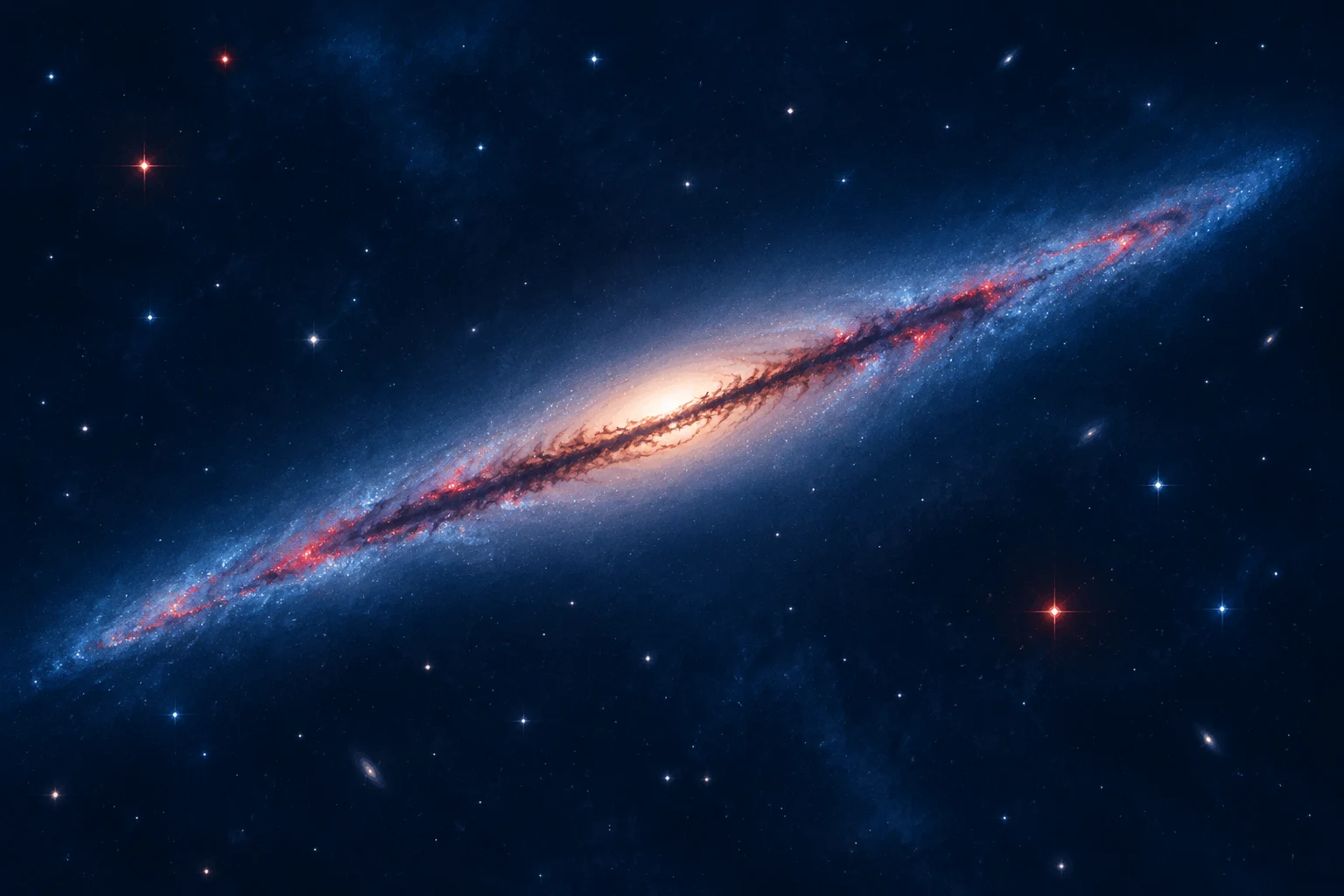
A NASA Hubble Space Telescope image released Oct. 16, 2026, shows NGC 1827, an intermediate spiral galaxy viewed nearly edge-on. NASA places the galaxy about 37 million light-years away in the constellation Columba, also known as the Dove.
The image was made with Hubble’s Advanced Camera for Surveys. It shows the galaxy’s disk crossed by dark dust lanes, with bright-blue areas along the disk that NASA says are likely sites of new star formation. A bright star appears near the galaxy’s central bulge, but it is in the foreground, between Earth and NGC 1827. The star’s four visible diffraction spikes result from light bending around supports for Hubble’s secondary mirror.
NASA said the observation is part of a survey examining 260 satellite galaxies associated with 22 host galaxies similar to the Milky Way. The survey covers systems within a radius of about 32 million light-years from Earth. Hubble has observed 111 of the target satellite galaxies so far, according to the agency. NASA estimates that observing the rest will require 149 additional Hubble orbits, assigning one orbit to each remaining galaxy.
The program focuses on low-mass galaxies because they can provide a way to test cosmological models at small scales. NASA said some models have difficulty matching observations at those scales. Data from the survey are expected to help researchers describe the properties of low-mass galaxies in Milky Way-like systems and refine the models.
The release does not present a new conclusion about the models or report a discovery from the image. Instead, it explains how the picture fits into the broader observing program and what researchers hope the survey data will contribute. NASA credited the image to the agency, the European Space Agency and Michael Jones of the California Institute of Technology, with image processing by Gladys Kober of NASA and the Catholic University of America.