

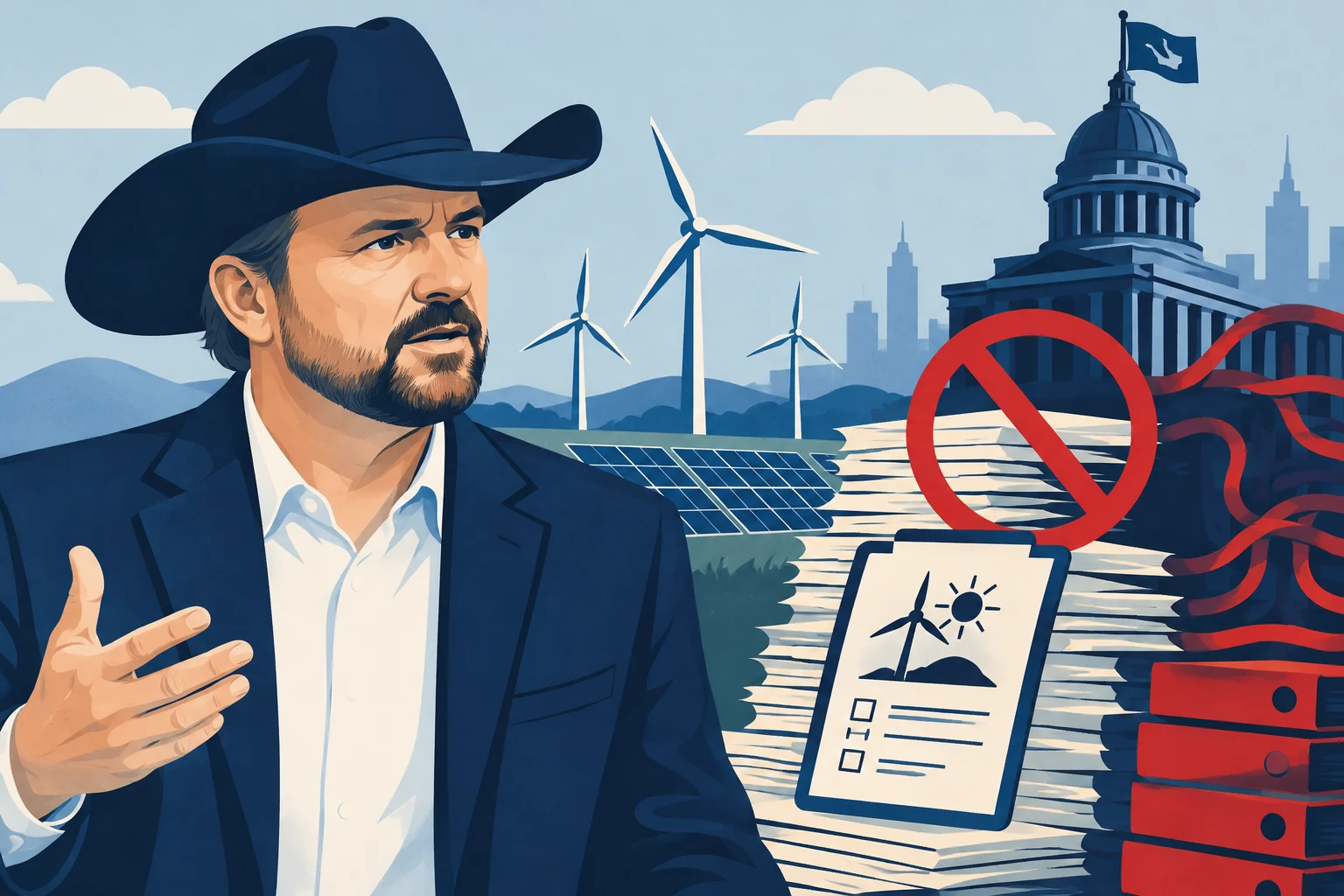
Country singer John Rich has joined New York landowners and local officials criticizing the state’s process for approving large renewable-energy projects. In a Fox News Digital interview, Rich accused Gov. Kathy Hochul’s administration of limiting local control over proposed wind and solar development in upstate communities. Hochul’s office rejected his criticism and pointed to other concerns it says affect farmers.
The dispute centers on the state Office of Renewable Energy Siting, or ORES. Established in 2020 under then-Gov. Andrew Cuomo, the agency generally reviews and permits renewable-energy projects capable of generating at least 25 megawatts. State rules direct developers to avoid the most productive agricultural soils when possible and to reduce or compensate for effects on farmland when avoidance is not possible.
ORES may also override local zoning and land-use requirements it considers unreasonably burdensome. Critics argue that authority gives state officials too much influence over local decisions. Rich said it weakens “home rule,” the idea that communities and property owners should have a meaningful say in land use where they live.
Rich also challenged the state’s treatment of prime farmland. He alleged that Hochul’s administration relied on research from Cornell University to revise the definition, making it easier for renewable projects to use agricultural land. Those assertions were presented as Rich’s claims in the interview; the material provided does not include an independent assessment of the research or the alleged change.
Hochul’s administration has promoted large-scale solar and wind development while maintaining that projects are not taking over New York’s best farmland. The governor’s office has also argued that leasing land for solar development can help farmers retain their property within their families.
Rich’s opposition became public through his song “Dear Kathy,” released Oct. 28 with a music video. He said the song followed visits to upstate New York, where he held two town hall meetings, including one at the farm of landowner and ORES critic Alexandra Fasulo. Rich said he met with hundreds of farmers and landowners and heard concerns that state decisions could override local authorities and residents.
He told Fox News Digital that he first encountered the issue through Fasulo’s social media posts. After questioning whether the state could sideline landowners, zoning boards and mayors, he said he went to the area to learn more. He described the meetings as politically mixed and said the concerns he heard crossed party lines.
The song’s lyrics speak on behalf of farmers and landowners opposing large projects on upstate farmland. Rich characterized it as a “fight song” and said it was intended to draw attention to what he sees as threats to family farms, rural communities and private-property rights. The video features landowners and the Holy Trinity Monastery in Jordanville, which has opposed nearby wind projects, according to the source material.
Rich also argued that the amount of proposed solar development could exceed 100 square miles when plans are combined. The supplied material attributes that estimate to him and does not provide project-by-project figures to verify it. He called the state’s approach potentially unconstitutional, but no legal ruling or formal finding on that question is included in the material.
Ken Lovett, a senior communications adviser on energy and environment for Hochul, responded on behalf of the governor’s office. Lovett said Rich should instead address President Donald Trump’s tariffs, the war with Iran and federal immigration enforcement, which he said are driving up fuel costs or otherwise harming farmers in New York and elsewhere. The response did not directly address Rich’s specific claims about ORES or the farmland definition.
Rich said he would be willing to meet with Hochul to discuss the landowners’ concerns. The material describes an ongoing policy dispute and the competing views expressed by Rich and the governor’s office; it does not establish whether particular renewable-energy projects have received approval or quantify their effects on farms.