


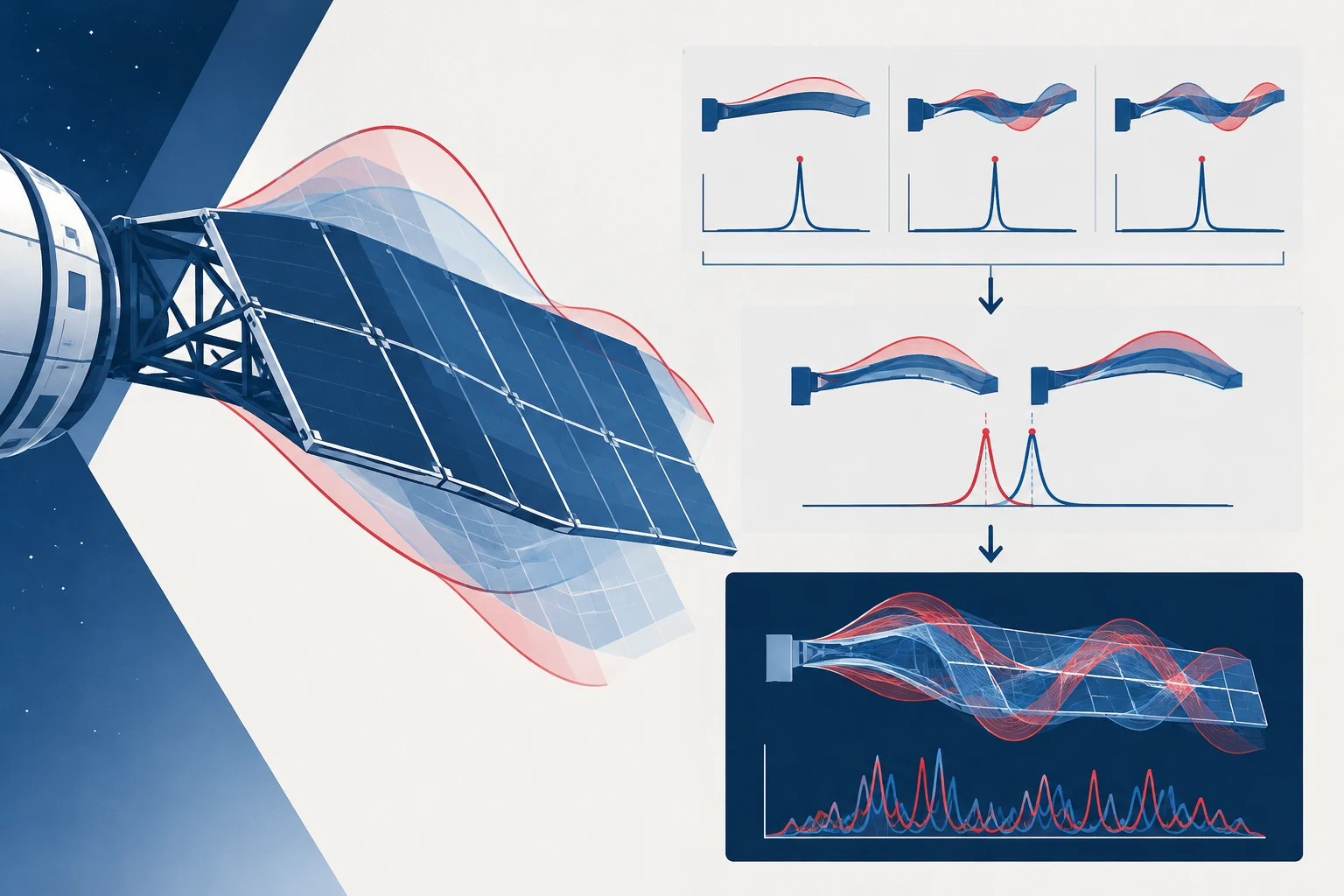
A NASA technical bulletin published Oct. 13, 2026, presents a framework for understanding how complex mode shapes can arise in lightly damped structures when two vibration modes are close in frequency and coupled by nonproportional damping.
The bulletin says that the key factor is not damping alone, but the strength of the coupling relative to the frequency separation between the modes. As interaction increases, the modes’ frequencies can move closer together and their shapes become more complex. At a transition point, the frequencies coalesce; with stronger interaction, the frequencies stay approximately equal while the modes’ decay rates separate. At very strong interaction, the shapes can become nearly real again, but represent different combinations of the original modes.
NASA describes the result as a reduced perturbation framework for interpreting phenomena including mode veering, complex mode formation, eigenvalue coalescence and decay-rate splitting. The bulletin recommends assessing complex poles alongside mode-shape phase rather than treating a complex shape on its own as proof of heavy damping, nonlinearity or poor test data.
For practical comparisons, the bulletin says analysts can derive a measure of interaction from the separation between identified poles and estimate the baseline modal spacing using uncoupled or pretest analytical modes. The framework is intended to connect structural testing and analysis.
The bulletin cites an August 2026 NASA technical memorandum by A. Majed, E. E. Henkel and Joel W. Sills on the emergence of complex modes in lightly damped structural systems.