

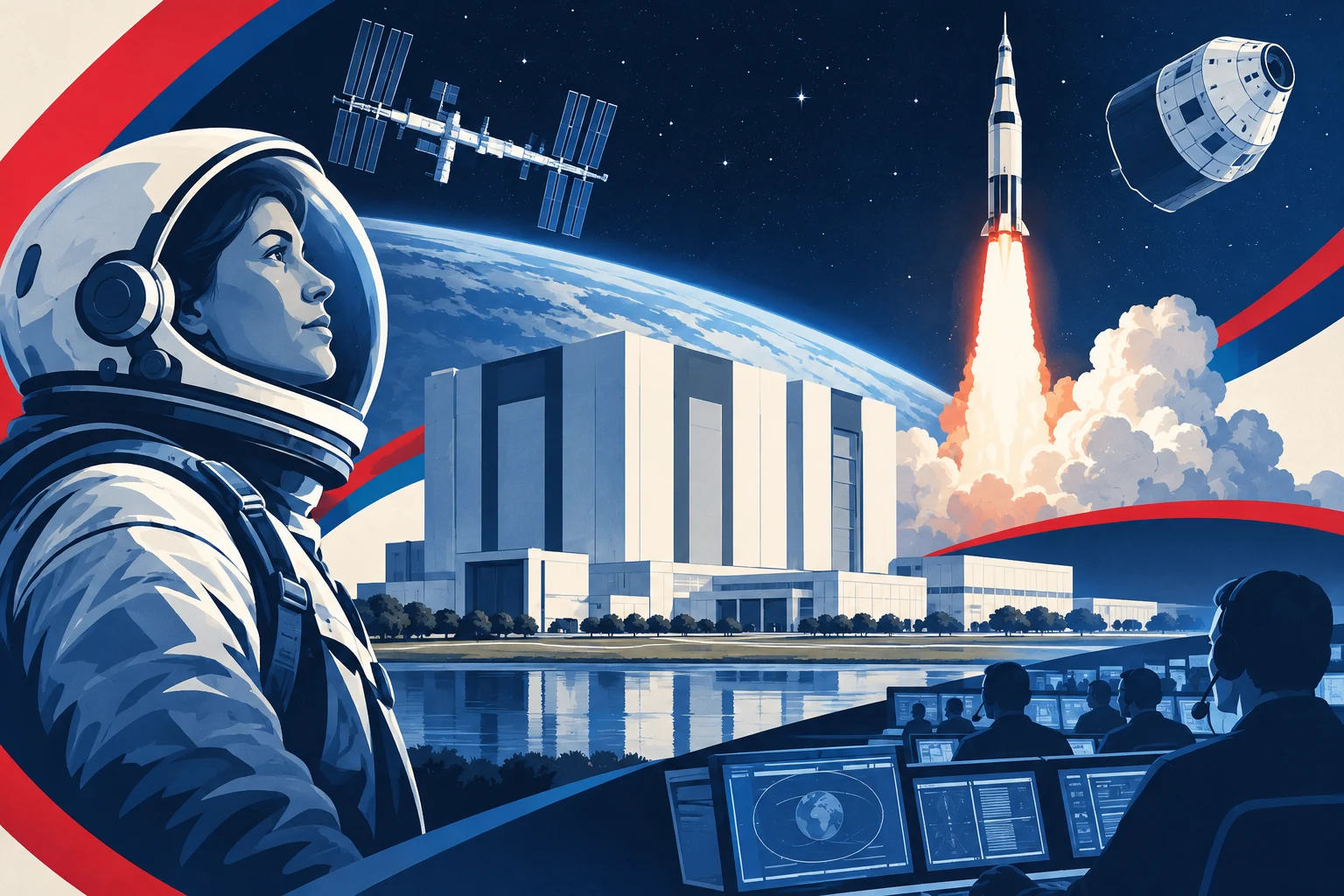
NASA’s Johnson Space Center marked the 65th anniversary of its establishment with a retrospective on the facilities and programs that have supported U.S. human spaceflight. The center was established in Houston on Nov. 1, 1961, as the Manned Spacecraft Center. NASA renamed it the Lyndon B. Johnson Space Center in 1973, honoring the president for his support of the nation’s space program, according to the agency’s history.
The center’s origins followed President John F. Kennedy’s May 25, 1961, address to Congress, in which he set the goal of landing a man on the Moon and returning him safely to Earth before the decade ended. NASA’s Space Task Group, then directing the human spaceflight effort and working on Project Mercury, needed more room as the mission expanded. The agency selected a site near Houston after evaluating locations around the country.
While the permanent campus was being built at Clear Lake, staff operated from 13 leased buildings in southeast Houston. Construction began in 1962, and the first employees moved onto the new site in late 1963. NASA describes the center today as its human spaceflight center of excellence, with the astronaut corps, Mission Control and teams supporting programs from low Earth orbit to lunar exploration.
Several buildings illustrate how the center’s work has changed. The Mission Control Center, in Building 30, was completed in 1964. Houston monitored Gemini missions before taking full control of Gemini IV in June 1965. NASA says the center has controlled every one of its human spaceflight missions since. The facility, named for flight director Christopher C. Kraft Jr. in 2011, supports the International Space Station around the clock and Artemis missions.
Training facilities also evolved with each program. Building 5 began supporting missions in 1965, initially with Gemini simulators, then adding Apollo spacecraft trainers. It later gained simulators for Skylab, the space shuttle and the space station; NASA says the facility now includes Orion and Starliner simulators. Building 9, initially a technical services facility, was adapted for Apollo lunar training in 1969. Its mockups have since supported shuttle and space station preparation, and the building now includes Orion and commercial spacecraft mockups as well as a system used to simulate reduced gravity.
Spacewalk training moved through several stages. NASA says neutral-buoyancy training began with Gemini XII in 1966. An above-ground pool was installed the following year, followed by another facility in 1980 to accommodate shuttle-era training. The Neutral Buoyancy Laboratory began operating in 1997, supporting shuttle and station training and testing spacesuits and lunar activities. NASA’s anniversary account also describes geologists conducting lunar geology training in the laboratory as part of Artemis preparation.
The Lunar Receiving Laboratory, built in Building 37, was designed to prevent possible lunar material from contaminating the outside environment. Construction began in 1966, and staff moved in the following year. Apollo 11, 12 and 14 astronauts spent three weeks in postflight quarantine there, while scientists examined samples returned by Apollo missions. After later use by life-sciences teams, the building was demolished; NASA says Lunar Receiving Park was dedicated on its former site in 2026.
Johnson’s current responsibilities extend beyond lunar exploration. NASA identifies Houston as the base for its Low Earth Orbit Program, including International Space Station operations and commercial partnerships and destinations. The agency also locates its Moon Base and Orion programs at Johnson, alongside human-health and research teams tasked with supporting crew health and performance on longer missions.
The anniversary account presents the campus as a working center whose facilities have repeatedly been adapted to new spacecraft and missions. Its milestones range from Mercury and Gemini through Apollo, the shuttle and the space station, with NASA describing Artemis as part of the center’s continuing human spaceflight work.