

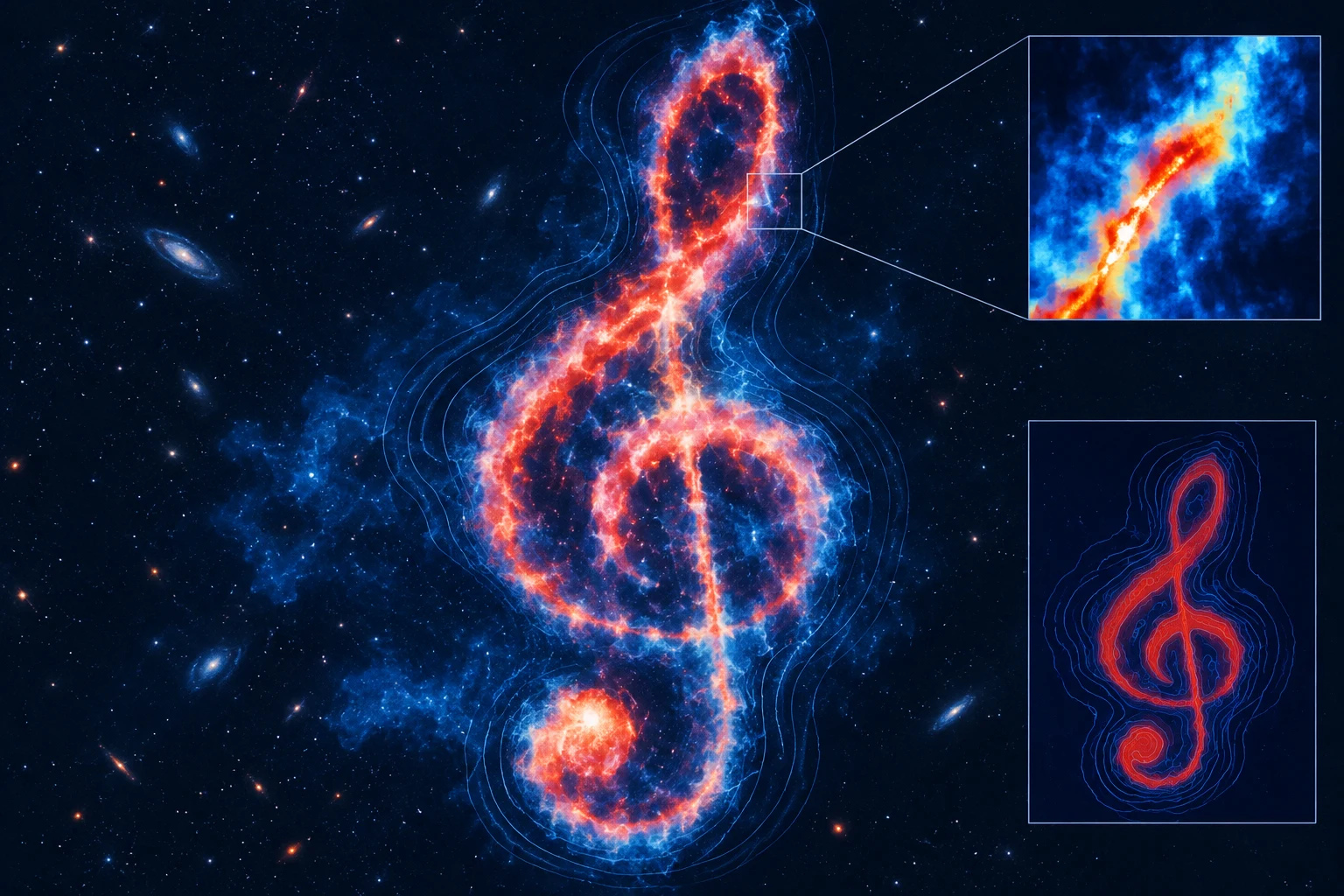
NASA’s Astronomy Picture of the Day for October 19, 2026, focuses on an unusual object known as Treble Clef. The radio structure stretches more than 2 million light-years and takes a shape that resembles the musical notation mark, according to the NASA feature.
The object is identified as VLSS J0318.9+5755. Its visible light is obscured by the Milky Way, making it difficult to study in ordinary optical observations. When researchers examined it in 2004, its nature was still uncertain.
More recent observations from NASA’s Chandra X-ray Observatory and the eROSITA instrument have prompted a possible explanation for how the structure formed. The NASA account presents this as a hypothesis: a central cloud of charged particles may originally have been cast out by a supermassive black hole at the center of a galaxy. After the particles’ radio emission faded, a shock wave associated with the collision of two galaxy clusters may have energized them again.
The featured composite image combines different kinds of observations. Radio emission appears in red, while the newly identified X-rays are shown in blue. Infrared data are also credited in the image information. NASA credits the X-ray observations to NASA’s Chandra X-ray Observatory and INAF-IRA, the infrared data to UKIDSS-GPS, and the radio data to ASTRON LOFAR. Image processing is credited to NASA’s Chandra X-ray Center and the Smithsonian Astrophysical Observatory.
The NASA feature says unusual objects such as Treble Clef can provide clues about interactions between galaxy clusters and the broader evolution of the universe. The proposed history of this particular structure remains a scientific interpretation rather than a settled account in the material provided.
The Astronomy Picture of the Day program presents a different astronomical image or photograph each day, accompanied by an explanation written by a professional astronomer. The October 19 entry lists Robert Nemiroff, Jerry Bonnell, Cecilia Chirenti and Keighley Rockcliffe as authors and editors.