

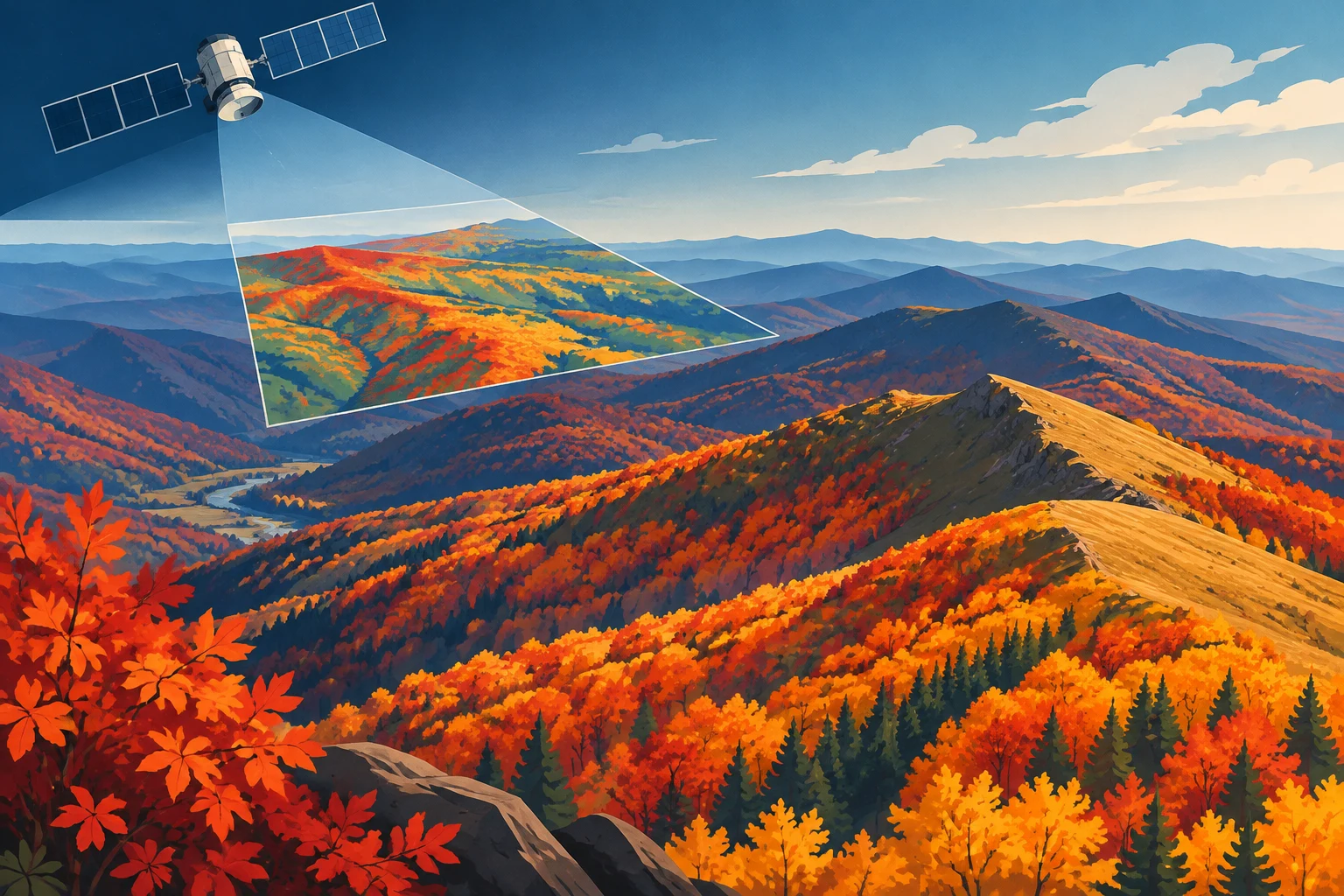
A NASA Earth Observatory image captured on Oct. 8, 2026, documents the seasonal change underway in Bieszczady National Park in southeastern Poland. The image was taken by the Operational Land Imager aboard Landsat 9, a satellite operated by NASA and the U.S. Geological Survey, according to the agency’s report.
The park lies in the Bieszczady Mountains, part of the Carpathians in southern Poland. NASA’s account describes broad forested hillsides where deciduous trees are turning from green to autumn colors. European beech is the main forest species, with sycamore maple also contributing to the changing foliage.
The color shift is linked to the seasonal reduction in daylight and cooler air temperatures. As trees reduce chlorophyll production, the green coloration fades and other pigments in the leaves become more visible, NASA explained. The report also notes that brown bears roam the Carpathians in autumn as they feed ahead of winter hibernation.
The forest gives way to a different landscape at higher elevations. In the area, beech forests reach roughly 1,000 to 1,260 meters, or about 3,300 to 4,100 feet. Above that elevation are open subalpine meadows, known locally as polonina, with grassland and shrubs including rowan, willow and green alder. NASA said meadow patches on ridges east-southeast of Smerek appeared tan in the image after losing their summer greenery.
The report places the local beech forests in a wider European history. After glaciers retreated, beech forests expanded north from refuges that included the Carpathians and Alps, contributing to the return of forest across land previously covered by ice. Parts of Bieszczady National Park belong to a UNESCO network of ancient and primeval beech forests spanning 18 countries, according to NASA.
The mountain area is also known for wildlife. European bison, which had become extinct in the wild, were reintroduced there in the 1960s and now number in the hundreds, NASA said, citing recent surveys. Brown bears and Eurasian lynx also live in the forests, which the report describes as providing refuge and food sources.
NASA credited the image to Michala Garrison, using Landsat data from the U.S. Geological Survey, and the story to Lindsey Doermann. Its listed references include Bieszczady National Park material, a 2022 study of subalpine woody vegetation in the Eastern Carpathians, and UNESCO information on Europe’s ancient and primeval beech forests.