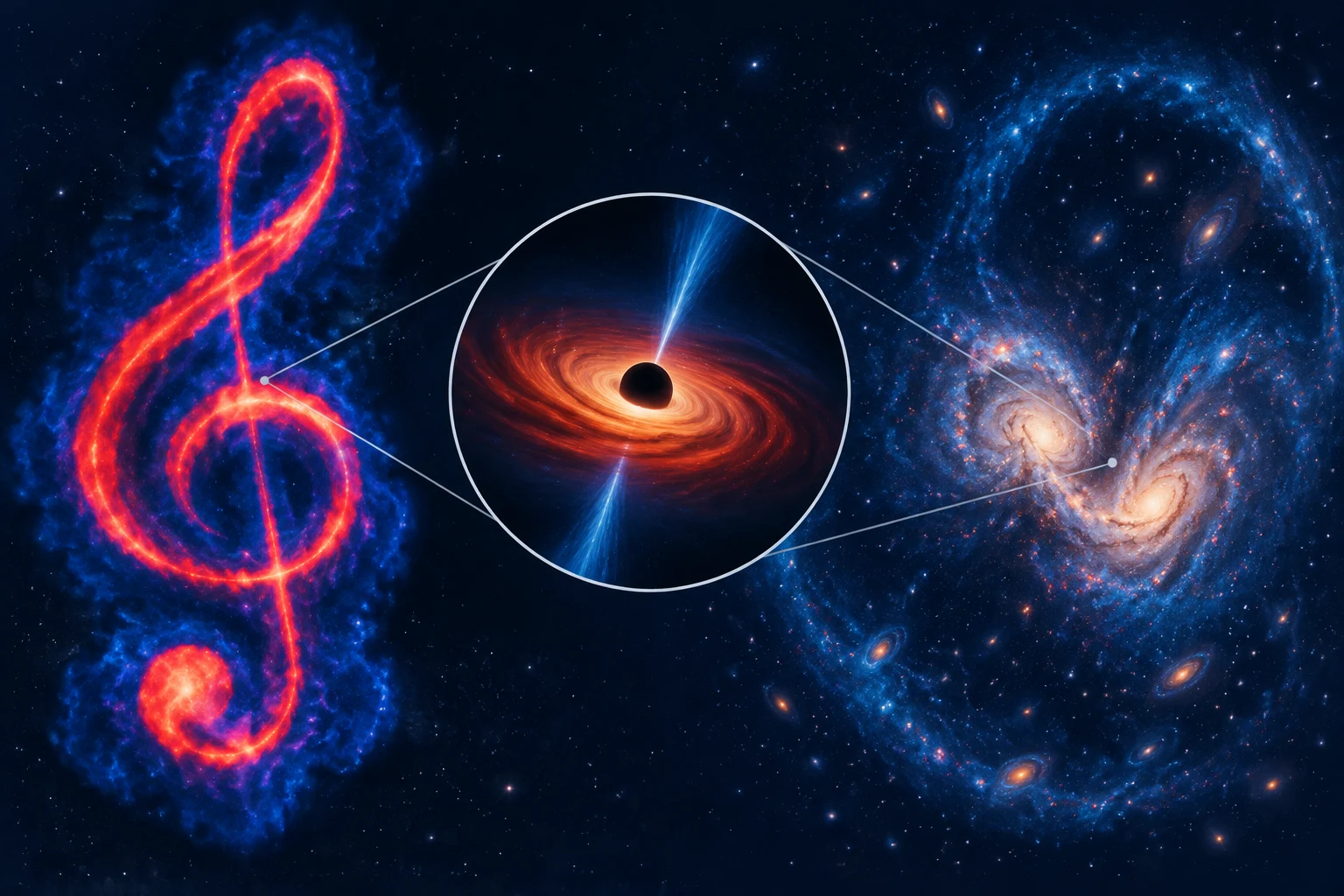
A radio formation nicknamed the “Treble Clef” may have taken shape through a supermassive black hole outburst followed by a merger of two galaxy clusters, according to research reported by NASA on Oct. 14, 2026. The name refers to the structure’s resemblance to the musical symbol; the researchers say that likeness has no scientific connection to music.
The study, led by Andrea Botteon of Italy’s National Institute for Astrophysics, appeared Wednesday in Astronomy & Astrophysics. The team used X-ray observations from NASA’s Chandra X-ray Observatory and the eROSITA telescope to find hot, diffuse gas at the location of the radio structure. The gas indicates that the feature is associated with a galaxy cluster, and the researchers determined that two clusters there are in the process of merging.
Studying the region is difficult because it lies almost directly behind the plane of the Milky Way. Stars, gas and dust in our own galaxy obscure the view from Earth. NASA’s account says the research team used telescopes capable of observing through this intervening material to investigate the source of the formation.
The researchers propose that the structure arose in two stages. First, an earlier eruption from a supermassive black hole at the center of the cluster sent charged particles and magnetic fields outward at close to the speed of light. This produced radio emission that gradually weakened as the particles lost energy. Later, the collision of the clusters may have compressed or energized the particle cloud, causing it to shine more brightly in radio waves again. The team said shock waves generated by the collision could have contributed to that revival.
To examine signs of the merger, the researchers analyzed the shape of the cluster’s hot gas in Chandra images. They removed an oval pattern representing the gas’s largely symmetrical distribution. In the resulting image, X-ray emission appears stronger on the left and right sides of the cluster’s center and weaker in the middle. The team interpreted this pattern as evidence that the collision likely took place along that left-to-right axis in the image.
The researchers estimate that the direct collision happened a few hundred million years ago and that the clusters are now moving apart. NASA’s composite image brings together X-ray observations from Chandra and eROSITA, radio data from the European LOFAR telescope network, and infrared observations from the United Kingdom Infrared Telescope. NASA says the combined image also incorporates both the original X-ray data and the image created by removing the symmetrical gas pattern.
Galaxy clusters contain hundreds of galaxies and large quantities of extremely hot gas, making them among the largest structures in the universe. In this case, the radio emissions trace the material thought to have been first expelled by the black hole and later affected by the cluster collision. The proposed sequence offers an explanation for the unusual shape, while the study describes the formation process as likely rather than certain.
NASA’s Marshall Space Flight Center manages the Chandra program. The Smithsonian Astrophysical Observatory’s Chandra X-ray Center oversees science operations from Cambridge, Massachusetts, and flight operations from Burlington, Massachusetts.