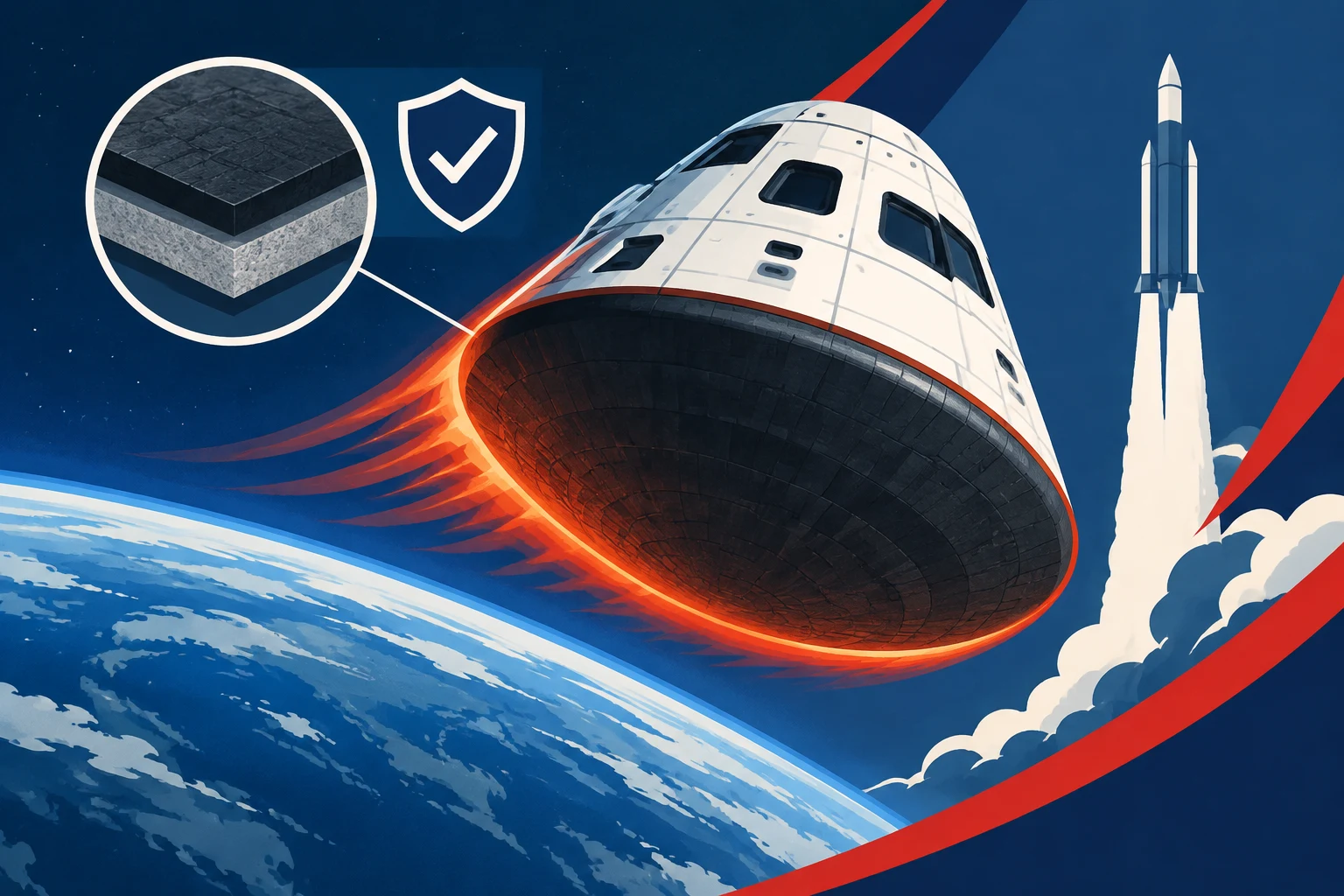
NASA says engineering reviews of the Orion capsule flown on Artemis II found its heat shield and other thermal protection systems performed as expected during the spacecraft’s return from the Moon. The mission carried four astronauts, marking the first time people flew aboard Orion.
During reentry, Orion reached a reported peak speed of 39 times the speed of sound. NASA said exterior temperatures rose above 4,000 degrees Fahrenheit, while cabin temperatures remained in the mid-70s. The capsule entered the atmosphere within 192 feet of its planned entry interface and splashed down 0.59 miles from the predicted landing point off San Diego, according to the agency.
NASA had adjusted the spacecraft’s reentry path after investigating the Artemis I heat shield. That earlier flight revealed cracking and material loss that led to additional testing, including arc-jet tests at NASA’s Ames Research Center. For Artemis II, NASA limited the maximum distance Orion could travel through the atmosphere before landing. The agency said the change reduced the time the shield spent in a temperature range associated with the Artemis I damage.
Initial checks after the April 10, 2026, splashdown included underwater images taken by Navy divers and inspections aboard the recovery ship. NASA reported less cracking and char loss than on Artemis I. A later engineering assessment found nine areas of char loss on the heat shield’s main dish, compared with 103 on the previous flight. NASA said the amount of cracking and char loss was reduced by a factor of ten, attributing the improvement to the shorter downrange trajectory.
After Orion returned to Kennedy Space Center in Florida, specialists examined the shield, which consists of 186 blocks made from the ablative material Avcoat. The heat shield was later sent to Marshall Space Flight Center in Alabama. NASA said sample removal and internal X-ray scans began there in August to help engineers assess how the material behaved during flight.
The review also found that Orion’s aerodynamic and heat-related performance matched preflight predictions based on analysis and ground tests. NASA reported consistent performance in design features, including the seams between Avcoat blocks and material around bolts used to separate the heat shield from the spacecraft’s compression pad.
Inspectors also evaluated Orion’s backshell, the protective covering on the sloped sides of the crew module. It is made up of about 1,300 ceramic tiles. NASA said the tiles performed as expected and that inspections of protective seals around openings—including windows, vents, thrusters and the side hatch—showed no signs of overheating.
Engineers have also scanned the heat shield with lasers and are comparing the measurements with data collected before flight to estimate how much material receded. NASA said additional sample testing and thermal analysis are underway. The work is intended to inform future heat-shield development, production and engineering data collection.
The agency said lessons from the Artemis I investigation also informed changes to the shield planned for Artemis III, including work to make the Avcoat blocks more uniform and consistent in permeability. NASA reported that technicians installed the Artemis III heat shield in early July and joined the Orion crew and service modules later that month. The spacecraft has since been powered up for initial checks of the connections between the modules.
NASA described Artemis II’s results as useful for later missions, but said analysis and testing remain in progress. Its announcement said teams are preparing Orion for Artemis III, which it described as a mission in low Earth orbit. NASA identified the planned crew as Randy Bresnik, Frank Rubio, Andre Douglas and European Space Agency astronaut Luca Parmitano, and said the mission is intended to test rendezvous operations with lander vehicles from Blue Origin and SpaceX. The agency said lunar landings are planned to begin with Artemis IV in 2028.